Sunday, May 31, 2020

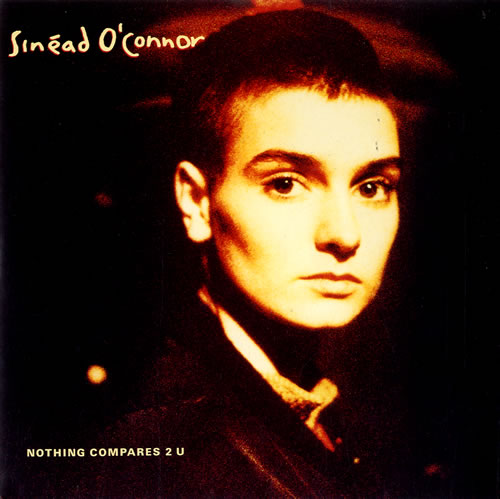
"Nothing Compares 2 U": You Throwing Shade On Sinead?

I'm sorry, but something about Sinead O'Connor just makes me chuckle. She's like that girl in high school English class who, no matter how innocuous the topic, always finds a way to register a complaint.

I love how Sinead O'Connor is essentially famous for two reasons: 1) "Nothing Compares 2 U"; 2) saying crazy shit. Note that the "Musical Career" section of her Wikipedia page is the same exact length as both the "Controversies" and "Personal Life" sections of her Wikipedia page. Because Wikipedia knows what we came for! If it's true that "there's no such thing as bad publicity," there may be such a thing as "publicity that keeps you in the public eye but doesn't actually help you have more hits." Although I'm about 97% certain that Sinead O'Connor didn't give a flying fuck about having hits. Quick: name all of Sinead O'Connor's hit singles. There's that Prince song she didn't even write, and ... I guess "Mandinka"? (Yes, she has had a smattering of other chart appearances in the UK, but my point mostly stands.) And yet somehow, doesn't it feel like Sinead O'Connor has had this highly lengthy career? Like Scotch tape, or Wrigley's gum, she's just always been around.

I have, on hand, at least one partial explanation for her seemingly non-one hit wonder status: O'Connor never met a tribute album she didn't like. She has contributed to everything from Stay Awake (a Disney songs tribute album) and Brand New Boots and Panties (an Ian Dury tribute album) to Just Because I'm a Woman: Songs of Dolly Parton and God Don't Never Change: The Songs of Blind Willie Johnson. You're putting together a tribute album? Better call Sinead. There are artists who launched entire musical careers solely so that one day, Sinead O'Connor could contribute a track to the tribute album that would eventually be produced in their honor. Back in the day I possessed a copy of Two Rooms: Celebrating the Songs of Elton John & Bernie Taupin, to which O'Connor contributed a tremendous, virtually a capella version of "Sacrifice," transforming it from a mid-tempo light rock pleasantry into a haunting, soul-wrenching ballad dripping with remorse and longing. But that's not what I remember most. Oh no. What I remember most is this. Every artist who recorded a song for the album, be they Sting, George Michael, Kate Bush, or Eric Clapton, wrote a little blurb for the CD booklet, essentially describing, in three or four sentences, how much they loved Elton's songs, and why they chose the track they did, and how they went about reinventing it, etc. etc. Sinead O'Connor's blurb for "Sacrifice" simply consisted of the following: "I can't believe no one did 'Candle in the Wind'." That was it. That was her entire blurb. No comment about the song she actually covered, no comment about how much Elton had meant to her as a little girl, blah blah blah. Just one sentence about something that had bothered her. We're talking some peak Sinead right there.

The other Sinead anecdote that stands out to me is when "technical difficulties" occurred during her performance of "Mother" at the Wall - Live in Berlin concert in 1990. From Wikipedia:
Roger Waters tried to get Sinead O'Connor to sing her parts anyway, or mime the song, while the error was being fixed. Offended by being asked to mime, she didn't return after the show to re-record the performance (which is how "The Thin Ice" was saved for the CD/Video release.) Instead, the release version of "Mother" comes from the dress rehearsal on the previous night before the concert.
Dude. When you've made Roger Waters look like the calm, cool-headed professional, you know you're in a category of your own. When you've out-tantrummed Roger Waters, you have really brought it to another level.

I guess I would take O'Connor more seriously if I didn't sense a complete lack of a sense of humor in her music. It turns out she does have a self-deprecating side, given that she named her 2013 tour the "Crazy Baldhead Tour," and let's not overlook this excerpt from her Wikipedia page: "While her shaved head was initially an assertion against traditional views of women, years later, O'Connor said she had begun to grow her hair back, but that after being asked if she was Enya, O'Connor shaved it off again. 'I don't feel like me unless I have my hair shaved. So even when I'm an old lady, I'm going to have it.'"

But in the end, Sinead's unpredictability is a feature, not a bug. I can chuckle at a singer and enjoy her music at the same time, right? The two attitudes are not mutually exclusive. I'm not quite laughing with her, but I'm not quite laughing at her. At least she's not boring. You know what? You go girl. You go ahead and say that controversial thing that no one in the audience actually came to hear you say.

The question, then, is not how a singer this uncompromising and volatile ever made great music, but rather, how a singer this uncompromising and volatile ever scored a hit as massive as "Nothing Compares 2 U." You might say that Sinead O'Connor having a massive #1 hit was about as likely as, I don't know, Dexys Midnight Runners having a massive #1 hit (Pfft, like that would ever happen). But "Nothing Compares 2 U" was one of those rare global monsters, hitting #1 virtually everywhere in the universe simultaneously, as if all of humanity had a mind-meld and proclaimed, "THIS song ... shall be #1." The single's Wikipedia page lists its chart performance in twenty countries, and it hit #1 in every single one of those countries except for France and Spain (maybe they like their women a little more submissive on the Bay of Biscay?). I mean, what the what. An early '90s release from, say, MJ or Madonna performing like that, I could understand, but a virtual unknown? It's not like "Nothing Compares 2 U" was written by a pop superstar or anything.

[whispers into Little Earl's earpiece] Wait, really? He wrote that? Get outta here.

For the first time in my life, I just listened to Prince's 1984 demo version of "Nothing Compares 2 U" (courtesy of Mr. Rogers Nelson having died and his estate not having the same stick up their lavender-shaded butt over the concept of one's music being accessible online), and then I proceeded to listen to the version released by The Family, one of those Prince-in-all-but-name projects that came out circa Purple Rain. A comment on YouTube underneath Prince's version sums up the situation: "If you ever thought Sinead did this better, please... NEVER call yourself a Prince fan."

Done. Easy.

Quick digression on Prince: I admire his catalog, and would not argue that his place in the critical pantheon is particularly undeserved (I also have come to appreciate his music more deeply now that he has passed). I simply just never find myself coming home after a rough day and thinking to myself, "You know what I really need to listen to tonight? Prince." I wrote the following to several friends a week or so after The Purple One's demise:
The metaphor I’ve occasionally used to describe my feelings toward the musical output of Prince: Imagine a delicious gourmet meal, stylishly displayed on a fine silk tablecloth, featuring every kind of tasty dish you could ever want – roasted duck, buttered lobster, pasta primavera, baskets of ripe fruit, freshly-baked muffins, turkey, gravy, mashed potatoes, peach cobbler, pie a la mode – you name it. The fanciest wine, glistening silverware, scented candles … cuisine fit for medieval royalty. However, sprinkled ever-so-slightly over this magnificent feast, here and there, are warm droplets of semen. Boy, that meal sure looks delicious, but, I’m sorry, I am not going to be eating any of it.
Prince isn't just Music For Guys With Girlfriends, he's more like Music For Guys With Bondage Partners. I want to relate but ... I just can't. Also, I know many critics and fans have praised Prince as a singer, but I don't particularly care for his voice. I don't hate it, but I don't connect with it either. And there's an awful lot of Prince's singing in Prince's music. Honestly, Prince just never seemed to struggle with much self-loathing or self-doubt to me. Like Highway 61-era Dylan, Prince's biggest problem simply seemed to be that other people failed to understand how much of a genius he was and that they were annoying him all the time.

Sinead O'Connor, on the other hand ... now here's a singer who's had some genuine problems in her life. When Prince sings "It's been so lonely without you here/Like a bird without a song/Nothing can stop these lonely tears from falling/Tell me baby, where did I go wrong?," I don't quite buy it. These just sound like lyrics Prince cribbed from a million other soul ballads he listened to when he was growing up, and he figured he should just throw them in there for effect. But Sinead O'Connor? She can't even make it through a freaking music video shoot without sobbing. We're talking one sad cookie here.

So it finally hit me. You know what O'Connor did with "Nothing Compares 2 U"? She turned a Prince song into a George Michael song. Just listen to that intro. There are times I've heard that initial chord on the radio and, frankly, I figured I was hearing the start of "One More Try." I'm sure Sinead has had enough of danger, and people on the street, and is looking out for angels, just trying to find some peace, you know? An extremely 1990 touch was utilizing a vaguely hip-hop beat in a chilly ballad that was built around Euro-classical elements such as violin, grand piano, and random monks chanting "Ah-ah-ah-ah." Let's hear it for surprising little touches like: 1) the drum beat entering on the fourth measure, not the third or fifth measure as one might expect; 2) the chorus gaining several additional, unexpected chords the second time around; 3) even more additional, unexpected notes popping up at the tail end of the last verse ("But I'm willing to give it another tryyyy-uh-ah-hi-yyyyee"). She brought all of those touches to the party herself. You know what O'Connor did to Nothing Compares 2 U"? She completely, utterly de-Princified it. Personally, she turned it into a song I might actually listen to upon coming home after a rough day. I kind of wish she would have done this to the rest of Prince's catalog. Just imagine her versions of "Head" or "Jack-U-Off." (Quick note on the iconic video: the best music video Joan of Arc never made?)


Prince's attitude toward O'Connor - at least according to O'Connor - further validates my hesitation to fully admire the man, for while "Nothing Compares 2 U" may have been a match made in musical heaven, an encounter between the two strong-willed artists conjures to mind something more like Godzilla vs. Mothra. From Wikipedia:
I did meet [Prince] a couple of times. We didn't get on at all. In fact, we had a punch-up. He summoned me to his house after "Nothing Compares 2 U". I made it without him. I'd never met him. He summoned me to his house—and it's foolish to do this to an Irish woman—he said he didn't like me saying bad words in interviews. So I told him to fuck off. He got quite violent. I had to escape out of his house at five in the morning. He packed a bigger punch than mine.
Come on, man. The woman just turned your dopey throwaway ballad into a hypnotic, gut-wrenching worldwide smash, and all you can do is dictate how she should and shouldn't behave in public? I'm with Crazy Baldhead on this one. Well, if Prince couldn't say it, at least I'll say it. Thank you, Sinead O'Connor. Thank you for making a version of a Prince song that wasn't sprinkled with semen. And I'm sure if I ever thanked you in this exact manner to your face, you'd probably just tell me to fuck off. But I wouldn't mind.

Sunday, May 10, 2020

"Freedom '90": A "Super" "Model" Of Image Dismantling AKA Freedom '90, Quarantine '20

What the ... my God. How many sex change operations did George Michael end up having merely to make this one single video? Let's see .. he got himself a succession of nose jobs, grew a mole, even dyed his skin a couple of times ... the guy was truly sick. I know everyone's disturbed by Michael Jackson, but this is beyond the pale.

At any rate. I'm a sucker for artists who, at the peak of their popularity, just say, "Fuck it," and decide to alienate their audience. Because if it doesn't pay off at the time, it always seems to look good in retrospect. And hey, sometimes it even pays off at the time (see: Pepper, Sgt.). The easy thing to do is to simply keep giving the audience what they want - but are you giving yourself what you want? Ideally, an artist can do both, but, let's face it, a lot of people are stupid. They just want to blow a couple of hours on a Friday night watching Fast & Furious 23 or Rocky 48.676. Most people aren't looking for a challenge.

But with "Freedom '90," I think Georgie Boy managed to have his cake and eat it too. Here we have a single that was simultaneously a giant kiss-off to the entire record-buying public AND a zippy, latin-tinged uptempo hip-shaker that, lyrical claims to the contrary, pretty much gave the record-buying public exactly what they wanted. Merely reading the lyrics on the cold page, one might imagine this song as a ballad, but Georgios rides this "Sympathy for the Devil" groove for six-and-a-half minutes and sounds like he's having the time of his life doing it. (A few of my favorite musical details: the "I Saw Her Standing There"-style hand claps that pepper the vamp which follows the opening chorus; the rapid acoustic guitar strums that kick off each line of the verse; the piano glissando that powers the verse into the pre-chorus.) Against all odds, despite all the bitterness and self-hatred he's dishing out, the sprightliness of the music somehow reflects the "freedom" he's proclaiming in the lyrics. Yeah, go ahead, name me another top 10 hit from the early '90s that's anything like this one. I'll be waiting.

I'm going to go out on a limb here and suggest that, by the time of Listen Without Prejudice, Vol. 1, George Michael was recalling his Wham! years with, shall we say, a distinct lack of fondness. Personally, I'd rather have a Wham! marathon than, I dunno, a Sonic Youth marathon, but that's just me. Come on George, don't be so hard on yourself. But I suppose he was feeling the sting of artistic remorse. In the first verse of "Freedom '90," George prefaces this howl of conscience with a vulnerable plea:
I won't let you down
I will not give you up
Gotta have some faith in the sound
It's the one good thing that I've got
I won't let you down
So please don't give me up
'Cause I would really, really love to stick around, oh yeah
Translation: My new music ain't gonna sound like my old music, but you got to have faith-uh-faith-uh-faith-uh! Then the mea culpa commences:
Heaven knows I was just a young boy
Didn't know what I wanted to be
I was every little hungry schoolgirl's pride and joy
And I guess it was enough for me
To win the race, a prettier face
Brand new clothes and a big fat place
On your rock and roll T.V.
But today the way I play the game is not the same, no way
Think I'm gonna get myself happy
Well, I can certainly see why he wouldn't have found being "every little hungry schoolgirl's pride and joy" particularly fulfilling. Hi-Yo! But I digress. Have you ever had doubts about something you were doing, and yet ... you decided to keep doing it anyway? I've never had this happen to me personally, but I've had friends tell me what it's like. Wears you out, grinds you down, until one day you just can't take it anymore. And you know that switching gears is going to cost you, but you're willing to pay that price, because it's finally dawned on you that the cost of not switching gears might be higher. That's "Freedom '90":
I think there's something you should know
I think it's time I told you so
There's something deep inside of me
There's someone else I've got to be
Take back your picture in a frame
Take back your singing in the rain
I just hope you understand
Sometimes the clothes do not make the man
You can change, George! It's OK! I allow it! Jesus H. Christ. He's making Wham! sound like the Nazi Party. If so, this is the funkiest Nuremberg trial I've ever heard. And what's he got against Singin' in the Rain? Did Debbie Reynolds step on his foot in a restaurant or something? I think what he's trying to say is "I don't want to be your cheerfully saccharine song-and-dance man anymore," but no one associates George Michael with expertly-composed Gene Kelly routines. Lyric could've used a re-write, but I'll let it slide. Carry on:
All we have to do now
Is take these lies and make them true somehow
All we have to see
Is that I don't belong to you, and you don't belong to me yeah yeah

Freedom! (I won't let you down)
Freedom! (I will not give you up)
Freedom! (Gotta have some faith in the sound)
You've gotta give for what you take (It's the one good thing that I've got)
Freedom! (I won't let you down)
Freedom! (So please don't give me up)
Freedom! ('Cause I would really, really love to stick around)
You've gotta give for what you take
And so we come to the critical question of our age: what is freedom? Is freedom the ability to do whatever you want? The ability to live without regret? The ability to release whatever music is floating your boat without the record company complaining about it? The ability to ignore public health experts and take a trip to the nail salon in the middle of a pandemic? Sometimes I wonder if freedom is simply a seductive illusion and the reality is that we're all trapped inside the prison of ill-defined George Michael lyrics. The second verse deftly touches on the existence of Andrew Ridgeley without shedding any meaningful light on his actual role in Wham!:
Heaven knows we sure had some fun, boy
What a kick just a buddy and me
We had every big-shot good time band on the run, boy
We were living in a fantasy
We won the race, got out of the place
I went back home, got a brand new face
For the boys on MTV
But today the way I play the game has got to change, oh yeah
Now I'm gonna get myself happy
Andrew Ridgeley was living in a fantasy, all right - the fantasy that he was doing something valuable in Wham! Hi-Yo! Also, I'm getting this mental picture of the duo's "big-shot good time" peers such as Duran Duran, Tears for Fears, and The Smiths literally running away from Wham!, and I have to chuckle ever-so-slightly. At any rate, the song's bridge might be my favorite section (musically, I certainly dig the key change followed by wah-wah guitars shifting maniacally across the stereo spectrum), because here is where George's dueling impulses of self-loathing and self-acceptance really manage to duke it out:
Well it looks like the road to heaven
But it feels like the road to hell
When I knew which side my bread was buttered
I took the knife as well
Posing for another picture
Everybody's got to sell
But when you shake your ass
They notice fast
And some mistakes were build to last
That's what you get (That's what you get)
That's what you get (I say that's what you get)
That's what you get (for changing your mind)
That's what you get for changing your mind
That's what you get
That's what you get (And after all this time)
I just hope you understand
Sometimes the clothes do not make the man
He's not whining, he's not deflecting, he's not claiming that he was some sort of "victim" who was "taken advantage of" by the business. He chose this path! He's admitting that he was deliberately complicit in the creation of the image that he no longer wishes to perpetuate. To tear it all down is a massive pain in the ass, but, as he says, "that's what you get for changing your mind." He's cool with it. He's ready to deal with the blowback. How should we interpret the "I took the knife as well" line? Is he suggesting that the pain of making mindless '80s synth-pop was akin to the pain of being stabbed in the chest with a bread knife? Or is he suggesting that he took that bread knife in his hands and proceeded to stab his rivals with it on his way to the top? Jesus, who knew the Wham! experience was so violent?

In the end, one last round of the chorus grants George his true vocal freedom, as he lets rip in the fade-out with the kind of liberating ad libs that were the man's forte: "You got to give-uh-whatcha-give-uh-whatcha-give-uh-whatcha taaaayyyy-aaaayy-aaake ... yeah! You got to give-uh-whatcha-give-uh-whatcha-give ... may not be what you want from me, just the way it's got to be ... lose the face, now ... got the new, got the new ..." I'm fairly certain that not even Nelson Mandela, when his 27 years in captivity finally ended, sounded quite as pumped as George does right there.

So after a brief Google search, I found this article written shortly after George's death, from NPR's Linda Holmes, titled "The Individualism and Fist-Pumping of George Michael's 'Freedom '90'," and now that I've read it, I kind of wonder if I could have saved myself the effort of composing this blog post (but nah). To summarize Holmes's take: "Freedom '90 is not just an expression of individuality, but an expression of vulnerability and dependency as well ... and it also grooves like a motherfucker. Which is kind of what I said. Excerpts:
It begins with just the beat, then the bass and keyboards, and the first appearance of a chant that will recur over and over: "I will not let you down/I will not give you up." It's a song of independence, but its first declaration is of mutuality: a promise and a vow, a sort of "I offer" and "I want" rhythm. Then: "Gotta have some faith in the sound/it's the one good thing that I've got." So there's "faith" wordplay, and there's the idea that artists are not just in business, even when they're pop musicians. Again, while it's declaring independence, it's also admitting vulnerability: part of the reason to preserve your artistic and personal sense of self goes well beyond principle – you do it because to do otherwise can make you desperate and lonely. Then a shift: "I will not let you down/so please don't give me up/'cause I would really really love to stick around."

"Please don't give me up." Please. Very often, you find a song of independence – of freedom – steeped in a kind of "I don't need anybody and I don't care what anybody thinks" autonomous flippancy, structured like a kiss-off. This is the opposite...

When "Freedom '90" rolls into the chorus, it's with the same commitment to mutuality that showed up in the opening: "All we have to do now/is take these lies and make them true somehow." It would have been so easy for this song to be about his freedom, and to just say, "All I have to do now/is take these lies and make them true." But both the use of "we" and the trailing "somehow" – the latter is sung almost on a sigh – make it a song of commonality between a very famous pop star and the people who listen to him.
Yeah, what she said! What's powerful about the song is that George isn't just telling his audience to fuck off (although I kind of think he's doing that); rather, he's asking his audience to accept the "new" George. Indeed, many have read the song as the singer anticipating public reaction to a certain "secret" of his. Here's a quote on Wikipedia from an interview he gave in 2004: "By the end of the Faith tour I was so miserable because I absolutely knew that I was gay... I didn't suddenly want to come out. I wanted to do it with some kind of dignity. So I thought 'okay, you have to start deconstructing this whole image.' " Of course, being arrested by an undercover cop in a public restroom isn't exactly what I'd call "coming out with dignity," but hey, at least the sentiment was there.

And it looks like there was a semi-happy ending after all, because although it stalled at #28 in the UK (lord knows why), "Freedom '90" hit #8 in the US, and I actually remember hearing it a lot more on the radio than I heard "Praying for Time," even though that single hit #1, and basically, what I'm saying is, people loved the "new" George Michael just as much as the old one. Or rather, let me say that in the US, George may have won the battle but he lost the war, whereas in the UK, he lost the battle but won the war. Although his popularity never did wane in Britain, he only managed a few more hits in America after this one, and never did duplicate the success of the Faith era. Sure, George, you can have your "freedom" ... and take it back to Britain with you while you're at it.


OK, so, this video. Whenever my co-blogger Zrbo and I, in our younger years, got around to discussing the relatively overlooked works of the George Michael oeuvre, he would always express his admiration for "the awesome video for 'Freedom '90' with all the supermodels singing the lyrics!" Ironically, while I vividly recall seeing the "Praying for Time" video back in 1990 and finding it rather groundbreaking, although it seems like most people hardly mentioned that video in the years to follow, I have no recollection of seeing the "Freedom '90" video at the time, even though I've learned in retrospect that it was (and is) considered rather groundbreaking.

Here's the deal. Supermodels are generally not the types of celebrities I admire very much, although I'd probably date one if I could (on the other hand, who wants to deal with all that ego?). According to a slew of articles, the "Freedom '90" video "ushered in the era of the supermodel" or some nonsense like that. Am I supposed to ... celebrate this? Although I appreciate the way in which George Michael and David Fincher used the video to subvert viewers' expectations and to render explicit MTV's desire to turn every talented musician into a photogenic pin-up, part of me feels like the video has merely fed into our culture's obsession with superficial glamour while ostensibly attempting to critique it. Yeah, all right, I'm sounding like Professor Higglediggle here, but when half the comments underneath the video on YouTube are statements like "Linda, Christy, Naomi, Tatjana, Cindy all put the 'Super' into Supermodels. They don't make them like they used to!" and "When models were actually beautiful! Today....not so much," I just don't get it. These people rank supermodels the way I rank ... George Michael songs. But George Michael songs can be dark and intense and thoughtful; supermodels are just ... supermodels. Well, people love the video, and I can see why (here's an oral history from the New York Times if you'd like to learn more of the gritty backstory). But if it had featured, say, a series of skeletal gay men dying of AIDS lip-syncing "Freedom '90," now that would have had some real sting to it. Let's see what our fair professor has up his sleeve this time:
Failing to circumnavigate the overworked codes of communal empowerment, Michael avoids using his accumulated symbolic capital to (re)contextualize the repressed "other," instead appealing to the politics of substitution as style. His glottal cry of "freedom" never transcends the sententious dualism implicit in his assemblage of (homo)erotic formations, ignoring Foucault's analyses of sovereign and disciplinary power as formulated in Discipline and Punish. For the viewer, the "freedom" suggested by the reductive co-optation of the "supermodel construct" in the music video serves as a non-subjective reminder of that viewer's physical inferiority. Michael's attempt to "free" himself from his creative history only reinforces his subservient position ("To win the race, a prettier face") per the culture industry that birthed him.

Sunday, April 19, 2020

"Escapade": Leave Your Worries Behind ... Unless You're A Jackson, In Which Case, Well, Just Do The Best You Can

Once upon a time, in a world where malls contained indoor ice skating rinks, our local rink went by the beguiling name of "Ice Capades." Then one day, out of the blue, Janet Jackson came out with a terrific song extolling the virtues of ... my local skating rink? Why she wanted to proclaim the glory of Ice Capades for all the nation to hear, I had no idea, but who was I to argue? Ice Capades was cool. Ice Capades was exciting. I usually had fun when I went there, as long as I didn't slip on my ass and bruise my knee. Nevertheless, something about Janet's paean to this rather obscure attraction didn't quite add up. I quickly learned that Janet was not singing "Ice Capades" at all, but rather, the mysterious word "Escapade."

"Escapade"? What the fuck was an Escapade?

Yes, "Escapade": the most creative usage of obscure vocabulary in late '80s R&B this side of "My Prerogative." But it takes more than the talents of any old Scrabble champion to create a #1 hit, and while the title may have earned Janet, Jam, and Lewis a couple of extra points, it was the music behind it that truly landed them a triple-word score. One observation I will make about "Escapade" that is neither praise nor criticism: the hookiest, catchiest part of the song is not the chorus, or even the verse, but the pre-chorus. Essentially, the song opens with the melody from the pre-chorus, which flies through the air on a trapeze of synthesized keyboards and chimes. It's a very counter-intuitive structural choice - so I suppose that's praise after all. Another observation that might sound like criticism but is intended as praise: In an era when Madonna was doing everything in her Kabbalah-sanctioned powers to turn her lower register into one resembling Johnny Cash's, Janet was unashamed to let her super-squeally little girl voice soar to the skies. I think I can claim, with some confidence, that at 3:20, she utters the purest, holiest "C'monnnnnnn!" ever uttered in the annals of dance-pop. And I've always enjoyed the way the song awkwardly tumbles to a conclusion, with only some hints of percussion and backing vocals remaining as Janet carries on obliviously, eventually noticing that the party has seemingly ended without anyone having informing her, leading to a slightly haphazard "On-an-escapade bebe," cold stop.


Yeah. Honestly, that's about all I have to say about "Escapade," so let me use the rest of this post to utter a few words on Rhythm Nation 1814 as a whole (although I might reserve discussion of a certain silky ballad for a separate entry). Do I feel comfortable calling Rhythm Nation 1814 a "great album"? It certainly was ahead of the curve in one respect: like a many a '90s album, I'd say it runs a little long. We're talking 64 non-stop minutes of Janet here. In fact, this was arguably one of the first pop albums to be designed primarily for the CD and not LP audience, as 64 minutes is not a great length for an LP (too long for a single album, but a bit skimpy for a double). Some of the length is an illusion: although it appears to have 20 "tracks," at least eight of those are merely spoken word interludes, so in truth, there are only twelve tracks proper. But given that each of those tracks are five minutes long, that's still too many! I wouldn't even call some of the non-hits like "State of the World," "The Knowledge," and "Lonely" "filler." In a way, I feel like the album is actually more consistent than Control. I guess I just prefer my Janet in 45-minute bursts.

At any rate, I knew it was a blockbuster album, but frankly, I forgot how many high-charting hits Rhythm Nation 1814 kept tossing off, as if Janet were the Yankees and the Billboard charts were the World Series. Sure, have another championship trophy, Janet! It's not like anyone else was desperately longing for a #1 hit that week. There are hits from the album I don't even remember hearing back in the day, like "Alright" and "Love Will Never Do (Without You)." I can't say I dislike any of these singles, but upon revisiting them, they all come off a tad ... samey to me. When it took over the airwaves in late 1989, I drooled all over "Miss You Much," but now it sounds a bit underwritten to these ears; I feel like the melody isn't catchy enough for a beat that's so mid-tempo. If your song is going to be powered by the beat, it better be a beat like "Rhythm Nation," you know what I'm saying? "Black Cat" sounds like an early demo of "Escapade," but with a heavy metal guitar riff slapped on top of it. Everybody's made such a big deal about "Janet making a hard rock song!" But isn't "Black Cat" basically what every fifth Prince song, give or take, sounded like? Points for a sprinkling of diversity, but I'm more partial to the idea than to the execution. "Alright" sounds too much like her later hit "Runaway," and I have established, in the court of Little Earl, that it is possible for an artist to plagiarize her future self (see Glenn Frey and "All Those Lies"/"You Belong To The City"). That said, I thought I might as well at least click on the video, and I'm glad I did; picture the video for "When I Think of You" but with unexpected cameos from the swinging (as opposed to New Jack swinging) Cab Calloway and Cyd Charisse. At this point I fear that Janet was beginning to suffer from Paula Abdul Syndrome, which is defined as the following: "An affliction common in the dance-pop genre, where an artist's videos are sometimes considered more entertaining than the songs they are promoting."


"Love Will Never Do (Without You)" has a more melodic chorus than "Miss You Much," I'll grant it that, but ... I dunno. I just feel like these five songs are essentially five different versions of the same basic template, with "Escapade" being the absolute very best version of that template.

Final thought: as I watch the "Escapade" video again (which strikes me as perhaps a mash-up of Lionel Richie's "All Night Long" video, Black Orpheus, and Mad Max?), I'm also having trouble with what you might call the "Janet/Michael" Conundrum, best summed up by a male peer of mine in the mid-'90s: "Janet's so good-looking and hot, but ... she looks like Michael, and Michael is like the exact opposite of hot." It's really not her fault, and there's nothing she can do about it, but it cannot be denied. Janet in her prime was, shall we say, an extremely attractive woman, and yet ... there's something in the back of my brain that doesn't allow me to enjoy this quality of hers to the fullest. It is what it is. This might help explain why Janet sounds so convincingly enthusiastic on a song like "Escapade." I mean, we could all use a vacation now and then (although I suspect few of us will be taking one any time soon), but let's just say that, with a family like hers, Janet could have really used one more than most.

Sunday, March 29, 2020

"Lovesong" And "Enjoy The Silence": Music For Depressed Guys With Girlfriends

Back in college, my former co-blogger Yoggoth and I used to have a term we would employ to describe certain acts whose music we enjoyed despite not really feeling like we belonged in those acts' target audience. The term was "Music for guys with girlfriends" - the two of us clearly being, and forever destined to be, "guys without girlfriends." For instance, we both agreed that, despite their respective artistic merits, Frank Sinatra, Van Morrison, Bob Marley, Prince, and Pearl Jam were obviously "music for guys with girlfriends." They were music for men who took the presence of attractive women in their lives for granted. One day, while discussing certain prominent alternative acts from the '80s, I proceeded to riff on this term. I said to Yoggoth, "You know what the Cure and Depeche Mode are?" "What?" "Music for depressed guys with girlfriends."

See, if you were actually depressed, you would be listening to something more like Nick Drake, or Joy Division, or Elliott Smith, or Sly & the Family Stone's There's A Riot Goin' On, or Big Star's Third/Sister LoversThat is music that is actually depressing. The Cure and Depeche Mode? They're music for guys who want to think that their lives are really depressing, when in all likelihood, 99% of the human race probably would love to have the "problems" those guys have. The Cure and Depeche Mode were for comfortable suburban teens who never bothered to make the effort to discover the truly depressing stuff.

Because despite their ostensibly gloomy trappings, "Lovesong" and "Enjoy the Silence" are, as far as I can tell, essentially two songs about guys with girlfriends singing about how awesome their girlfriends are.

Let's back up a bit. Here's how you know that '80s British alternative rock, by 1990, had finally crashed into the mainstream. Back then, I didn't know my Robert Smith from my Smiths (or even my Robert Smith from my Mark E. Smith), and yet even I, the least "alternative" ten-year-old in existence, knew these two songs. I did not know the names of the artists responsible for these two songs, nor did I care. But I knew them like I knew "Love Shack" and "She Drives Me Crazy." They were ubiquitous patches in the quilt that was Herbert Walker Memories. We're not talking "Blue Monday" or "How Soon Is Now?" here - British alternative songs that everyone claims to have been listening to in the '80s even though I personally do not remember ever hearing them in the '80s. I mean, I couldn't have given two shits about British alternative rock, and yet if even I heard these two songs, that should tell you something about how big they were. You might say they were the tips of two very mascara-smeared icebergs.

Another thought: although I enjoy both Disintegration and Violator quite a bit, they are on my list of "Albums With An Obvious Opening Track That Don't Feature The Obvious Opening Track As The Opening Track." It's quite an impressive list. For instance, how much more would I like Thriller if the opening track were "Billie Jean" instead of "Wanna Be Startin' Somethin'," or Physical Graffiti if the opening track were "Kashmir" instead of "Custard Pie," or Achtung Baby if the opening track were "Mysterious Ways" instead of "Zoo Station," or Sublime if the opening track were "What I Got" instead of "Garden Grove"? Conversely, there are certain albums I probably wouldn't enjoy quite as much if they didn't start with such an unequivocal bang. What if Mellow Gold didn't kick off with "Loser," or Elvis's first album with "Blue Suede Shoes," or Face Value with "In The Air Tonight," or Bridge Over Troubled Water with ... "Bridge Over Troubled Water"? I feel like an album can weather a few rough patches if it's got a winner at the top, but the converse is not so true. You better not fuck up the choice of opening track, is what I'm saying. "But wait," you respond, "The Cure and Depeche Mode had no way of knowing that 'Lovesong' and 'Enjoy the Silence' were going to be the biggest singles from their respective albums, so how could they have known to put them first?" But see, I know they were the biggest singles from the album, and so it's perfectly clear to me, in retrospect, that they should have been placed first. Great bands have to predict the future, OK? I'm sure some 17-year-old Arizona teenager dressed in her finest Hot Topic couture is bristling at my flippant dismissals of "Plainsong" and "World In My Eyes," but hey, it's the internet and I can say what I want.

Those who declare Disintegration a "classic album" do not bother me, but I find the praise a bit puzzling. I wish I found all the songs as diverse and energetic as "Lovesong," "Fascination Street," and "Lullaby." I feel like there are 1) too many songs on the album; 2) too many songs that feature the same tempo; 3) too many songs with minimal chord changes; 4) too many songs with synths imitating strings. But it's all listenable, when you're in that "My parents need to stop flipping through my diary" sort of mood.

Yet "Lovesong" sports the compact, catchy, jangling glory I seek. No seven minutes of moody atmospheric noodling here. On the contrary, it's like the Cure doing late '60s L.A. sunshine pop. There's an organ straight out of Ray Manzarek's worst peyote trip, an omnipresent tambourine that Michelle Phillips would've been proud to shake, and a piercing, distorted guitar riff that Neil Young might have laid down in a stoned stupor, not remembering the next morning that he'd even played it. Other highlights: the synth so successfully imitating strings that, for most of my life, I simply assumed they were strings; the extra guitar part around 2:15 that, though electric, almost carries a "flamenco" feel. I mean hell, if this song hadn't been a giant US hit, then no Cure song would have been.


The video finds Robert Smith re-enacting a deleted scene from The Dark Crystal, crouching among an array of sexy stalagmites, the light rendering his skin the same hue of blue as his shirt; I guess you could say he was feeling rather "blue" in this video (*cough*). I love how, in the opening shot, as the camera pans downward, we initially see what appears to be a particularly thick patch of moss in the left-hand corner, or perhaps a thorny black bush? But no - after a few more tantalizing seconds, this strange blob of twigs reveals itself to merely be ... Robert Smith's hair!

The casual listener and viewer might be forgiven for assuming, based on Smith's mopey delivery and the so-called expression (or lack thereof) on his face, that the song is a howl of psychological despair, but nope. "Whenever I'm alone with you/You make me feel like I am home again." "However far away, I will always love you." This isn't depressing at all! According to Wikipedia, "Robert Smith originally wrote the song for his long-time girlfriend and then fiancée, Mary, as a wedding present." Music for depressed guys with girlfriends? More like music for depressed guys with fiancées.

Then there's "Enjoy the Silence." "All I ever wanted, all I ever needed/Is here in my arms"? Not depressing! (Unless he's singing about a blow-up doll a la Bryan Ferry.) Of course, a synth-pop song can still be great even if it's not depressing. I suppose no song is "perfect," but if there's any way "Enjoy the Silence" could have been improved, I'd like to know exactly how, mister. Right off the bat, it commences with a bouncy, see-saw rhythm that implores the listener to gently tap toes. Notice how it employs the same "synth that kinda sounds like a human singing 'Aah'" effect previously utilized in Cutting Crew's "I Just Died In Your Arms," although I would say to more menacing, artistically credible effect. And let's not forget the gently-plucked guitar figure smothered in more delay than an Amtrak schedule.

"Enjoy the Silence" is one sneaky little slice of gloom, for while appearing to repeat its basic motifs, a closer listen reveals continuous shifts from beginning to end, so that one's attention never flags. There's the initial two-chord vamp that kicks off the song and which returns every now and again, almost like it's the song's default "resting position" (it makes me think of a video game character that simply jogs in place, waiting for the touch of the joystick to bring it to life again). Then there's the verse melody, which isn't quite the chorus melody and isn't quite the two-chord vamp either, but I'll be damned if it isn't all tonally related somehow (where's a musicologist when you need one?).

But what Depeche Mode brought that their peers sometimes forgot were the BEATS. Depeche Mode's beats hit hard. They had force. Their hooks were catchy, but they never neglected the pure physical side of the music. I doubt that many Depeche Mode fans listened to hip-hop, but Depeche Mode themselves were surely following all the trends in rap, house, techno, ambient, etc. They brought the funk. And they knew how to pace themselves. The beat sounds plenty hard enough at the start of the track, and continues at that volume all the way through the first verse, but once the chorus hits, the beat suddenly grows twice as loud and hits twice as hard. I also love the little "breakdown" section after the first chorus, as if the song is saying, "Hold on buddy, let me recharge myself ... all right, ready to go!" Then on the second chorus, they add this bass-heavy "laser beam" sound that flies at your ears from both stereo channels, like you're listening to the track in the womb. I swear to God (who, based on a blasphemous rumor, I've heard has a a sick sense of humor) - Depeche Mode took every little trick they'd ever learned in their entire recording career, from the Vince Clarke years on down, and poured it all into this brooding little monster.

(Side note: I'm not as puzzled by those who praise Violator as a "classic" album, which I find more consistent, more uniform, and more mood-sustaining than Disintegration, but it's also shorter, so that helps. Still, I have this nagging sensation that it wasn't optimally sequenced. They threw all the strongest songs in the middle! Who does that? The album appears to build and build all the way up to ... "Blue Dress" and "Clean"? We're not exactly talking "Brain Damage/Eclipse" here. Still, if that cute goth guy ignored me in Physics class all day, I would totally put this on when I got home.)


Although I'm all in favor of grainy shots of Dave Gahan trudging through Alpine meadows and Scandinavian fjords, the best part of the video has to be the brief black-and-white shots of the band standing in the "silence" while wearing leather jackets and looking sexily glum. Just from the artsy-fartsy combination of slow motion footage interspersed with subliminal flashes of rose stalks alone, I could have guessed that the director had an "ijn" somewhere in his name without knowing anything else about him. (But yes, I know who Anton Corbijn is.)

One more memory involving me and a co-blogger. At the tail end of high school, I found myself riding in a car one day with a young Herr Zrbo (yes, we go back that far), and when "Enjoy the Silence" came on the radio, he proceeded to enter into a mildly harmless rant which went something along the lines of "Oh God, fucking Depeche Mode, this is that song for all those stupid couples who feel like 'No one understands us!' and 'Everyone just hates us 'cause we're so in love!' Gimme a break." I probably laughed and concurred in agreement, but, honestly, I kinda liked the song myself. The irony here is that the person in that car who complained the most about "Enjoy the Silence" is now married with offspring, whereas I am the one sitting on my ass blogging about music for depressed guys with girlfriends. Maybe I should have complained more when I had the chance.

Sunday, March 8, 2020

"La Luna": Belinda Goes Latin AKA My New Nickname For Belinda Carlisle: Lazy Madonna

Want a surefire way to make me chuckle? Just compare Belinda Carlisle's career to Madonna's. Somehow, I never fail to find amusement in this comparison, and not because it's hardly a fair comparison at all. Pop music is not a contest, but if it were, you might say that Madonna got to the finish line so far ahead of Belinda, she had time to cook breakfast, eat it, and clean the fucking dishes before Belinda even appeared over the horizon. Doesn't matter. I can't help but root for the underdog. Madonna Madonna Madonna, everybody's always blabbing about Madonna, but call me the captain of Team Carlisle.

The funny thing is, as my completely healthy and reasonable fascination with the career of this erstwhile Go-Go slowly gathered momentum in the fashion of the giant boulder that menaces Indiana Jones at the start of Raiders of the Lost Ark, I began to notice something: Madonna and Belinda Carlisle's careers have continuously intersected in kooky, unexpected ways. I'm not talking about anything blatant or deliberate. Nothing that's entered the realm of common knowledge. I'm talking about a series of little dinky connections, the kind that only true '80s pop aficionados could spot. For example:
  1. Mary Lambert directed the video for the Go-Go's' "Turn to You"; Lambert directed the videos for Madonna's "Borderline," "Like a Virgin," "Material Girl," "La Isla Bonita," and "Like a Prayer"
  2. Donna De Lory briefly sang back-up for Belinda circa 1987; De Lory sang back-up for Madonna from 1987 to 2006 and was a prominent member of her touring "entourage," if you will
  3. Rick Nowels produced and co-wrote almost all of Belinda's solo material; Nowels co-wrote three songs with Madonna on her Ray of Light album
  4. Tony Ward starred in the video for "I Get Weak"; Ward starred in the videos for "Cherish," "Justify My Love," and "Erotica"
  5. Sandra Bernhard famously hung out with Madonna in the late '80s; Bernhard has less-famously hung out with Belinda for decades
  6. Madonna released two songs on the VisionQuest soundtrack; as I discovered years ago, Belinda sang backing vocals on a throwaway Don Henley track that also appeared on the VisionQuest soundtrack
I'm sure I could come up with a few more connections if I tried, but hey, I've got to go to work tomorrow. What I find truly amusing about all this is that, as far as I'm aware, their paths have always managed to crisscross without ever truly, officially colliding. Take the 1984 MTV Video Music Awards, where Madonna humped the stage in a wedding dress and gave, to use a phrase I tend to avoid, an "iconic" performance, while Belinda merely stumbled out onto the stage in a blurry daze with Kathy Valentine to present an award to Iggy Pop. The orbits of these two planets have even hovered toward each other as recently as the 2016 Billboard Music Awards, where Belinda fronted her longtime band in their 2,738th rendition of "We Got the Beat," while Madonna, as I understand it, showed up later in the program to pay tribute to Prince (who, if you can believe it, was briefly her lover?).

Here's how you know Madonna's and Belinda Carlisle's destinies are truly intertwined: Madonna was born the day before Belinda was. Read that sentence again carefully. I don't just mean that Madonna's birthday is one day on the calendar ahead of Belinda's. Oh no. Madonna was literally born the day before Belinda was. Madonna Ciccone was born on August 16, 1958. Belinda Carlisle was born on August 17, 1958. They are almost the same exact age. Do you know what that means? Do you know what that means?

ABSOLUTELY NOTHING.

Kinda weird though. Right?

All these shared colleagues and communal moments, and yet, I don't believe the two of them have ever actually met each other. If they have, Belinda has never mentioned it, although she's frequently expressed genuine admiration for her contemporary. Judging from an infamous scene in Truth or Dare, however, the same might not be said of Madonna. Once upon a time, the clip was on YouTube, but if I recall correctly, it features Madonna sitting in her dressing room, looking snotty and bored, while the aforementioned Donna De Lory sings a snippet of "Heaven is a Place on Earth" (a song that, as Belinda's backing vocalist, she would have known quite well), as a female companion continuously pounds her back, thus generating an exaggerated approximation of Belinda's prominent vibrato. As De Lory does this, Madonna mutters something like "These girls annoy me." You know what probably annoyed Madonna? The fact that, no matter how many more records she sold, no matter how much more seriously rock critics took her music, no matter how many more pretentious journalistic think-pieces she inspired, she would never approach the effortless physical majesty that was late '80s Belinda Carlisle. And Madonna wasn't the type to let that kind of superficial shit roll off her back.

Anyway. What I'm trying to say is this: the comparison had been bubbling around in my brain for a while, but I couldn't quite condense it into a simple, marketable phrase. Then one day, it came to me:

Lazy Madonna.

BOOM. That's why they pay me the big bucks, people. Belinda Carlisle's career is exactly what Madonna's career might have looked like ... if Madonna had been much, much lazier. Which is not to suggest that Belinda has been lazy. She has achieved more in her lifetime than I ever will. I mean this in the most flattering way possible. Belinda's laziness is part of her charm. Who can relate to Madonna? She's like a giant amorphous blob of ego. Belinda is all too mortal, all too human, but therein lies the beauty of life itself.

Belinda is like the In-N-Out to Madonna's McDonald's. In-N-Out is a successful franchise. Many who eat there tend to prefer it to McDonald's. But would anyone dare to suggest that In-N-Out has had a bigger impact on the fast food industry than McDonald's? Or, in baseball terms, Belinda is like the Kenny Lofton to Madonna's Barry Bonds. Lofton was a fun player, made the All-Star team, had some priceless playoff moments. Most MLB players would kill to have had the kind of career that Kenny Lofton had. Many fans might be personally more fond of Lofton than they are of Bonds. But Bonds was simply on another level. They were not equals.

I used to feel ashamed of myself for daring to think of Belinda as a performer even remotely comparable to Madonna. One day I took a peek at the All Music Guide, to see if they had any light to shed on the matter. I looked up Madonna and clicked on the "Similar Artists" tab. And there, at the very end of a long list of artists, I mean the absolute last name listed, was Belinda Carlisle. I had to smile wryly to myself. It's like someone at AMG was thinking, "Yeahhhh, I guess, she's sorta kinda like Madonna, maybe if you're generous." She just barely squeaked in. (Curiously, on the same page now, Belinda is the tenth name listed, out of roughly fifty. I think my blog series might have raised her standing?)

I say all this as a prelude to a discussion of Belinda's 1989 single "La Luna." If Belinda Carlisle is Lazy Madonna, then "La Luna" is Belinda Carlisle's "La Isla Bonita." It is Rick Nowels deciding that, hey, if Madonna can sprinkle a little pico de gallo onto her otherwise Anglocentric pop confections, then damn it, so can Belinda. Behold as Belinda tangos through a soundscape of spidery flamenco guitar, prickly castanets, and feisty ... I want to say ... chopping blocks? (I demur to anyone else who can more accurately describe the percussion sound that drives the chorus.)

I can just see Rick and Ellen now. "How do we make our cheesy Belinda ballad a little more ... cosmopolitan, a little more ... Mediterranean?" A song called "The Moon"? Borrrr-ing. Ah, but a song called ... "La Luna" ... now's that exotic, that's mysterious. It's like "The Moon" ... but in Spanish. Muy bueno, mis amigos. Especially effective is the quick name-drop of Marseille, which, to any of my fellow Count of Monte Cristo fans out there, should instantly evoke tales of vengeful lust and passionate intrigue.

Belinda hams it up nice and convincingly on the verses, although during the pre-chorus she seems to hit the lower limits of her register, as if she is dipping her throat in the moonlit sea, only to soar abruptly upward on the chorus toward the celestial body in question, the droplets flowing from her fiery locks. By the time the chorus arrives, the castanets, chamber maids (fine, back-up vocalists), and acoustic minstrels seemingly link arms and form a circle in the village square, and frankly, I half expect someone to shout out "Olé!" Suddenly after the second chorus, the flamenco guitarist finds himself in a dank, cobblestone-littered alley, face-to-face with a sexy, menacing violinist. The duel is on! Her eyelids flicker in the moonlight, luring him onward, onward! Then after the bridge, our fiddling she-devil clones herself and surrounds poor Belinda with the sweet sounds of her strings. What can save her? What else: a key change! Amusingly, "La Luna" may sport the best Stephane Grappelli-style violin fade-out this side of Bob Dylan's Desire (heard in full on the album mix).

"La Isla Bonita" hit #4 in the US and #1 in the UK. So if, as I propose, Belinda is Lazy Madonna, then how did "La Luna" do? Fittingly, it didn't do squat over here, and managed to peak in Britain at a whopping ... #38. Ay Carumba. To say that it deserved better is to say that a starving orphan deserves better, but that's OK. "La Luna" is here any time people want a taste of its sultry carnal magic.


The video finds our former Dottie Danger wearing the Contact Lenses of Death. I mean come on, Belinda's eyes were naturally beautiful, but I'm pretty sure they weren't that beautiful. They didn't leap out of her skull with the incandescent radiance of glistening jewels. Those have got to be lenses people. It's like her eyes have been dipped in a fairy godmother's kiss. They're not even blue, they're some kind of hyper-blue. At any rate, Belinda spends most of the video stretching, posing, and flipping that wavy red hair in her luxurious bed, having apparently become Marie Antoinette, clutching a strategically-placed sheet to her chest, trying not to accidentally freeze her entire kingdom with her eyes. Is it just me, or does this castle possess some surprisingly bright candles? Interspersed are images of Belinda's court arriving at what appears the be the erotic costume ball from Eyes Wide Shut (the violinist apparently being played by Rumpelstiltskin), as well as oddly anachronistic shots of modern day Belinda strolling around an unspecified European city, looking decidedly un-sorceress-like, and some studly piece of Eurotrash who could go toe-to-toe with George Michael in a stubble contest. Dios mio! Favorite YouTube comments:
i"m sure those eyes have killed many times... innocently or not

She is so god damn beautiful in this video clip with such an angel's voice. PS: Stephanie don't break up with me over this comment pls

They must have airbrushed out the angel's wings on Belinda's back.

I think Belinda Carlyle would look great covered in gooey custard.

She looks like she's trying to shoo away flies with her hair at the start.

HER FACIAL BONE STRUCTURE IS AN AESTHETIC FEIST

Given that Belinda is sitting down for 90% of this vid, she sells it 100%.

I'd eat raisins out of that juicy fart box of hers, and I fucking hate raisins!

Sunday, February 16, 2020

"Groove Is In The Heart"? And All This Time, I Thought It Was Blood

A few years back, I found myself playing a trivia game at a house party on New Year's Eve - yes, me! - at a New Year's Eve party! - and one aspect of the game went something along the lines of "hum that tune." One partner on a team would draw a card that had the name of a pop song on it, and that person's job was to merely hum the tune and not sing it, and the other partner had exactly sixty seconds in which he or she needed to guess the name of the tune, or else the whole team would be docked 50 bazillion points and receive ridicule from the twelve other participants looking on heartlessly. This night I was partnered with a woman who possessed the right level of enthusiasm but, let's just say, a less than stellar level of humming skills. She pulled a card and stared at the song title. "Oh, OK, I know this one!" The timer began, and she proceeded to make this noise: "Eh Uh Eh Uh Ehhh-uhhhh!" I recognized nothing. "Eh Uh Eh Uh Ehhh-uhhhh!" Still drawing blanks. She kept uttering the same exact incomprehensible collection of syllables. Sweat trickled down my face as the grains of sand in the hourglass hurtled toward the bottom, but, try as I might, a song title would not come. Her performance became infused with a more desperate air, arms flailing and eyes pleading, but I couldn't even name a song title in jest. Finally, the clock expired. She thrust the card into my face and shouted, "God damn it, 'Groove Is In the Heart'!" Yes, it turned out that the song she had been trying to hum was Deee-Lite's "Groove is In the Heart." Gathering my wits, I explained myself like so: "There are so many sections of "Groove is In the Heart" that you could hum! You could hum the "Ah couldn't ask for anothah, I-I-I-I-I-Ah!" You could even hum the bass line and I probably would have gotten it." But alas, 'twas not to be. The groove had clearly not been in our hearts that night.

Those encountering "Groove is In the Heart" upon its release in 1990 could have been forgiven for believing that a new breed of dance-pop was suddenly about to dominate the coming decade - one distinctly separate from the synth-dominated sounds of the '80s. Dance-pop that would be kaleidescopic, free-wheeling, all-inclusive, genre-bending. Nope. Instead, we mostly ended up with stuff like "C'mon N' Ride It (The Train)" and "Tootsie Roll." But think of what could have been. "Groove Is In the Heart" has a little something for everybody:
  • Quirky guest ramblings from former James Brown/Parliament-Funkadelic bassist and lead professor of Funk University (look it up) Bootsy Collins (e.g. "Ehhh-astronomical!")
  • Guest horns from arguably James Brown's two most prominent sidemen, Maceo Parker and Fred Wesley
  • Guest rap from Q-Tip of A Tribe Called Quest (back when A Tribe Called Quest had barely even begun its "quest" to exist - I think their first album had only been released months prior)
  • Sample of the theme from Green Acres
  • Slide whistle
  • Congas, cowbells, shakers, tambourines, and every percussion instrument under the sun
  • Shout-out to Horton Hears a Who
  • Did I mention the slide whistle?
I mean something for everybody. When this song hit the airwaves in 1990, ten-year-old Little Earl didn't have the slightest inkling of the significance of any of the hipster cameos listed above, but I could tell you one thing: this song grooved. I also assumed, not having seen the video, that lead vocalist and live-action Scooby Doo character Lady Miss Kier was black. She sounds more black than Caron Wheeler from Soul II Soul (and is certainly the finest white singer to ever sing the words "succotash wish.") Wait, scratch the Scooby Doo reference. You know who she looks like? I swear, she's a dead ringer for Brian Eno circa Taking Tiger Mountain (By Strategy).

In one sense, I'm inclined to describe "Groove Is In the Heart" as a swinging retro-'60s bachelor pad floor stomper a la "Love Shack" or "Good Thing" (to quote my man Todd In the Shadows, "You know, as much as I love 'Groove Is In the Heart,' I always liked Deee-Lite more the first time heard them ... when they were called the B-52's"). (Also, I would have recommended that you check out Todd's video if you wanted to learn more about who exactly the two other guys in the "band" were, the scene Deee-Lite allegedly sprang from, why they vanished virtually as soon as they arrived, and basically all the other stuff I was too lazy to write about ... except it looks like YouTube pulled some copyright crap on his ass. Edit: Someone else re-posted it.) But in another sense, it's actually a song more in line with the cut-and-paste, "sampledelica," pre-Biz Markie/Gilbert O'Sullivan lawsuit era of hip-hop. While Bootsy Collins appears in the video holding a bass guitar, he does not, at least according to Wikipedia, play one note of bass on the song. Thankfully Deee-Lite had the good sense to rescue a glorious bass line from the obscure Herbie Hancock track "Bring Down the Birds," where it would have otherwise languished for all eternity in the moldy basements of jazz-loving assholes worldwide.


Sadly, while the groove was obviously, beyond a reasonable doubt, in the heart, for Deee-Lite, the groove was definitely not in the charts, as they never managed to score another Top 40 hit. After having listened to the song's parent album, World Clique, I wonder if this might have simply been a case of false advertising. Anyone who had bought the album hoping to hear more bright, campy, hook-filled nuggets of goodness along the lines of the "big hit" would have probably wondered if they'd bought the wrong CD, because frankly, the other tracks sound more like downtempo Lisa Stansfield Eurodance than paisley-tinted lounge-pop. And nothing increases the odds of One Hit Wonder status like a big hit that's unrepresentative of the group's overall sound (just ask Strawberry Alarm Clock, or Blind Melon). But let me say this: the list of acts who had more Top 40 hits than Deee-Lite, but who never had a hit even half as enjoyable as "Groove Is In the Heart," might be a long one. May it be poorly hummed in trivia games for all eternity. Favorite YouTube comments:
I feel like I was dropped into a lava lamp

People be asking for more cowbell, but I'm like, needs more slide whistle.

After further review Groove is still in the heart

True science fact: Every time this video is played a new drag queen is born.

The 1960s, as brought to you by 1990.

This is where the eighties backed up into the seventies.

I feel like I'm watching a Sims house party

What if this is the only thing aliens know about earth

This must be what a dog feels when it sticks it's face out the car window.

This is exactly what you see when your are sitting in the library on LSD.

When you figure out how to turn on the microwave with your head still inside of it

I feel like this is what it looks like after you've eaten that weird cactus

If you don't dance to this song, you're probably an accountant who drives a beige Toyota Camry 😁

Girl got more moves than a ten board chess match.

If this is Dee-lite, then I wanna see Dee-regular.

Sunday, January 26, 2020

"Good Thing" The Fine Young Cannibals Never "Drove Us Crazy" With Some Crappy Follow-Up Album, Eh?

Well, at least they weren't those disrespectful, ungrateful young cannibals that you see roaming the streets at all odd hours, besmirching the good reputation of our town. No siree. Nothing but fine, upstanding, proper young cannibals in this band.

If someone had taken a poll, back around 1983 or so, asking close followers of the British Ska Revival who they might have thought, out of all the musicians involved, would form the nucleus of a spin-off group that would eventually release a massive US #1 album in 1989 that would feature two massive US #1 singles, I doubt many of those responding would have answered, "Well, the bassist and the guitarist from the English Beat, obviously."

One might have put some money on Graham "Suggs" McPherson, lead singer of Madness, a band that, unlike the English Beat, actually scored a US top 10 hit. It probably wouldn't have been a terrible stretch to envision Terry Hall and his Sideshow Bob haircut making a more forceful appearance on the American charts in one form or another, be it with the Fun Boy Three, a new line-up of the Specials, or some other off-the-wall side project yet to be conceived. If you'd have said English Beat lead vocalist Dave Wakeling and his toasting sidekick Ranking Roger, you would have been in the ballpark at least, as they went on to form General Public, something of a punk/ska supergroup (featuring members of the Clash, the Specials, and Dexys Midnight Runners!), which scored a US #27 hit with "Tenderness."

The top 30. Right. That's about what you'd expect from an English Beat side project. Well, Andy Cox and David Steele were, shall we say ... "hungry" for more. But just who were they going to find to assist them with devouring all that succulent human flesh?

Roland Gift has a singing style so choked and so pinched, he makes Robin Gibb sound like Tom Jones. If I'm in a less charitable mood, I might describe him as one of those singers who - Thom Yorke is another for me - equates "poor pronunciation" with "emotion" and "passion." Look, Sam Cooke didn't have to mumble and gurgle to sound soulful, you know? Let's just say that if I didn't like so many of the other elements in the Fine Young Cannibals' sound, Gift's idiosyncratic style might get on my nerves a bit more. As it is, I can roll with his Mick Jagger-circa-1981 vocal affectations.

Between 1990 and 2010, I always chuckled a bit whenever I thought about The Raw & the Cooked, because for about a year it must have seemed like the Fine Young Cannibals were going to be the biggest thing ever, and then POOF! - they vanished into the woods like a Donner Party casualty. "Ha ha ha," I thought to myself. "Can you believe all those people who got so excited about the Fine Young Cannibals?? Man, people are so clueless." Then, sometime around 2011, I actually listened to the album. You know what? I probably would have gotten excited about the Fine Young Cannibals too.

In all my years of '80s music fandom, I don't know if I've ever heard anything quite like it. Wikipedia lists the album's genre as "alternative rock/new wave/soul/dance-rock"; AMG's Jo-Anne Greene likewise refers to a "shopping list of genres" such as "Mod, funk, Motown, British beat, R&B, punk, rock, and even disco..." I mean hell, why not just throw in a steel guitar and cross country and western off the list too? But I don't think the album (which, to clarify, was actually the band's second) comes off like one of those intentionally eclectic Prince/Beck-style genre-hopping exercises. It just sounds like a bunch of British guys goofing around and making the kind of music they've always secretly been into. As a means for established new wave musicians to try a little something different in a low-key, unambitious way, without much in the way of heavy critical or commercial expectations, the Fine Young Cannibals remind me of the Tom Tom Club or the Power Station. And those Tom Tom Club and Power Station albums turned out pretty good!

For instance: In the Wacky and Yet Surprisingly Awesome Cover Version Hall of Fame, I think FYC's remake of the Buzzcocks' "Ever Fallen in Love" might deserve its own wing (right next to Judas Priest's remake of "Diamonds and Rust" and Scissor Sisters' version of "Comfortably Numb"). It swings, it grooves, it shimmies, it shakes - makes me wonder what they could've done with "New Rose," "White Riot," or "12 X U," you know?


While the jangly "Don't Look Back" was the album's third most successful US single, I would place the third and fourth tracks, "I'm Not the Man I Used to Be" and "I'm Not Satisfied," only a notch or two behind the mega-hits on the enjoyment scale. If a couple of cuts seem to tread water, at least they're slotted towards the end of the album where I don't really notice them. At 35 minutes, The Raw & The Cooked is short and sweet and doesn't strain for unnecessary significance.

So, the two big hits. They were hits, they were big, and you know why. On "She Drives Me Crazy," Gift really emits that "three-year-old toddler" sex appeal; at times I get the impression that he needs a quick diaper change. On the borderline incomprehensible verses, he kind of sounds like a painfully shy schoolgirl forced to give a book report in front of the entire class. I used to think he sang, "She drives me crazy/And no one cares." Yes, you're right! No one cares about this stupid crush you have, Roland. But damn, what a snare sound. Honestly, until I read the album's Wikipedia page, I had no idea just how much thought and energy went into that one simple effect:
...the unique snare drum "pop" sound on "She Drives Me Crazy" was created by [producer David] Z recording the snare drum portion separately. A speaker was then placed on top of the snare drum, and a microphone below. The original recording of the snare drum part was played back through the speaker and re-recorded. Reflecting on creating the snare sound with Mix Online in 2001, David Z said: "I took the head off a snare drum and started whacking it with a wooden ruler, recording it through a Shure 57 microphone. As I did that, I started twisting the hell out of the [API 550] EQ around 1 kHz on it, to the point where it was starting to sound more like a crash. I blended that with a snare I found in the Linn itself, which was a 12-bit machine, so it sounded pretty edgy to start with." Dan Daley of the website added:
But the coup de grace for the sound was when Z pumped the processed and blended sample through an Auratone speaker set upside down atop another snare drum, which rattled the metal snares and gave the result some ambience and even more high end. The whole thing was limited slightly and then sent to a track on a roll of Ampex 456 running on a Studer A800 at 15 ips. Only a slight amount of reverb was added to the track later on. The sonic result was closer to a hollow wood block sound than any snare found on a conventional rock record...
Personally, I would have increased the lower end on the Shure 57, ran the echo through an Ampex 236, not a 456, and placed the microphone behind an EK-XG with anti-reverb limiter, but that's just me. I guess it still came out sounding pretty good regardless. The deliberately artificial percussion pushes the song into dance-pop territory, but the roaring guitar pushes it right back into rock, and the whole track is like a giant see-saw between these two impulses, and in the end, I think we all came out the winners in this battle.


As white British '80s Motown homages go, "Good Thing" just might give "Town Called Malice" and "High Fidelity" a run for its money. The opening guitar strum kicks things off like a gun at a race track, and the bridge, with its "whoo-hoo-hoo" backing vocals, sounds like Holland-Dozier-Holland snorting Smokey Robinson's coke with Norman Whitfield rolling up the bills. But how many Motown singles sported a boogie woogie piano solo as hot as this one's? Small epiphany: I just realized that the sound at 2:05 is not, as I had assumed for years, a saxophone playing exactly two notes, but Roland Gift singing "Waaah-haaah." The man could have had a second career as a saxophone impersonator. His closing "Good gaaah! Gooh!" suggests an attack of involuntary esophagospasms, but the backing vocalists don't sound the least bit concerned (and the video is like an extended three-minute riff on the Quadrophenia album cover).


So then what the hell happened? Why did an album that hit such an artistic and commercial sweet spot become Gift, Cox, and Steele's last meal? From Wikipedia:
The band's record label and manager had never previously experienced success the size of The Raw & the Cooked, and "they didn't know how to handle it." In the words of Gift, "they kept saying to us our next record had to be even bigger which was really stupid. That was one of the main things that killed it for me." As such, the band never recorded a follow up album, and after a hiatus that began in 1992, their first and only song recorded and released after the album was "The Flame" for their 1996 compilation album The Finest, and they subsequently disbanded. Gift said "We just stopped wanting to do it. You might wake up one day and think 'I'm out' but you don't realise it's been at the back of your mind for a while. It was hard to stick to how we appraised the band originally, which was to make great music."
Well, sometimes even the most ravenous cannibals simply lose their taste for carrion.

Sunday, January 12, 2020

Something Happened To "Something Happened On The Way To Heaven" On The Way To Supermarket Hell AKA Phil Hits Rock Bottom And Even The Doggie Knows It

This one doesn't mess around. Before you even have a chance to ask yourself, "Hmm, in what manner is this particular Phil Collins song going to commence?," BLAM! You're down on the mat with blood coming out of your nose and the referee's already counting to ten.

The peppy little intro to "Something Happened On the Way to Heaven" has always conjured up an image in my mind of Phil Collins as a congenial game show host jogging out from behind the curtain to greet the contestants at the start of the broadcast. "Welcome back to Who Wants to Be a Millionaire! And now, here's your host, Phil Collins!" It's like the late '80s equivalent of the instrumental rendition of Otis Redding's "I Can't Turn You Loose" that plays as the Blues Brothers take the stage. Scratch that: it's like the theme music for Fox Sports Sunday, complete with synthesized bass blasts, buzzing guitars, and ear-piercing trumpets. I can practically hear Joe Buck chiming in now: "It's a beautiful afternoon here at Mile High Stadium, where the Denver Broncos host the Kansas City Chiefs with the AFC West championship on the line."


The above observation aside, I don't have a whole lot to say about "Something Happened On the Way to Heaven," other than that I love it from start to finish and top to bottom, just like every other Phil Collins hit I love to death, even though I probably shouldn't. To quote Phil's clear artistic equal, Radiohead, "Everything is in its right place." Quite what heaven has to do with any of this I have no idea. It's certainly a little avant-garde that the title only appears once, in the middle of a verse. Didn't this song come out around the same time as All Dogs Go to Heaven? For that presumably coincidental reason, I've always associated it with an animated canine voiced by Burt Reynolds, but that's probably way off base. However, I just glanced at the song's Wikipedia page and smiled knowingly to myself, as I recognized that the photo used on the single sleeve is a still from Powell and Pressburger's A Matter of Life and Death, a highly surreal, sweet, romantic, off-beat film that never seems to make "Greatest Films" lists but which I highly recommend to anyone who has a taste for post-war British cinema (perhaps even more highly than The Red Shoes).

All right, fine, I guess I better listen to the lyrics?

Aaaaaand ... I'm back. Sounds like another bitter break-up song. Which ex-wife was this written about again?

I'd like to single out the magnificent bridge, which is the the kind of bridge that pop songs don't seem to feature anymore, where a sudden key change descends from on high, utterly transforming the feel of the track for about twenty seconds before swiftly returning to the celestial kingdom from whence it came. Phil had more beautiful bridges in his arsenal than the metro areas of New York and San Francisco combined. Hi-Yo!

And then, Phil finally provided the world with the doggie daydream video it was longing for. Given that this was 1989, I think the likeliest explanation is that Phil and the boys were killing time in the hotel room, happened to catch an episode of America's Funniest Home Videos on TV, and concluded, "You know what people love more than anything? Dogs doing stupid stuff. Let's film a video ... from the point of view ... of a dog!" I mean sure, Madonna and Paula Abdul could get all "fancy" with David Fincher if they felt like it, but as far as Phil Collins was concerned, nothing beats the cinematic power of a back-up singer stepping in dog shit and a bass player's shoe receiving an unexpected sprinkling of dog pee. George Michael, you can keep your sexy supermodels: Phil Collins's videos have dog pee. Not to mention evocative "doggie daydream" sequences a la Fellini, where our canine friend fantasizes that he's A) the hero of a silent film and B) the main guest at a royal feast (frankly, he'd probably be just as satisfied with Purina). Roll over Anita Ekberg. No, I mean, literally roll over, you've become a dog and you're starring in a Phil Collins video.


Surprisingly, according to Phil, the "heaven" reference is a tad more significant than it initially appears to be. From In The Air Tonight:
It had been a long, sweet ride, but by '88, the market for horse tranquilizer was finally bottoming out. Crack was the thing now, but that shit was for ghetto kids - I rolled with class, you feel me? It was time to either kick the juice for good, or get creative.

I just couldn't take the first step. I couldn't admit I had a problem - not to my ex-wives, not to Rot Rot, not even to my drum kit. I decided to get creative.

Me and a roadie raided a Sussex race track just before dawn. I tell you, there's nothing a crowbar, a blowtorch, and a can of WD-40 can't do. I got back to the country house and, having absentmindedly locked myself out, crawled through the doggie door in the kitchen. As the humiliation swept over me, the words of Julio, my number one dealer who, having read the writing on the wall, had finally retired to St. Kitts & Nevis two months prior, rang in my ears: "You can't mix it too pure, Felipe. You need to lace it with a diluting agent. You can't shoot what the horse shoots. You dance with death, hombre." Fuck that asshole, I thought to myself as I pressed play on my VHS copy of Slutty Step-Wives of Slovenia, which, I had to admit, wasn't quite as good on the 32nd viewing as it had been on the 31st viewing, then dashed to the kitchen, where I promptly poured the bag of tranquilizer into a blender, along with a bottle of cough syrup and a squirt of chocolate milk, slammed the lid onto that sucker, and hit "puree."

The first couple of minutes were sheer equestrian bliss, but then ... well, I knew something was wrong, terribly wrong. My patented gated reverb drum sound began to ring in my head, drowning out my thoughts, smothering me with its nightmarish din. Suddenly I was floating up, up, up toward the light. This is it, I thought. Julio was right all along. I'd had one shot of horse tranquilizer too many. I was finally about to meet my end.

Figures from the past twirled by me, in a manner reminiscent of the figures from Dorothy's life in Kansas twirling by her window as she clings to her bed inside the tornado. I saw the Turkish soothsayer, the Mauritanian circus performer, that FBI agent we bumped off in San Diego - they were all spinning around me, laughing, cackling. There was Phillip Bailey, and Frida from ABBA, and Bob Geldof. Away in the distance, I caught a glimpse of an imposing figure. It seemed like ... St. Peter at the pearly gates? Or was it Gabriel the angel, blowing his horn? As I came closer, a chill ran through my bones.

It was Peter Gabriel.

"Phil, now that you're dead, I'm going to re-join Genesis and re-record all of your Genesis songs ... with my vocals!" He chortled with gusto, his head tilted back, his eyes gleaming. "And then I'm going to re-record all your solo songs ... with my vocals!!"

"No! No ... where am I? There's been a mistake, I tell you, I've got to go back!"

Suddenly one of my ex-wives appeared, and then another one, and then another one. Ex-wives kept multiplying and multiplying, and before I knew it, I was surrounded by 16 ex-wives. "You have a choice to make, Phil." They were speaking to me in unison. "You can die like this. Or you can return to earth, on one condition."

"Yes, what's that? I'll do it! You name it, I'll do it."

"You finally quit that stuff ... for good."

Something happened on the way to heaven. What happened was that, after years of struggle, I finally came to terms with my horse tranquilizer addiction.

The choice, while difficult, was clear. I tumbled back to earth. When I came to, I felt a warm liquid seeping through my pants. The dog was peeing on my leg. This was the final indignity. I crawled up off the floor, took a deep breath, and poured the rest of that chemical crap down the garbage disposal. From that moment on, I pledged to soothe my troubles with a perfectly acceptable substitute:

Alcohol.

Tuesday, December 31, 2019

Zrbo's Favorite Songs of 2019

Wow, 2019! What a year, huh? All that STUFF that happened. It was nuts! Right? And let's not forget all those people that died. But, then, there were all those people that lived too! Crazy!

I don't have much to say about the state of music anymore. By now I've mainly retreated into my own world of music (sitting in a bunker), with only the occasional bit of popular music piercing through (here behind my wall). I couldn't even tell you what's in the Top 40 anymore, maybe a Kanye song, or maybe Drake? I heard there's someone named Lizzo? I dunno. With that caveat, here are some songs that managed to break through.

5 - Lebanon Hanover - "Babes of the 80s" (She Past Away Remix)


I have to give credit where credit is due. Youtube's algorithm is remarkably good at zeroing in on a specific music preference and offering more of it up for your listening pleasure. Here we have a song brought forth by our algorithmical gods, bestowed onto me, and I now bestow it on to you.

I've never heard of the band Lebanon Hanover, but these guys goth, and they goth hard. Yes, I just turned goth into a verb. This song is steeped in late-night murky spooky club dance. But look, what w'ere really here for is the VIDEO. And what a marvelous video it is.

This video is an amazing capsule of 80's dance culture. Look at these people! When modern entertainment tries to recreate the 80s (Stranger Things et. al.) it could never dream of achieving what we see here. Just look at the lanky, sweaty guy at 1:06, or the 80's version of Jersey Shore in his jacket at 1:25 and 3:27. There's also this amazingly average looking couple at 4:20 who dance perfectly in time with the actual song.

Then at 2:15 we have one of the most amazing specimens you could possibly hope to find. This guy saw the video for A Flock of Seagulls' "I Ran" and ran straight toward some marvelous hair. Holy New Wave Batman!

Ok, so I can tell that some of this video looks a little more recent. The mohawked woman who starts off the video and a few people shortly thereafter look like they were probably filmed in the past decade. Also, the more I watch the video the more I know I've seen some of this old footage before, I just can't remember where from. So this is probably not some long lost footage that the Swiss duo Lebanon Hanover have been sitting for 30 years. But wow. A nice, moody dark wave club song and a fantastic little video to go with it.

4 - Childish Gambino - "Redbone"


Alright, I realize I'm a couple years late to this song, but by god is this thing funky. I'll confess this only here on this very blog, but whenever this song starts up within about three seconds my urge to engage in some substances legal in my state begins to skyrocket. It practically demands it. Mr. Gambino (or should we say, everyone's second favorite Hans Solo) sure has an ear for the funkiest of grooves.

3 - Charli XCX & Christine and the Queen - "Gone"


You may recall that I had a Charli XCX song on last year's top 5. I put Charli on the list again this year because I find her pop experimentation intriguing. She's pushes at the boundaries of what pop can be. For example, on this year's album Charli which includes last year's pick "1999", she has a follow up called "2099" - and it sounds just like that. Like some sort of bizarre pop music from the future. I honestly think it sounds horrible. But you know what? I'm glad someone's at least trying to create something different in the pop music space.

With the video for "Gone" we have Charli and genderqueer artist Christine and Queens having some sort of sexual power fantasy strapped to cars in the rain thing going on, and damn do they bring the energy. Especially Christine, she just throws her whole self into the endeavor. It's quite impressive.

2 - Chvrches - "Never Say Die"


I said at the beginning of this post how I've largely retreated into music and artists I'm already familiar with. Why, just last year I had a Charli XCX song on this list, and I've mentioned Chvrches in my yearly top ten's at least twice before. This track is actually off of 2018's album Love Is Dead that I didn't get around listening to until this year. With Love is Dead the band decided to go with an outside producer for the first time, enlisting guidance by bringing in Eurythmic's Dave Stewart. It's a much glossier, almost pop-like album. It's a good album, but it feels to me like a lot of the weirder, stranger edges of Chvrches have been slowly sanded off with each subsequent album. Many songs sound a little too pop friendly. I miss the stranger tracks like their debut album's "Science/Visions", or "Lungs".

That being said, there are some good songs to be found on Love Is Dead and "Never Say Die" is one of them. I don't really have much to say about the track - I like the sparkly synths and the way it fades off at the end, lending the impression that it goes on forever.

1 - Mila Mar - "A Song For Me"


With all the shit going on in the world, and with the multitude of stress in my own life (did I mention I had twin boys this year?) I needed something calm. Mila Mar's "A Song For Me" was my calming anchor. Mila Mar is this little German group I stumbled upon many years ago that musically is difficult to describe. They kinda alternate between world music, opera, and light pop music. It's a Mazzy Star situation as well - the name of the band is Mila Mar, but the amazing voice behind it is Anke Hachfeld, who I've read has a ridiculous four octave range (she performs solo under the name Milù).

You can hear Anke's versatility on this track, and if you're interested in hearing more you couldn't do any better than listen to their track "Was Bleibt" (What Remains), that would make Richard Wagner weep with envy (someone give her a viking helmet already, for God's sake!).

"A Song For Me" begins calmly and slowly, with notes that almost sound like a lullaby or children's song. Sung in a made up language, a la Sigur Ros, the song has no real lyrics, just impassioned morphemes that express great emotion. The song slowly gathers steam, with drums coming in near the end to help lift it to a triumphant finish. It's the perfect song to wake up to in the morning (which I did many times) and it's my favorite song of 2019.