Showing posts with label Huge '80s Hits That I Don't Actually Remember Hearing In The '80s. Show all posts

Tuesday, September 18, 2012

Weird, Random German '80s Hits

There are some '80s pop culture jokes I've missed out on, while Zrbo has probably been smiling in gleeful recognition. Why? Because he speaks German and has lived in Germany, which I don't and have not. If I had, I might have been all too familiar with these next three songs.

Zrbo came back from Germany one time and started making jokes about Falco. I didn't really know who Falco was, and I ... still don't! But in 1981 he released "Der Kommissar," the first ... German rap song?


The British group After The Fire recorded an English language version, which might have possibly been the first British rap song (check that - I forgot about The Clash's "The Magnificent Seven"). After The Fire's cover peaked at #5 in the US and became a staple of '80s compilations forevermore. There is a raging YouTube debate as to which version is better. I mean raging.


Falco would achieve American glory under his own name with "Rock Me Amadeus," a song that I had heard about for years but have only heard just recently. Suffice to say, I don't think it compares favorably to the musical works of its subject. My guess is that, if Mozart were alive to hear "Rock Me Amadeus," he would probably not like it.


Oddly, although Nena recorded German and English versions of "99 Luftballons," and the English version was a #1 hit in the UK, Ireland, Australia, and Canada, it was the German version that Americans preferred! Nobody had any idea what the hell she was singing about, and it was probably for the best, according to this (grammatically questionable) Wikipedia summary:
The English (but not the German) version tells about two children who buy 99 balloons at a toy shop and release them into the air, where faulty radar equipment is unable to identify the balloons. The German version starts with the narrator stating he will tell of a story about 99 balloons. Both versions then continue much in the same way with the government immediately put their troops on red alert and scrambles fighter jets to intercept the balloons, which ultimately triggers a nuclear war. Although originally in German, no countries are ever named. In the apocalyptic aftermath, the song's narrator stands in the rubble of the city and finds a single remaining balloon. Thinking of the other child, he releases the balloon.
Wait. Really? That's kind of ... fucked up! I always thought this was just some bland love song. Take your Third World War songs back to Germany Nena, and stay there.

Tuesday, September 11, 2012

A Flock Of Seagulls: Better Hair Than Music

When rock critics condescendingly dismiss the '80s as being more about the hair than the music, they're usually exaggerating. Usually.

Mike Score, A Flock Of Seagulls' lead singer, was a hairdresser who formed a band. No, really.

I'd heard the name thrown about here and there, but I always wondered just how ridiculous A Flock of Seagulls could have been. The answer: pretty ridiculous.


Everything I said about Kajagoogoo's "Too Shy" applies here. If you had to explain to a young person of today what the '80s were like, and how a band could just come out of nowhere, have a huge hit, and then sink back into the ether, and they give you a puzzled, confused look in return, just show them this.

Honestly, the camera doesn't swirl enough for my taste. Also, I think the girls simply couldn't afford sunglasses, so they decided to paint giant rectangles around their eyes instead. Also, I know I'm making fun of it, but this song kind of rocks.

In the end, there is the hair. According to Wikipedia, "his 'seagull' or 'wings' hairstyle was created when Score was trying to style his hair like that of David Bowie's character, Ziggy Stardust. AFOS bassist Frank Maudsley was trying to use the mirror at the same time, and placed his hand on Score's head, leaving only the hair on the sides of his head sticking up."

Well that's one explanation. I also heard he was trying to grow an afro, but happened to stand too long in front of a jet engine. Whatever he was trying to do is really beside the point. In fact, I have a theory that he was the inspiration for Edward Scissorhands.

Friday, September 7, 2012

Kajagoogoo: "Too Shy" To Have More Than One Hit

When the cultural powers-that-be gather together at the great summit of '80s pop, and they are faced with the task of having to name the ultimate, most frivolous, most ridiculous, most flash-in-the-pan '80s hit of all time, Kajagoogoo's "Too Shy" may be the song that they name.

First of all: Kajagoogoo? Really? How could they possibly have more than one hit? The universe would not allow it.

Sadly, once again the UK has ruined everything by letting Kajagoogoo have a few other smaller British hits. So how about this instead: the universe would not have allowed Kajagoogoo to have more than one American hit?

I'd seen this song listed on every '80s nostalgic cash-in compilation album, but I had never actually heard it until last year. Just from looking at the band name and the song title, however, I felt like I got the idea. When I finally heard the song, I have to say it was everything I hoped for and more.


"Too Shy" is like the leftover bits of Human League and Duran Duran that you found stuck in the garbage disposal and you slapped together to make a spare '80s synth-pop song. In fact, Duran Duran's Nick Rhodes produced the song, and dare I say it, but it's better than most of the hits his own band came up with! The lead singer, Limahl, sounds like Boy George, only slightly more gay. There isn't a trace of genuine rock and roll muscle to be found. And when that chorus comes around, I can't resist swishing my hands from side to side in a slightly effeminate manner.

The video doesn't disappoint either. There's a giant banner that reads "Welcome Home Boys," perhaps suggesting a post-war theme, but I don't think they had Roland synthesizers back in 1945. Call it a hunch. Nor did anyone sport Limahl's haircut, which suggests Rod Stewart and anticipates Andrew Ridgeley. I also like his yellow "barely a shirt."

There are far too many silly '80s hits for us to label any one song the ultimate champion (the next song in this series is certainly going to make its case), so let's just say this: in the realm of shameless '80s disposable hits, "Too Shy" may have been equalled, but it has never been surpassed.

Thursday, August 30, 2012

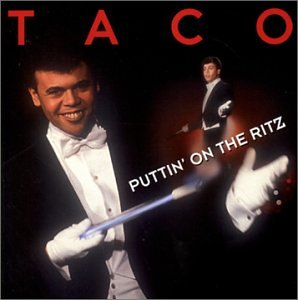
A Grown Man Named Taco Is Telling Us How To Dress

Little could Irving Berlin have suspected, when he composed "Puttin' On The Ritz" in 1929, that one day it would be performed, with synthesized backing, by a grown man going by the name of Taco.

Taco is not his stage name. His full name is Taco Ockerse. He was born in Indonesia, claims to be Dutch, and began his career in Germany. Didn't we all!

The lyrics in Taco's version are actually the second, revised lyrics. According to Wikipedia, "the original version of Berlin's song included references to the then-popular fad of flashily-dressed but poor black Harlemites parading up and down Lennox Avenue." Try this on for size:
Have you seen the well-to-do
Up on Lennox Avenue
On that famous thoroughfare
With their noses in the air
High hats and arrowed collars
White spats and fifteen dollars
Spending ev'ry dime
For a wonderful time

If you're blue and
You don't know where to go to
Why don't you go where Harlem sits
Puttin' on the Ritz
Spangled gowns upon the bevy of high browns
From down the levee
All misfits
Puttin' on the Ritz

That's where each and ev'ry Lulu-Belle goes
Ev'ry Thursday evening with her swell beaus
Rubbing elbows

Come with me and we'll attend
The jubilee, and see them spend
Their last two bits
Puttin' on the Ritz
Progressive? Racist? I couldn't even begin to claim enough cultural context to tell you. Don't expect any analysis from Clark Gable:


Fifteen years later, "for the film Blue Skies (1946), where it was performed by Fred Astaire, Berlin revised the lyrics to apply to affluent whites strutting 'up and down Park Avenue'." Now it went like this:
Have you seen the well-to-do
Up and down Park Avenue
On that famous thoroughfare
With their noses in the air
High hats and arrowed collars
Wide spats and lots of dollars
Spending every dime
For a wonderful time

If you're blue and you don't know
Where to go to, why don't you go
Where fashion sits
Puttin' on the Ritz
Different types, who wear a day coat
Pants with stripes, and cut away coat
Perfect fits
Puttin' on the Ritz

Dressed up like a million dollar trooper
Trying hard to look like Gary Cooper
Super-duper!

Come, let's mix where Rockerfellers
Walk with sticks, or umber-ellas
In their mitts
Puttin' on the Ritz
I can see Taco now: "Hmm, this song isn't bad, but you know what it really needs? Synthesizers." In his delicate hands, Berlin's Depression-era show tune got the Inspector Gadget treatment, complete with wobbly synth lines that would have been too cheap for a late night horror film, and creepy robotic backup singers hissing "Super-duper."

Then there is the video. Taco may have gone with the more politically correct lyrics, but he certainly didn't abandon political incorrectness:
The music video for Taco's version became controversial because of its blackface dancers. An edited version was released which replaces these dancers with a picture of Gary Cooper (except in the last part where the video zooms in focusing on Taco). In the instrumental dance part, it shows the feet of the blackfaced dancers and later places Taco dancing inset.
Nothing like a little blackface to bring back that old timey feel. Here's the original clip:


Now here's the edited version [Edit: Looks like it's not on YouTube anymore]:

That is some impressive '80s editing my friends. I can almost see the conversation in the MTV break room now: "Bob ... I'm gonna need to you take this video, and, without filming any new footage, cut around all the shots of people in blackface - you know ... a little zoom here, some cropping there ... you can figure it out."

In the end, blackface may have been the least disturbing facet of this video. How about the homeless people surrounded by flames, the creepy mannequins, the glowing cane, or even the mouse? And then there is Taco himself, who has been compared in the YouTube comments to everyone from Tim Curry to "Booger" from Revenge of the Nerds. Here are some other winners:
He looks like that dummy who came to life in the twilight zone ventriloquist episode

He looks as weird as he sounds...the last two seconds of this video were particularly disturbing.

Best dressed Jedi ever.

I dont know bout all you guys...but this mother fucker looks creepy as fuck....especially when he does his little head motion after he says "coat perfect fits" .....dude creeps me the fuck out.

the video get weirder as it progresses

I preferred his earlier collaborations with enchilada.

Blackface is sexy.

As a Martian I am offended by the pianist's blatant racism of Greenface.

This song is on repeat in hell.

I enjoy this version because Taco is the physical manifestation of everything that fuels my nightmares.

All I can think of is a picture of Vladimir Putin's face on a ritz cracker. 

Sunday, August 26, 2012

Gary Numan: More Than "Cars," But How Much More?

Here is what most Americans probably think of Gary Numan:

"Ha ha! 'Here in my car'! 'Driving my car'! So funny! He's singing about cars!"

Here is what most Brits probably think of Gary Numan:

"Pop music legend."

Well, maybe not "legend." But in America, Numan was a one hit wonder. In the UK, Numan was a superstar. And in Little Earl's mind?

Eh, somewhere in between.


Gary Numan is like late '70s David Bowie without Brian Eno. Or without David Bowie. He's got the sound nailed, all right; he just needs something worthwhile to sing about. He makes Bowie seem like a heart-on-his-sleeve, confessional singer-songwriter by comparison. Somebody should have just sat down and told him, "Gary, buddy, you can make cool futuristic robot music, but at some point you're going to need to come up with some lyrics that aren't a total deadpan sci-fi joke." Maybe he can't help it, according to this quote from Wikipedia:
Polite conversation has never been one of my strong points. Just recently I actually found out that I'd got a mild form of Asperger's syndrome which basically means I have trouble interacting with people. For years, I couldn't understand why people thought I was arrogant, but now it all makes more sense.
Numan first entered the public eye as the leader of a band called the Tubeway Army, which was essentially Numan's show (their singles now appear on his compilations as if they were originally "Gary Numan" releases anyway). As the Tubeway Army, Numan had a UK #1 hit with "Are 'Friends' Electric?" which sounds to me like some kind of vague reference to Philip K. Dick's "Do Androids Dream of Electric Sheep?" I think I might prefer this song to "Cars"; it's a little less gimmicky, a little bit catchier. "Less gimmicky" is certainly not a term that could have be applied to Numan's appearance, which was something like a cross between an albino and Keir Dullea from 2001: A Space Odyssey, although it was apparently not the result of some master plan:
According to Numan, this was an unintentional result of acne; before an appearance on Top of the Pops, he had "spots everywhere, so they slapped about half an inch of white makeup on me before I'd even walked in the door. And my eyes were like pissholes in the snow, so they put black on there. My so-called image fell into place an hour before going on the show."
Hey, and Johnny Cash originally wore black because his band needed to buy matching suits, and black was the cheapest color they could find, not because he wanted to represent the stark suffering of humanity. But you grab onto that image, Gary. You grab onto that image and you run with it.


Numan's first release under his own name was The Pleasure Principle, featuring song titles such as "Metal," "Complex," "Films," and "Engineers." I know about the late '70s gas shortage, but I wasn't familiar with the late '70s song title shortage. Speaking of gas, here's what Numan says about the origin of "Cars":
I was in traffic in London once and had a problem with some people in front. They tried to beat me up and get me out of the car. I locked the doors and eventually drove up on the pavement and got away from them. It's kind of to do with that. It explains how you can feel safe inside a car in the modern world... When you're in it, your whole mentality is different... It's like your own little personal empire with four wheels on it.
With insights like that, Numan could have been the Jack Handey of New Wave. Also, Numan and Trent Reznor are apparently best friends, with Reznor saying that Numan's music has been "vitally important and a huge inspiration," and Numan claiming that "Closer" is "his favorite hit single of all time." I'll bet they're a big hit at parties.


So, "Cars." When I first heard "Cars" in college, it did not sound to me like the work of an artist who may have recorded other worthwhile material. That I believe Gary Numan has indeed done so is his small moral victory, I suppose.

Tuesday, August 21, 2012

Come Off It Eileen

I'd heard the title "Come On Eileen" long before I heard the actual song. It was supposed to be one of the ultimate '80s one hit wonders, some would say the ultimate (it topped VH1's 100 Greatest One Hit Wonders of the 80s list, for example). Snarky writers would drop its name when attempting to summarize the frivolous and unpredictable nature of '80s cultural taste. I remember thinking, "Wow, all these people keep talking about 'Come On Eileen,' it must be a really great song!"

I imagined that the band was female. Dexys Midnight Runners could have been anybody. Even though the title of the song appeared to depict a person speaking to someone named Eileen, I just heard "Eileen" and thought, "female." And when I finally heard the song, I still thought the band was female.

As with so many "one hit wonders," Dexys Midnight Runners weren't one hit wonders at all - in England. They were, however, two album wonders. Their first album, Searching for the Young Soul Rebels, featured the UK #1 single "Geno," a tribute to Geno Washington, an American soul singer who had only been successful in Britain.


That's Dexys Midnight Runners in a nutshell. The band were extremely British, with the sort of ungodly concoction of imitation Memphis soul and Celtic folk that only a British band could generate, and only a British audience could love. What's surprising, then, isn't that they had only one hit in America, but that they managed to have any hits in America at all.

Hard to say what my fellow countrymen saw in this particular British single over anything by, say, The Jam or The Specials, but there you have it. Lead singer Kevin Rowland's voice is the kind that tempts you to stick your dripping wet fingers into the nearest electrical socket, but other than that, he's not bad. One instrument that really did not need to make a return in pop music was the banjo, but Dexys Midnight Runners obviously thought otherwise.


I mean, really? This is the legendary '80s hit I was missing out on all those years? Give me Billy Ocean any day. Still, although I find the song irritating, I will concede it has that certain intangible something - silliness mixed with enthusiasm? A thousand tempo shifts? A banjo? The bottom line is this: my new love for '80s music is so all-encompassing, I think I'm starting to like songs that I don't actually ... like.

Sunday, August 12, 2012

Men At Work: Sneaking Some Bitterness "Down Under" A Goofy Surface

"Ha ha, we're Australian!" That's pretty much what the appeal of this song seemed to be to the people who I caught listening to it. Friends in college would play "Down Under" and get this little grin on their faces, as if to say, "Remember these silly guys from Australia who had a couple of hits and they were from Australia and wasn't that really funny?" Sorry, but I tend to look for more from my music.

Then I actually read about the song on Wikipedia. Here's what singer Colin Hay says:
The chorus is really about the selling of Australia in many ways, the over-development of the country. It was a song about the loss of spirit in that country. It's really about the plundering of the country by greedy people. It is ultimately about celebrating the country, but not in a nationalistic way and not in a flag-waving sense. It's really more than that.

It's ironic to me that so many people thought it was about a specific thing and that really wasn't the intention behind the song. If you listen to 'Born In The USA,' it's a similar song in that there's a lot of nuance missed because people like drinking beer and throwing their arms up in the air and feeling nationalistic. It's ultimately a song about celebration, but it's a matter of what you choose to celebrate about a country or a place. White people haven't been in Australia all that long, and it's truly an awesome place, but one of the most interesting and exciting things about the country is what was there before. The true heritage of a country often gets lost in the name of progress and development.
Hmm. Well ... now I kind of liked it! Let's look at some of these lyrics:
Do you come from a land down under?
Where women glow and men plunder?
Can't you hear, can't you hear the thunder?
You better run, you better take cover
It's not particularly honorable to "plunder," is it? People might hear "plunder" and think, "oh, like pirates, cool!" But maybe they meant "plunder" in a more critical sense, like how white people "plundered" the Aboriginies and "plundered" the country's natural resources. Some of the song's slang was probably lost on American ears. For example, to "chunder" is to vomit. In that sense, to sing "I come from a land down under/Where beer does flow and men chunder" is to not be as blindly celebratory of your countrymen as one might have otherwise assumed. And why is there thunder? Why do we need to "run" and "take cover"?! Sounds more ominous than patriotic if you ask me.


Now after listening more carefully, I realized the song was a bit darker than I had assumed. Instead of "We come from Australia, which is so weird and quirky," it's more like, "We come from from Australia, and we're supposed to feel kinship with complete strangers just because we share these weird and quirky things, but that's just the surface crap that sells to the foreigners, and maybe we really do have things in common, but those sorts of things, like a history of exploitation and our origins as a giant penal colony, aren't as appealing in a brochure." Just what does it mean to really come from a land down under? Eh, Crocodile Dundee?

So basically, it's a good song that was misunderstood and happened to appeal to stupid people. Or, to put it another way, Men at Work were expressing ambivalence about the selling of Australia, but the selling of Australia is exactly what made the song a hit in the first place, and exactly why people in America still like it. The only lyric anyone actually quotes is "I come from a land down under/when women glow and men plunder." Who cares what they're really trying to say.

Makes me want to go and stick my head "down under" a toilet. And when I do, it better flush in the right direction.

Thursday, August 9, 2012

Huge '80s Hits That I Don't Actually Remember Hearing In The '80s

Many is the time I have posted my eloquent observations on a classic '80s song, expecting the world to shout in wonderment and exclaim "Thank you, Little Earl, for your incomparable, inimitable analysis," only to see a comment stating something to the effect of "OMG! LOL! I can't believe you'd never heard that song before!" So in honor of my recently discarded '80s pop ignorance, I thought I would provide Herr Zrbo with that cheap sense of superiority he so desperately craves (and needs), and inaugurate a series I would like to call "Huge '80s Hits That I Don't Actually Remember Hearing In The '80s."

When I hear a song from the '80s that I heard in the '80s, I know it. It's an instinctive feeling. An '80s song is like a cherry blossom in summertime, or a child's laughter, or the cold morning breeze. Sometimes I can call to mind a specific memory of listening to the song. Sometimes there is no specific memory, rather only a vague sensation. But I can sense it in the core of my being. I heard this song in my childhood. I don't know precisely when, or precisely how, but I do know that I heard it. Music can be funny like that.

It is very possible that some of the songs in this series are songs that I did truly hear in the '80s. But I don't remember hearing them in the '80s, and that's all that matters here. Maybe the radio stations in the Bay Area didn't play these particular songs very often. Maybe they were bigger hits elsewhere. Maybe my parents didn't like these songs and always changed the station whenever they came on. This may explain why I don't remember hearing much hair metal, or synth pop, or a single Prince song.

At some point - maybe high school, maybe college - I would be hanging out with friends, reminiscing over '80s songs. Most of the songs I knew, and some I even remembered better than my friends did. But then there would be certain songs where they would all say, "Oh man, who remembers this song?" Maybe it was "Hungry Like The Wolf." Possibly "Our Lips Are Sealed." Could have been "Do You Really Want To Hurt Me?" Let's call it the Tomb of the Unknown '80s Mega Hit. And everyone was supposed to laugh at the awkward residue of our shared cultural heritage. But I honestly may not have ... remembered it.

The shame burned deep inside me. I laughed and smiled just like everyone else, pretending I understood. But I said nothing.

I thought those days were long over - until a couple of years ago. As I attempted to explain to Zrbo earlier, there is a difference between a huge '80s hit I don't remember hearing in the '80s but ended up hearing at some point in the '90s, and a huge '80s hit I don't remember hearing until my recent obsession with '80s music began. I thought of splitting these songs up into two different series, but in the end I am going to lump them all together. Ignorance is ignorance. Why split hairs?

I know what I am going to get. Someone, and I am not saying who, is going to leave comments such as, "You mean to tell me that you'd never heard ____?? I heard that song all the time!! I can't believe your ignorance of '80s music runs that deep, WTF, LOL!"

Well not anymore, my friends. Not anymore.