Believe it or not,
"Mickey" was not Toni Basil's fifteen minutes of fame. Toni Basil is a
dancer and choreographer, not a singer. She was also an occasional
actress, appearing in such acclaimed, edgy late '60s movies as Easy Rider
and Five Easy Pieces. I remember seeing the credits for those movies and
thinking, "Wait, is that the same Toni Basil? Couldn't be." Oh, but it was.
She's the girl with long black hair.
Toni
Basil has done choreography for films such as American Graffiti, Peggy
Sue Got Married, My Best Friend's Wedding, Legally Blonde, etc. The
choreography for David Bowie's 1974 Diamond Dogs tour? Toni Basil. The
choreography for Talking Head's "Once In A Lifetime" music video? Toni
Basil. As with Toto, Toni Basil has had a massive effect on your life
and you didn't even know it.
Or maybe you did, if
"Mickey" happened to have a massive effect on your life, that is. Along with "We
Got The Beat," it is one of the cornerstones of Cheerleader Rock. And if any '80s music video would happen to display superlative choreography, that video would be "Mickey."
But
I will forever know "Mickey" as "Ricky," from Weird Al's first album, back when he still played accordion on every song, and long before he had the clout to, say, borrow video sets from Michael Jackson. In fact, I'm always taken aback whenever I listen to "Mickey" and it doesn't segue into the I Love Lucy theme at the end. I didn't know much about I
Love Lucy when I first heard "Ricky," and honestly, I
still don't know much about I Love Lucy even today. But I know a brilliant Weird Al song when I hear one. Maybe it's just his
attempt to do a Cuban accent, or his character's inability to
realize that "every day's a re-run and the laughter's always canned";
like Truman in The Truman Show, Ricky believes he has free will, but in reality, he merely exists for other people's
amusement.
And now for something that I suppose you might call a spin-off series of Huge '80s Hits That I Don't Actually Remember Hearing In The '80s.
The
first cassette that I ever bought with my own money was Weird Al's
Greatest Hits. True, it was actually my father's money, but I think I
earned it by doing chores, and he had no influence
on my purchase, and I kept the cassette in my own private music stash.
The second cassette I ever bought with my own money was the Beatles' 20
Greatest Hits (an early version of Beatles 1), which was probably a
better choice, but not by much. A few years later, a friend loaned me
every Weird Al '80s album aside from Polka Party.
Listening
to '80s Weird Al in the '90s was a strange activity. As many die-hard
fans know, Weird Al often writes original compositions
in addition to parodies. Listening to his albums a decade later, I was
often unaware as to when a song was an original or when it was simply a
parody of a song I missed the first time around. As a result, I later
realized that several Weird Al "originals" were actually parodies.
Radio
rotation can be a funny thing. A song can be playing twenty times a day
for weeks at a time, and it seems like it's literally everywhere, and
then DJs can just collectively decide that its time is up and everyone
is sick of it, and the song gets locked away in a hyperbolic chamber
deep within the recesses of pop culture, never to be heard from again,
until it is rediscovered by a brave VH1 archeologist. Some songs will
end up on permanent radio playlists even though they were only
marginal hits at the time (for example, Madonna's "Holiday" only peaked at #16). By the same token, when was the last time you
heard a radio station play "The Macarena"?
A pop
culture satirist like Weird Al can be so in tune with the present
cultural moment while he's satirizing, he can sometimes preserve works
that would have otherwise been forgotten. Weird Al has had more longevity than most of the acts he's parodied.
Such
is the power of Weird Al that, when I eventually heard the original
hits, all I could think of was the Weird Al version. Even when I hear
them today, all I can think of is the Weird Al version. I couldn't even
sing you the actual lyrics, but I can sing the Weird Al lyrics.
A key part of Weird Al's appeal is the strength of his actual music.
His production team over the years has done such a good job of
professionally recreating the sound of the hits he's satirizing that
when you're listening to his parodies, you're rarely distracted by the
music. Hence, the discrepancy between the normal-sounding music and the
ridiculous new lyrics is what generates the comedy. Am I stating the obvious? The lyrics are
humorous, but he sings them in a serious fashion. Do you understand?
Above
all, Weird Al's parodies call attention to the overall banality and
interchangeability of the vast majority of pop song lyrics. I mean, "Beat It"
might as well have been about food, right? It certainly wasn't Michael
Jackson's magnificent wordplay that made the song a hit.
Sure,
I heard "Like a Virgin" before I heard "Like a Surgeon." I heard
"Addicted To Love" before I heard "Addicted To Spuds." But this series
is a tribute to those '80s hits that I initially heard as performed by
the mustachioed master.
When
I said that Belinda Carlisle was attractive, in truth there was
actually more to say. It depends on which Belinda we are talking about.
Are we talking the Go-Go's Belinda, the solo Belinda, the punk Belinda?
For there was not really one Belinda. Most of the Belindas were
attractive, but some were ... how shall we say this? More attractive
than others.
When I first began reading about Belinda's
punk days, I had this image in my head of the 1987 stick-thin,
glistening auburn-haired Belinda running around and being a punk. Not quite.
You see, back in her punk days, Belinda was a bit
... heavier. It was not obvious that one day she would become Belinda
Carlisle, Ultimate California Superbabe. Much has been made of her
transformation from the Go-Go's to her solo career, but just as amusing,
in my opinion, is her transition from pre-fame Go-Go's to famous
Go-Go's.
In her punk days, Belinda didn't just dress
like a punk; she dressed like a hilarious punk. Other punk rockers were
trying; Belinda was trying and succeeding. L.A. punk photographer Jenny
Lens has an excellent collection of early Belinda and early Go-Go's
photos on her website. Lens actually seems concerned about copyright
protection and the unauthorized reproduction of her photos and she's not
some extremely wealthy corporate figure, so I am going to respect her wishes and not reproduce any of her photos on my blog. But if you want
to have a good laugh, I recommend clicking on this page.
In
photos 1, 9, and 10, Belinda and her mysterious gang of space vixens
look like something straight out of Barbarella, complete with whips,
chains, and torn lingerie. The
trash bag dress (photos #3-6) has become somewhat notorious in Belinda lore, but
other punk rockers had worn the trash bag dress before. No, my personal
favorite would have to be photo #8, in which Belinda is wearing a 45 RPM
record as a necklace. A necklace.
Above all, you just have to shake your head and wonder how, in just a few short years, someone who looked like this...
... would eventually look like this:
Yes, I am being told (cups his hand to imaginary earpiece a la Jon Stewart) that this is actually the same person.
There are
some '80s pop culture jokes I've missed out on, while Zrbo has probably
been smiling in gleeful recognition. Why? Because he speaks German and
has lived in Germany, which I don't and have not. If I had, I might have
been all too familiar with these next three songs.
Zrbo
came back from Germany one time and started making jokes about Falco. I
didn't really know who Falco was, and I ... still don't! But in 1981 he
released "Der Kommissar," the first ... German rap song?
The
British group After The Fire recorded an English language version, which might have possibly been the first British rap song (check that - I forgot about The Clash's "The Magnificent Seven"). After The Fire's cover
peaked at #5 in the US and became a staple of '80s compilations
forevermore. There is a raging YouTube debate as to which version is better. I mean raging.
Falco would achieve
American glory under his own name with "Rock Me Amadeus," a song that I
had heard about for years but have only heard just recently. Suffice to
say, I don't think it compares favorably to the musical works of
its subject. My guess is that, if Mozart were alive to hear "Rock Me
Amadeus," he would probably not like it.
Oddly,
although Nena recorded German and English versions of "99 Luftballons,"
and the English version was a #1 hit in the UK, Ireland, Australia, and
Canada, it was the German version that Americans preferred! Nobody had
any idea what the hell she was singing about, and it was probably for
the best, according to this (grammatically questionable) Wikipedia
summary:
The English (but not the German) version tells about two children who
buy 99 balloons at a toy shop and release them into the air, where
faulty radar equipment is unable to identify the balloons. The German
version starts with the narrator stating he will tell of a story about
99 balloons. Both versions then continue much in the same way with the
government immediately put their troops on red alert and scrambles
fighter jets to intercept the balloons, which ultimately triggers a nuclear war.
Although originally in German, no countries are ever named. In the
apocalyptic aftermath, the song's narrator stands in the rubble of the
city and finds a single remaining balloon. Thinking of the other child,
he releases the balloon.
Wait. Really? That's kind of
... fucked up! I always thought this was just some bland love song. Take
your Third World War songs back to Germany Nena, and stay there.
From the same minds who brought you the Bed Intruder Song comes this amazing ditty. I've never wanted to eat at a Five Guys Burger & Fries so much until I watched this mouthwatering morsel of a song (look at the bacon!). And as always, we turn to our fellow Youtube commenters to provide insight:
"His next song is on Type 2 diabetes"
"I'm a Vegan, but I still gives this a thumbs up"
"Oh god, I almost forgot to watch this song today."
and finally:
"THIS IS THE MOST INSPIRATIONAL THING I HAVE EVER SEEN"
When
rock critics condescendingly dismiss the '80s as being more about the
hair than the music, they're usually exaggerating. Usually.
Mike Score, A Flock Of Seagulls' lead singer, was a hairdresser who formed a band. No, really.
I'd
heard the name thrown about here and there, but I always wondered
just how ridiculous A Flock of Seagulls could have been. The answer:
pretty ridiculous.
Everything I said about Kajagoogoo's "Too Shy" applies here. If you had
to explain to a young person of today what the '80s were like, and how a
band could just come out of nowhere, have a huge hit, and then sink
back into the ether, and they give you a puzzled, confused look in
return, just show them this.
Honestly, the camera doesn't swirl enough for my taste. Also, I think the girls simply couldn't afford sunglasses, so they decided to paint giant rectangles around their eyes instead. Also, I know I'm making fun of it, but this song kind of rocks.
In the end, there is the hair. According to Wikipedia, "his 'seagull' or 'wings' hairstyle was created when Score was trying to style his hair like that of David Bowie's character, Ziggy Stardust.
AFOS bassist Frank Maudsley was trying to use the mirror at the same
time, and placed his hand on Score's head, leaving only the hair on the
sides of his head sticking up."
Well that's one explanation. I also heard he was trying to grow an afro, but happened to stand too long in front of a jet engine. Whatever he was trying
to do is really beside the point. In fact, I have a theory that he was the inspiration for Edward Scissorhands.
When
the cultural powers-that-be gather together at the great summit of '80s
pop, and they are faced with the task of having to name the ultimate,
most frivolous, most ridiculous, most flash-in-the-pan '80s hit of all
time, Kajagoogoo's "Too Shy" may be the song that they name.
First
of all: Kajagoogoo? Really? How could they possibly have
more than one hit? The universe would not allow it.
Sadly, once again
the UK has ruined everything by letting Kajagoogoo have a few
other smaller British hits. So how about this instead: the universe would not have allowed Kajagoogoo to
have more than one American hit?
I'd seen this song listed on every '80s nostalgic cash-in compilation album,
but I had never actually heard it until last year. Just from looking at
the band name and the song title, however, I felt like I got the idea.
When I finally heard the song, I have to say it was everything I hoped
for and more.
"Too Shy" is like the leftover bits of
Human League and Duran Duran that
you found stuck in the garbage disposal and you slapped together to
make a
spare '80s synth-pop song. In fact, Duran Duran's Nick Rhodes
produced the song, and dare I say it, but it's better than most of the
hits his own band came up with! The lead singer, Limahl, sounds like Boy
George,
only slightly more gay. There isn't a trace of genuine rock and roll
muscle to be found. And when that chorus comes around, I can't resist
swishing my hands from side to side in a slightly effeminate manner.
The
video doesn't disappoint either. There's a giant banner that reads
"Welcome Home Boys," perhaps suggesting a post-war theme, but I don't
think they had Roland synthesizers back in 1945. Call it a hunch. Nor did anyone sport
Limahl's haircut, which suggests Rod Stewart and anticipates Andrew
Ridgeley. I also like his yellow "barely a shirt."
There
are far too many silly '80s hits for us to label any one song the
ultimate champion (the next song in this series is certainly going to
make its case), so let's
just say this: in the realm of shameless '80s disposable hits, "Too
Shy" may
have been equalled, but it has never been surpassed.
We needed someone to guide us through the basics, starting with how to plug in our equipment. We really were that clueless.
Charlotte
was a California blonde with a sensibility that was more pop than punk.
It was probably because she actually had some music training ... Margot
and I approached her one night backstage at the Starwood and asked if
she wanted to join us in our new band, the Go-Go's. It's funny to think
that we hadn't even played a gig but we were already talking as if there
was nothing more real and happening than our band ... We told her
who was in the group and that she would play lead guitar, which she
said sounded great. What she left out was that she didn't know how to
play lead guitar.
No problem! Here's how Charlotte tells it:
Belinda came up to me that night at the Starwood, I was playing with my
punk band The Eyes; it was The Jam, The Dickies, and The Eyes, and we
would play two sets a night. Of course, I can’t imagine that today
(laughs). But it was between sets, Belinda and Margot came up to me and they looked so freaky to me,
because I was pretty normal looking. I think Belinda had purple hair and
she was wearing a trash bag, and spiky heels with ripped stockings.
Now it’s no big deal, but back then it was freaky. And Margot had pink
and green hair and all this freaky makeup. And I thought, Well, this
sounds like fun.
Again, another life-altering decision
clearly made with the gravity the occasion deserved. It turns out that
Charlotte would fit right in:
Slash magazine ran our first print interview/feature, and in it, Jane
described herself as an "ex-Catholic, ex-cowgirl, ex-fashion designer."
Charlotte said that she possessed an IQ of 165 and declared herself a
genius whose fantasy was "to be gang-raped by seven Mister Rogers
clones." I described myself as a reject from a "strict Southern Baptist
home" who liked "huge sweatshirts, rabbit feet, the Hollywood cemetary,
rosaries, penguins, the Marquis de Sade, and gin rummy."
Sign me up! At
this point Belinda, most of the other Go-Go's, and various members of
the L.A. punk scene lived in a soon to be infamous apartment building known as the
Canterbury.
If someone had blown up the Canterbury,
and God knows someone might have tried, most of Hollywood's punk scene
would have been destroyed. I heard rumors the Canterbury's landlord was
also a pimp and oversaw a theft ring ... The Canterbury was a great big
interconnected stew of crazies devoted to two things, partying and
music, though it was hard to tell where one ended and the other began
... Theresa and I had a studio apartment with a kitchen. It came with a
disgustingly dirty and worn plaid sofa - the piece that qualified it as
"furnished." We also shared a Murphy bed. One day, in a burst of
inspiration, I set out to paint the bathroom bloodred, but I ran out of
steam halfway through and never finished.
Well, what's more
punk than a bloodred bathroom? A halfway painted bloodred bathroom.
In the book We Got The Neutron Bomb: The Untold Story Of L.A. Punk,
former Runaways manager (and all-around sleazy music business hanger-on)
Kim Fowley put it best:
The scene at the Masque and the Canterbury got into a lot of decadence
and debauchery, and all of the fucking and sucking, and the heroin and
the dog fucking and the obese shit-assing with the Go-Go's and their
early circle. Somewhere in the vomit, the blood, and vaginal pus,
somewhere among the filthy hypo syringes and the blubber, there probably
was poetry. Scene cheerleaders got to have their scabied cunts eaten on
dirty roach-infested floors while this loop music raged and worms
crawled, you know? It was excremental existential sexual shit at death's
door.
Little
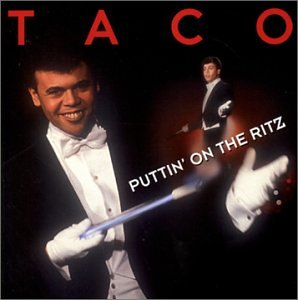
could Irving Berlin have suspected, when he composed "Puttin' On The
Ritz" in 1929, that one day it would be performed, with synthesized
backing, by a grown man going by the name of Taco.
Taco
is not his stage name. His full name is Taco Ockerse. He was born in
Indonesia, claims to be Dutch, and began his career in Germany. Didn't we all!
The lyrics in Taco's version are actually the
second, revised lyrics. According to Wikipedia, "the original version of
Berlin's song included references to the then-popular fad of
flashily-dressed but poor black Harlemites parading up and down Lennox Avenue." Try this on for size:
Have you seen the well-to-do
Up on Lennox Avenue
On that famous thoroughfare
With their noses in the air
High hats and arrowed collars
White spats and fifteen dollars
Spending ev'ry dime
For a wonderful time
If you're blue and
You don't know where to go to
Why don't you go where Harlem sits
Puttin' on the Ritz
Spangled gowns upon the bevy of high browns
From down the levee
All misfits
Puttin' on the Ritz
That's where each and ev'ry Lulu-Belle goes
Ev'ry Thursday evening with her swell beaus
Rubbing elbows
Come with me and we'll attend
The jubilee, and see them spend
Their last two bits
Puttin' on the Ritz
Progressive?
Racist? I couldn't even begin to claim enough cultural context to tell
you. Don't expect any analysis from Clark Gable:
Fifteen years later, "for the film Blue Skies (1946), where it was performed by Fred Astaire, Berlin revised the lyrics to apply to affluent whites strutting 'up and down Park Avenue'." Now it went like this:
Have you seen the well-to-do
Up and down Park Avenue
On that famous thoroughfare
With their noses in the air
High hats and arrowed collars
Wide spats and lots of dollars
Spending every dime
For a wonderful time
If you're blue and you don't know
Where to go to, why don't you go
Where fashion sits
Puttin' on the Ritz
Different types, who wear a day coat
Pants with stripes, and cut away coat
Perfect fits
Puttin' on the Ritz
Dressed up like a million dollar trooper
Trying hard to look like Gary Cooper
Super-duper!
Come, let's mix where Rockerfellers
Walk with sticks, or umber-ellas
In their mitts
Puttin' on the Ritz
I can see Taco now: "Hmm, this song isn't bad, but you know what it really needs? Synthesizers."
In his delicate hands, Berlin's Depression-era show tune got
the Inspector Gadget treatment, complete with wobbly synth lines that
would have been too cheap for a late night horror film, and creepy
robotic backup singers hissing "Super-duper."
Then there is the video. Taco may have gone with the more politically correct lyrics, but he certainly didn't abandon political incorrectness:
The music video for Taco's version became controversial because of its blackface dancers. An edited version was released which replaces these dancers with a picture of Gary Cooper (except in the last part where the video zooms in focusing on Taco). In
the instrumental dance part, it shows the feet of the blackfaced
dancers and later places Taco dancing inset.
Nothing like a little blackface to bring back that old timey feel. Here's the original clip:
Now here's the edited version [Edit: Looks like it's not on YouTube anymore]:
That
is some impressive '80s editing my friends. I can almost see the conversation in the MTV break room now: "Bob ... I'm gonna need to you take this video, and, without filming any new footage, cut around all the shots of people in blackface - you know ... a little zoom here, some cropping there ... you can figure it out."
In the end, blackface may have been
the least disturbing facet of this video. How about the homeless people
surrounded by flames, the creepy mannequins, the glowing cane, or even the mouse? And then there is Taco himself, who has been compared in the YouTube comments to everyone from Tim Curry to "Booger" from Revenge of the Nerds. Here are some other winners:
He looks like that dummy who came to life in the twilight zone ventriloquist episode
He looks as weird as he sounds...the last two seconds of this video were particularly disturbing.
Best dressed Jedi ever.
I dont know bout all you guys...but this mother fucker looks creepy as
fuck....especially when he does his little head motion after he says
"coat perfect fits" .....dude creeps me the fuck out.
the video get weirder as it progresses
I preferred his earlier collaborations with enchilada.
Blackface is sexy.
As a Martian I am offended by the pianist's blatant racism of Greenface.
This song is on repeat in hell.
I enjoy this version because Taco is the physical manifestation of everything that fuels my nightmares.
All I can think of is a picture of Vladimir Putin's face on a ritz cracker.
Here is what most Americans probably think of Gary Numan:
"Ha ha! 'Here in my car'! 'Driving my car'! So funny! He's singing about cars!"
Here is what most Brits probably think of Gary Numan:
"Pop music legend."
Well,
maybe not "legend." But in America, Numan was a one hit wonder. In the
UK, Numan was a superstar. And in Little Earl's mind?
Eh, somewhere in between.
Gary
Numan is like late '70s David Bowie without Brian Eno. Or without David
Bowie. He's got the sound nailed, all right; he just needs something
worthwhile to sing about. He makes Bowie seem like a
heart-on-his-sleeve, confessional singer-songwriter by comparison.
Somebody should have just sat down and told him, "Gary, buddy, you can
make cool futuristic robot music, but at some point you're going to need
to come up with some lyrics that aren't a total deadpan sci-fi joke."
Maybe he can't help it, according to this quote from Wikipedia:
Polite
conversation has never been one of my strong points. Just
recently I actually found out that I'd got a mild form of Asperger's
syndrome which basically means I have trouble interacting with people.
For years, I couldn't understand why people thought I was arrogant, but
now it all makes more sense.
Numan first
entered the public eye as the leader of a band called the Tubeway Army,
which was essentially Numan's show (their singles now appear on his
compilations as if they were originally "Gary Numan" releases anyway).
As the Tubeway Army, Numan had a UK #1 hit with "Are 'Friends'
Electric?" which sounds to me like some kind of vague reference to
Philip K. Dick's "Do Androids Dream of Electric Sheep?" I think I might
prefer this song to "Cars"; it's a little less gimmicky, a little bit
catchier. "Less gimmicky" is certainly not a term that could have be
applied to Numan's appearance, which was something like a cross between
an albino and Keir Dullea from 2001: A Space Odyssey, although it was apparently not the result of some master plan:
According to Numan, this was an unintentional result of acne; before an appearance on Top of the Pops,
he had "spots everywhere, so they slapped about half an inch of white
makeup on me before I'd even walked in the door. And my eyes were like
pissholes in the snow, so they put black on there. My so-called image
fell into place an hour before going on the show."
Hey, and Johnny Cash originally wore black because his band
needed to buy matching suits, and black was the cheapest color they
could find, not because he wanted to represent the stark suffering of
humanity. But you grab onto that image, Gary. You grab onto that image
and you run with it.
Numan's first release under his own name was The Pleasure Principle,
featuring song titles such as "Metal," "Complex," "Films," and
"Engineers." I know about the late '70s gas shortage, but I wasn't
familiar with the late '70s song title shortage. Speaking of gas, here's
what Numan says about the origin of "Cars":
I was in traffic in London once and had a problem with some people in
front. They tried to beat me up and get me out of the car. I locked the
doors and eventually drove up on the pavement and got away from them.
It's kind of to do with that. It explains how you can feel safe inside a
car in the modern world... When you're in it, your whole mentality is
different... It's like your own little personal empire with four wheels
on it.
With insights like that, Numan could have been the Jack Handey of New Wave. Also, Numan and Trent Reznor are apparently best friends, with Reznor
saying that Numan's music has been "vitally important and a huge
inspiration," and Numan claiming that "Closer" is "his favorite hit
single of all time." I'll bet they're a big hit at parties.
So,
"Cars." When I first heard "Cars" in college, it did not sound to me
like the work of an artist who may have recorded other worthwhile
material. That I believe Gary Numan has indeed done so is his small
moral victory, I suppose.