Stevie Nicks got around. Like a record, as Peter's tactless co-worker in Office Space might have put it. For instance, after dating her band mate Lindsay Buckingham for several years, she just turned right around and started having an affair with her other band mate, Mick Fleetwood! Jesus, why not sleep with John McVie while you're at it and just be done with it? At any rate, while bedding her way through the Southern California soft rock phone book, perhaps it was inevitable she would have gotten around to Don Henley. Although it may have seemed like a match made in multi-platinum heaven, apparently Henley accidentally got Nicks pregnant, and then demanded she get an abortion. Well if that ain't love, I don't know what is.
So, as with most things in life, the romance didn't last, but a flickering ember or two must have remained, as they recorded the gentle, countrified "Leather And Lace" for Bella Donna, which hit #6 in 1982, and is unfortunately not a song about a young, aspiring figure skater's exploration of S&M.
But I guess Stevie became bored with the sensitive "nice guy" and suddenly needed the touch of the "bad boy." Actually, as far as I know, she and Tom Petty never had a genuine fling, but in the recording studio, they certainly made sweet arena rock love. The title of "Stop Draggin' My Heart Around" is a textbook example of synecdoche, where the part represents the whole and vice versa, given that if someone actually dragged a person's heart around, it would quickly pop out of that person's chest and he or she would die. Although it appeared on a Stevie Nicks album and did not appear on the concurrent Tom Petty album (Hard Promises), for all intents and purposes, "Stop Draggin' My Heart Around" was essentially a Tom Petty & The Heartbreakers song with Stevie Nicks sprinkled on top; Petty and Mike Campbell wrote it, and the Heartbreakers played on it. All Stevie did was just ... show up! But if anyone can just "show up" and take over a song, it is Stevie.
Maybe it's just me, but does anybody else hear a hint of "Money For Nothing" in there? I keep half-expecting Sting to come in at any moment with "I want my MTV." But actually, thanks to Weird Al, whenever I hear this song, I'll always think of some poor schlub fruitlessly chasing a tow truck.
When Ray Parker, Jr. came out with the theme from Ghostbusters, everybody and their mother apparently thought, "Hey that sounds just like Huey Lewis and the News' 'I Want a New Drug'!" Everybody, except for four-year-old me, of course, who'd never heard "I Want a New Drug," but who had recently been scared shitless by a (possibly ill-advised?) theatrical viewing of Ghostbusters.
Years later I would see lists of Huey Lewis' hit song titles, and I was always confused by the title "I Want a New Drug." I thought drugs were bad, mmm-kay? Why would Huey Lewis, quite clearly a morally upright and decent person, be advocating drug use? Was the song supposed to be ironic? Was he playing a character? Even now, I'm looking at the lyrics and I have no idea why he's talking about drugs. According to Patrick Bateman, "not only is it the greatest antidrug song ever written, it's also a personal statement about how the band has grown up, shucked off their bad-boy image and learned to become more adult," but I'm not entirely buying it. Besides, nobody says, "I want a new drug." That's like saying "I want a new school." It just sounds awkward. Maybe you'd say, "I want to take a different kind of drug," but not "I want a new drug."
At any rate, in the late '90s I finally heard "I Want a New Drug," and you want to know the funny thing? It didn't even occur to me that the song sounded like "Ghostbusters." If anything, I would have assumed that Huey Lewis had ripped off Ray Parker, Jr. He certainly wasn't ripping off himself. "I Want A New Drug" is sort of Huey Lewis' stab at Aerobic Rock, and he stabbed well: not only did the song peak at #6, but it managed to top the Dance Club Play chart. I don't think Michael Jackson had anything to worry about.
The video featured the debut of Huey's now-iconic red sportcoat/black t-shirt/shades look, and, funny, but he keeps spotting the same girl everywhere he goes. Matter of fact, isn't that the same girl from the "Heart and Soul" video? Well by golly, it is! Her name is Signy Coleman, and fellow '80s blogger Noblemania managed to track her down recently:
How were you cast?
It was very funny. My agent said, “They’re looking for punk rockers so I want you to put some of that spray stuff in your hair and put on torn fishnet stockings.” I said, “Lynn, I’m not doing that. I don’t look anything like a punk rocker.” I said I’ll put on high heels but that’s about the extent of it. I went to the audition and there were 50 of the most hardcore punk rockers I’ve ever seen. I turned around to leave and the director popped his head out of the room they were casting in and said, “Hey, miniskirt, where are you going?” He pulled me in and said they were also looking for a girl who’s the opposite and stands out in the crowd of these unusual characters. I was asked to pretend to flirt with guy across the room, which I like to believe I had a little experience with at that point.
Did you have to audition for the second video (“I Want a New Drug”), or were you asked to be in it because of the first video?
I was just asked. They were filmed about a year apart. That one was more difficult. They had me on a boat in the bay when it was cold. The concert footage in it was real concert footage. Girls who are Huey fans are hardcore Huey fans. Right before they were about to start they walked me across the stage and put me dead center and there were girls in the front row of the audience who had all kinds of unladylike things to say to me. I won’t repeat them! The crew had to handpick a group of people to surround me so I didn’t get my hair ripped out, particularly when Huey leaned in to kiss me.
Lesson No. 1: Don't fuck with Huey Lewis fans. Lesson No. 2: Huey Lewis goes wherever he wants, even when it makes no sense. From Wikipedia: "The video is rather fast and loose with Bay Area geography: it starts with him driving toward downtown San Francisco, then on a ferry headed from Marin County toward San Francisco...then boarding a helicopter that flies over downtown back toward Marin County where the concert seems to be held." Hey, this was in the days before GPS, OK?
So, another solid hit, another tongue-in-cheek video - that it's, moving along, right? Not so fast.
One day, Huey was listening to the radio, minding his own business, when he heard a brand new song that sounded strangely ... familiar:
When the similarities between this song and the theme song of the 1984 film Ghostbusters were heard, Huey Lewis sued Ray Parker Jr. for plagiarism, claiming that Parker had stolen the melody from "I Want a New Drug". Lewis had been approached to compose the main theme song for the film, but had to decline because of his work on the soundtrack for Back To The Future. The two parties settled out of court. Details of the settlement (specifically, that Columbia Pictures paid Lewis a settlement) were confidential until 2001, when Lewis commented on the payment in an episode of VH1's Behind The Music. Parker subsequently sued Lewis for breaching confidentiality.
Well, yeah. When something's confidential, it's confidential - even fifteen years later. Ray Parker, Jr. never forgets, bitch. OK, so maybe he ripped off "I Want a New Drug." But you know what? He actually made it ... better. Let's face it, "Ghostbusters" is funkier, catchier, and heavier than "I Want A New Drug" ever was. At the very least, it may be the most danceable song about ghosts ever written (with the arguable exception of "The Monster Mash"). Besides, the song always makes me think of the movie Ghostbusters, which is, you know, a great movie. "I Want a New Drug" just makes me think of the D.A.R.E. program. If anything, the song Ray Parker, Jr. actually ripped off was the Bar-Kays' "Soul Finger," but let's not split hairs. Maybe Huey was just pissed off that, in a delicious irony, "Ghostbusters" only made it to #6 on the Dance Club Play chart, but hit #1 on the pop chart.
The "Ghostbusters" video didn't quite have the same budget as the Ghostbusters movie, but it does have more neon furniture, and more celebrity cameos (Irene Cara? Peter Falk?!). At about the 3:08 mark, the damsel in distress shows up in some sort of light blue button-up blouse that's also a skirt (?), but in a strange way I find it kind of hot.
Perhaps the musician who had the clearest vision for how to improve "I Want a New Drug" was not Ray Parker, Jr., but Weird Al. Over the course of three minutes and thirty seconds, Yankovic unleashes every potentially groan-inducing duck pun known to man: "I'll tie him up with duck tape"; "The duck stops here"; "Show me how to get down"; "One that won't smell too foul" - the man could go all night. The only thing missing was a music video with Signy Coleman in a duck suit.
Q:
Want to know how to have an instant UK #1 hit? A: Hire a hot producer,
promote the single with outrageous homosexual imagery, and get banned by
the BBC. It worked for Frankie Goes To Hollywood.
For
about five seconds, Frankie Goes To Hollywood were the biggest band in
the world. In England. In 1984. Their debut album, Welcome To The
Pleasuredome, topped the British charts and produced three #1 hits in a
row, including "Two Tribes" and "The Power Of Love." The album also included a version of Edwin Starr's "War" that featured a Ronald Reagan impersonator reciting dialogue such as "Then of course there is revolutionary love, love of comrades fighting for the people, and love of people, not an abstract people, but people one works with; when Che Guevara talked of love being at the center of revolutionary endeavor, he meant both," and a version of Bruce Springsteen's "Born To Run" that manages to be less bombastic than the original - and this is Frankie Goes To Hollywood we're talking about here. But the song that
made them infamous in both the US and the UK, then and for all time, was
"Relax."
It turns out that Frankie Goes To Hollywood wasn't much of a band at all. Mostly it was just producer Trevor Horn.
Trevor Horn was the brainchild behind the Buggles. Yes, that Buggles.
In
the most obvious career move ever, Horn and fellow Buggle Geoffrey
Downes joined progressive rock dinosaurs Yes. While Horn didn't remain
an official member of the band for more than one album, he produced two
more, including 90125, which featured the shockingly non-progressive
rock comeback hit "Owner of a Lonely Heart" (also skewered in Weird Al's
polka medley along with "Relax").
Let's not forget
ABC's The Lexicon Of Love (discussed elsewhere), avant-garde synthpop
collective The Art of Noise, former Sex Pistols manager (!) Malcolm
McLaren, Grace Jones, a couple of late '80s Pet Shop Boys songs ... the
list goes on. Hell, Trevor Horn could probably receive a blog series of his own,
though I doubt I'll give him one. The point is, he was hot.
While basking in his hot producer-ness, he caught Frankie Goes To Hollywood on TV, playing an early version of "Relax":
Horn
described the original version of "Relax" as "More a jingle than a
song", but he preferred to work with songs that were not professionally
finished because he could then "fix them up" in his own style ...
Ultimately lead vocalist Johnson was the only band member to perform on
the record; the only contribution by the other members was a sample
crafted from the sound of the rest of the band jumping into a swimming
pool. Horn explained years later, "I was just . . . look, 'Relax' had
to be a hit." Despite the band's absence from the record, Horn said, "I
could never have done these records in isolation. There was no actual
playing by the band, but the whole feeling came from the band."
Sure it did. The band may not have performed the music, but they certainly performed on some level:
ZTT initiated the ad campaign for "Relax" with two quarter-page ads in
the British music press. The first ad featured images of Rutherford in a
sailor cap and a leather vest, and Johnson with a shaved head and
rubber gloves. The images were accompanied by the phrase "ALL THE NICE
BOYS LOVE SEA MEN" and declared "Frankie Goes to Hollywood are
coming ... making Duran Duran
lick the shit off their shoes ... Nineteen inches that must be taken
always." The second ad promised "theories of bliss, a history of
Liverpool from 1963 to 1983, a guide to Amsterdam bars".
Sign me up.
On 11 January 1984, Radio 1 disc jockey Mike Read expressed on air his distaste for both the record's suggestive sleeve (designed by Anne Yvonne Gilbert)
and its lyrics. He announced his refusal to play the record, not
knowing that the BBC had just decided that the song was not to be played
on the BBC anyway. In support of their disc jockey, BBC Radio banned the single from its
shows a reported two days later (although certain prominent night-time
BBC shows — including those of Kid Jensen and John Peel — continued to play the record, as they saw fit, throughout 1984).
The now-banned "Relax" rose to number 2 in the charts by 17 January,
and hit the number-one spot on 24 January. By this time, the BBC Radio
ban had extended to Top of the Pops as well, which displayed a
still picture of the group during its climactic Number One announcement,
before airing a performance by a non-Number One artist ... The ban
became an embarrassment for the BBC, especially given that UK
commercial radio and television stations were still playing the song.
Later in 1984 the ban was lifted and "Relax" featured on both the Christmas Day edition of Top of the Pops and Radio 1's rundown of the best-selling singles of the year.
Well all's well that ends well. So surely the video was scandal-free, right?
The original video was directed by Bernard Rose and depicted a gay S&M parlour where the band members were admired by muscular leathermen, a bleached blonde drag queen and a large-bodied gentleman dressed as a Roman emperor. The video featured a scene where one of the band members wrestled a live tiger, to the admiration of the clubgoers, and ended where the "emperor" was so excited he shimmied out of his toga. Filmed in the unused East London theatre Wilton's Music Hall, it was promptly banned by both the BBC and MTV, resulting in the production of a substitute video directed by filmmaker Brian De Palma to coincide with the release of his film Body Double.
Here's the original video. It's no "Sex Dwarf," but what is?
Now here's the "substitute" video. Will someone please tell me what makes the "substitute" video any less questionable than the original video?
Not only are there several different "Relax" videos, but the
band (and Trevor Horn) also released an endless variety of "Relax"
mixes. There's the "New York" mix, the "Sex" mix, the "Disco" mix, the
"From Soft To Hard" mix, the "Come Fighting" mix, the "Warp" mix ... it
goes on.
All this hubbub seemed to overshadow the
supposed musical merits, or lack of merit, of the song itself. Honestly,
when I listen to "Relax," I hear a somewhat generic if vaguely amusing
'80s dance-pop single, nothing more and nothing less. It fascinates me
to no end that such an ordinary song could spark so much outrage. I
mean, why would "Relax" be banned, but not "Ghost Town"? OK, so he says
"come." That means it's about sex? If anything, the song's about not having sex, since he sings "Relax, don't do it," which you might assume to be a suggestion not to have sex, but I guess the BBC can do whatever it wants.
And
yet, now that all the dust has settled, whenever I hear "Relax," I'll
never think of the controversy, the BBC ban, or even Trevor Horn's
production. Nope, all I'll think of is Weird Al playing an accordion and
making raspberry noises on Dare To Be Stupid.
Beginning
with "Polkas On 45" from Weird Al Yankovic In 3-D, Weird Al discovered
the comedic value of the "polka medley." I can see him in the studio
now: "I've got it - imagine if all the great pop hits of the day were
randomly slapped together ... and covered in the style ... of a polka band.
I don't even need to write my own lyrics!"
"Polkas On 45," being Weird Al's first polka medley ever, featured a few
contemporary hits like "Every Breath You Take" and "Burning Down The
House," but mostly drew from classic rock, sampling snippets of songs by the Beatles, the Rolling Stones, the Who, the Doors, and Jimi
Hendrix. He probably figured, "Hey, this is the first and last time I'll
ever do a polka medley. I mean, surely the gag will wear out its welcome, right?"
For his second polka medley, "Hooked On
Polkas" from Dare To Be Stupid, Weird Al stuck exclusively to
contemporary hits. (I managed to find a clip of the medley on YouTube, but it "contains content from SME and Warner Chappell, one or more of whom have blocked it in your country on copyright grounds"; little do SME and Warner Chappell realize, but their precious Weird Al polka medley is still available on YouTube ... as part of the complete album, which has been posted elsewhere and remains unblocked. Damn, I'm good. You can listen to the whole album if you'd like, but the medley begins at the 33:07 mark.)
Now, imagine hearing "Hooked On Polkas" in 1995. At the time, I recognized
several of the tracks he'd crammed in there, such as "Footloose," "What's
Love Got To Do With It," and "Owner Of A Lonely Heart," and I chuckled
upon hearing them performed in such a bowdlerized fashion. But it's not
very funny if you hear a polka version of a song you don't actually
recognize, is it?
Now, imagine, years later, finally
hearing the songs that Weird Al had performed with bicycle horns and hand claps as if he were playing at Cousin Morty's bar mitzvah. Yes: Weird Al's polka medleys
introduced me to many a popular '80s song. See, what happened was, so much time had passed between
these hits' heyday and 1995, I found myself listening to Weird Al's polka parody
versions without ever having been exposed to the originals. This, I
suppose, was amusing in its own roundabout way, although not in the way
which Weird Al intended.
I could sort of sense at the
time that I was experiencing a joke that I was not "in" on. For example,
why was Weird Al shouting such nonsensical lyrics as "She looks so
great/Every time I see her face/She puts me in a state/Ooh, a state of
shock"? What forgettable pop hit was this? And why was he proclaiming
"We're not gonna take it"? Take what? What was it that he was not going
to take? Or "Bang your head/Mental health will drive you mad"? Or "So
why don't you use it/Try not to bruise it/Buy time, don't lose it"? Or
"Relax, don't do it/When you wanna go to it/Relax, don't it/When you
wanna come/Relax, don't do it/When you wanna sock it to it"?
After
listening to a Weird Al polka medley, you might come to the conclusion
that most '80s pop song lyrics are completely ridiculous and make no sense.
Let's take these one by one.
Question: does the
presence of Michael Jackson and Mick Jagger automatically turn a song
into a hit single, even if it kind of ... stinks? I.e. if a Jackson/Jagger
collaboration falls in the woods, and no one is there to hear it, does
it make a sound?
I'm guessing that young American
teenagers listened to "We're Not Gonna Take It" by Twisted Sister and
thought that they were being rebellious. But don't you think that, if
it's 1984, and you really wanted to be rebellious, you would have
been listening to something like Black Flag? Or hell, even if we stick
with metal, how about Ride The Lightning?
What goes for Twisted Sister goes double for Quiet Riot. Quiet Riot
are mostly known for "Cum On Feel The Noize," which was actually a cover
of a song by '70s glam rock group Slade. Is it sad when your biggest
hit was actually a cover? If it's any consolation, Quiet Riot did have
another, smaller hit with "Metal Health." Listening to Weird Al's
rendition, I thought the lyrics were "mental health will drive you mad,"
not "metal health will drive you mad." Because why would Weird Al be
singing about metal?
Duran Duran's "The Reflex" was a
#1 hit in both the US and UK, but that doesn't mean I have to like it.
It has the same problem all the other crappy Duran Duran songs have - a
lot of noises are being made but none of them blend together in a
pleasing fashion. I think Simon Le Bon manages to sing
"Why-eye-eye-eye-eye" in a more irritating manner than even Weird Al
does - and Weird Al was trying to be irritating.
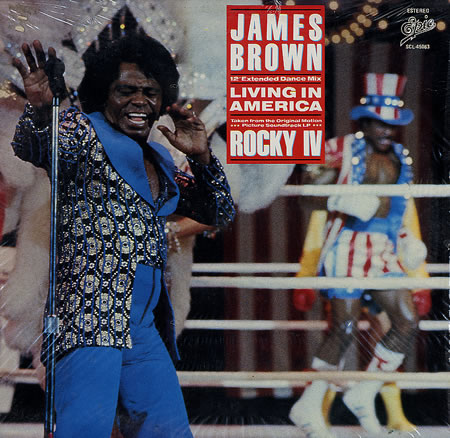
When I think of the '80s, I don't usually think of The Godfather of Soul.
Released
in 1986, "Living In America" became Brown's first Top 40 hit in a
decade, and as of this writing, his last (sure, he's dead, but come on, that
never stopped 2Pac). However, I'm wondering just how glad Brown was to
have been living in America just a couple of years later, when he was
arrested for drugs and weapons charges, then led police on a high-speed
car chase, and was ultimately sentenced to six years in prison (of which
he served three). I suppose one could say that James Brown "served for
his country."
But before all that image-burnishing, there was
Rocky IV. I'm not sure if "Living In America" was written specifically
for Rocky IV, but it might as well have been.
I remember my roommates in
college catching Rocky IV on TV and laughing
copiously; I wandered in and out of the room, and did not feel like I
was missing a cinematic treasure. I just read the plot
summary on Wikipedia. Let me get this straight: over-the-hill Apollo
Creed challenges a young and studly Soviet boxer who's pumped up on
steroids to a fight, Apollo dies in the ring, Rocky avenges Apollo's death by
training in the Russian mountains with an axe and a sled, he beats
the chemically enhanced Soviet boxer using nothing but his hard work and determination, and then he gives a big speech about the Cold War? Hmmmm. I seem to recall the first Rocky being at least somewhat plausible. I mean, why not have Luke Skywalker swoop down and blow up the Death Star while we're at it? And have hobbits and oompa-loompas help Rocky train?
Ah, but thanks to
Weird Al, whenever I hear "Living In America," I never think of Rocky Balboa saving
the free world from communism. Oh no. I always think of a man with a
very painful medical condition.
"Living With A Hernia"
became the lead-off track to Polka Party, which, according to Wikipedia,
"holds the dubious honor of being the lowest charting studio album
released by Yankovic." I'm not sure how Weird Al managed to receive
parody permission from a man with such a bad attitude, but props to the
Hardest Working Man in Showbusiness for being willing to go along with
jokes about intestines. It also probably helped that at the time, James
Brown and Weird Al shared record labels.
The song
quickly becomes a contest to see how many words Weird Al can come up
with that end in "-ation." We've got: "aggravation," "ruination,"
"location," "humiliation," "irritation," "medication." I'll bet if the
situation called for it, he could've come up with more. There's also a
highly educational section where he names several different types of
hernias, in lieu of Brown's naming several different American cities. I
mean hell, I already know the names of American cities.
While listening to Weird Al's second album In 3-D, I heard a track
called "The Brady Bunch" that stood out to me from the other cuts and had a melody I didn't recognize. The lyrics went
like this:
You can watch Mister Rogers
You can watch Three's Company
And you can turn on Fame
Or the Newlywed Game
Or the Addams Family
Say, you can watch Barney Miller
And you can watch your MTV
And you can watch 'till your eyes fall out of your head
That'll be OK with me
And you can watch...TV
I
remember thinking, "Damn, for a Weird Al original, this is really
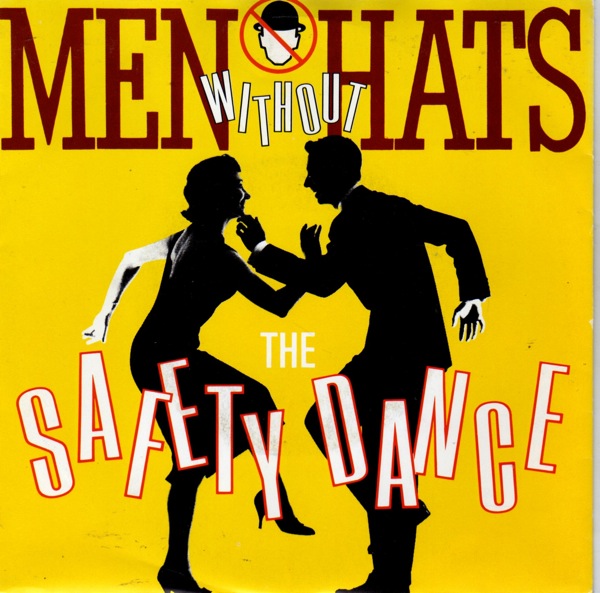
catchy!" Of course, it wasn't an original. It was a parody of Men
Without Hats' "The Safety Dance."
This may be the rare
instance of a Weird Al parody that is actually not as weird as the
original song. Men Without Hat's lead singer and songwriter, Ivan
Doroschuk, sounds like he's a robot that is running low on batteries.
Particularly unnerving is the way his voice drops when he sings the word
"Say," as if his computer programming has momentarily frozen. Even
stranger than his delivery are the enigmatic lyrics:
We can dance if we want to
We can leave your friends behind
'Cause your friends don't dance and if they don't dance
Well they're no friends of mine
Say, we can go where we want to
A place where they will never find
And we can act like we come from out of this world
Leave the real one far behind
And we can dance
And sing!
We can go when we want to
The night is young and so am I
And we can dress real neat from our hats to our feet
And surprise 'em with the victory cry
Say, we can act if want to
If we don't nobody will
And you can act real rude and totally removed
And I can act like an imbecile
So obviously the song is about ... safety? Dancing? Dancing safely? Numerous theories floated around,
from "a celebration of safe sex" to "a warning about nuclear
proliferation." But the true inspiration was a little less dramatic:
The writer/performer, Ivan Doroschuk, has explained that "The Safety Dance" is a protest against bouncers stopping dancers pogoing to 1980s New Wave music in clubs when disco
was dying and New Wave was up and coming. New Wave dancing, especially
pogoing, was different from disco dancing, because it was done
individually instead of with partners and involved holding the torso
rigid and thrashing about. To uninformed bystanders this could look
dangerous, especially if pogoers accidentally bounced into one another
(the more deliberately violent evolution of pogoing is slam dancing).
The bouncers did not like pogoing so they would tell pogoers to stop or
be kicked out of the club. Thus, the song is a protest and a call for
freedom of expression. Other lyrics in the song include references to
the way pogoing looked to bouncers, especially "And you can act real
rude and totally removed/And I can act like an imbecile".
Little
did Doroschuk realize just how much of an imbecile the world wanted him
to act like. The song peaked at #3 in the U.S. and #6 in the U.K. Men
Without Hats were on their way!
Which brings me back to
"The Brady Bunch." In the second half of his parody, Weird Al doesn't
even come up with his own lyrics. He simply starts singing the Brady
Bunch theme, word for word, to the melody of "The Safety Dance." In this
fashion, Weird Al demonstrates that he can parody a song that is
already funny, and although it might not end up being as funny as the
original, it can still be its own sort of funny. Have you ever started
making stuff up late at night with your friends? "The Brady Bunch" is
sort of like that. Maybe it was a good idea, maybe it wasn't, but damn,
you were having too much of a good time to care.
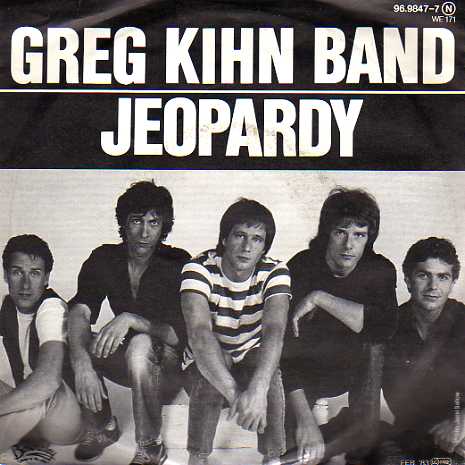
Greg
Kihn was a Huey Lewis-esque bar band rocker with a penchant for punny
album titles (Next of Kihn, Kihnspiracy,Rockihnroll, Kihnsolidation,
Kihntagious, Citizen Kihn ... it goes on). In 1983, he released the #2 hit "Jeopardy," which featured some killer music, but some rather
generic lyrics:
Where were you
When I needed you
Well you could not be found
What can I do
Oh I believed in you
You're running me around
Well you can take it as a warning
Or take it anyway you like
It's the lightning not the thunder
You never know where it's gonna strike
Our love's in jeopardy, baby ooh
Our love's in jeopardy, baby ooh
It
was a good jam, but something - hard to say what, exactly - was
missing. Only one man knew what that special something was. I can practically see him sitting there in his basement,
the light bulb appearing over his head. "Hmm ... 'Jeopardy'..."
Suddenly, in the hands of Weird Al, a mundane love song became the dark, twisted tale of an overly-confident game show contestant.
While the song's video is excellent,
there is something to be said for simply listening to "I Lost On Jeopardy" on its own; with less visual distractions, the angst of the protagonist really seeps in. However, it's
fascinating to see what Jeopardy used to look like before Alex Trebek
took over, and before the "answers" were displayed by a block of actual
television monitors on the wall. Someone on YouTube commented, "Why
didn't he get the actual host, and use the actual set?" Umm ... Weird Al
did get the actual host, and he did get the actual set. Did you know that Jeopardy goes back to 1964?
In fact, in the early '80s, the show had briefly gone off the air, but the popularity of "I
Lost On Jeopardy" helped bring it back in its new and improved
incarnation. Also, keep your eye out for the real Greg Kihn in a "hey everybody, I'm a good
sport" cameo.
In another sign of Weird Al's new-found industry clout, not
only did "I Lost On Jeopardy" feature then-current host Art Fleming in
the video, it also featured announcer Don Pardo, who delivers this scathing
monologue over the guitar solo:
That's right Al You lost
And now let me tell you what you didn't win
A twenty volume set of the Encyclopedia International
A case of Turtle Wax
And a year's supply of Rice-A-Roni, the San Francisco treat
But that's not all
You also made yourself look like a jerk in front of millions of people
And you brought shame and disgrace on your family name for generations to come
You don't get to come back tomorrow
You don't even get a lousy copy of our home game You're a comple-hete loo-hoo-ser
Admit it: this is probably what most of us feel like saying to failed game show contestants (announcers included), but we're just too polite to go there. There's this pathetic notion on game shows and thousands of other contests held daily in small towns all across America, in summer camps, in high schools, in retirement homes, that you should
be given points for "trying," and that even if you come in last, you
should still win "something." You know what? Maybe you just failed, OK?
Maybe you don't deserve our charity. As if a case of Turtle Wax is going
to make you feel any better.
But as brilliant as Don
Pardo's brutal contestant takedown is, the greatest moment of the song,
in my opinion, occurs immediately afterward. Here is Weird Al, he's just
been completely raked over the coals by the show's announcer, he should
be a shambling wreck of a man, but he simply jumps right back in with
an enthusiastic "Don't know what!" His failure has essentially bounced right off him. I find this oddly inspiring. Instead of sounding utterly
despondent, he only sounds mildly miffed. "Guess it just wasn't my
night," he surmises. That one little moment, I think, says miles about
the boundless optimism of the American spirit. The man should be crushed
and ruined, but nope, he's still dreaming of doing better "next weekend
on The Price Is Right." In America, hope springs eternal.
Believe it or not,
"Mickey" was not Toni Basil's fifteen minutes of fame. Toni Basil is a
dancer and choreographer, not a singer. She was also an occasional
actress, appearing in such acclaimed, edgy late '60s movies as Easy Rider
and Five Easy Pieces. I remember seeing the credits for those movies and
thinking, "Wait, is that the same Toni Basil? Couldn't be." Oh, but it was.
She's the girl with long black hair.
Toni
Basil has done choreography for films such as American Graffiti, Peggy
Sue Got Married, My Best Friend's Wedding, Legally Blonde, etc. The
choreography for David Bowie's 1974 Diamond Dogs tour? Toni Basil. The
choreography for Talking Head's "Once In A Lifetime" music video? Toni
Basil. As with Toto, Toni Basil has had a massive effect on your life
and you didn't even know it.
Or maybe you did, if
"Mickey" happened to have a massive effect on your life, that is. Along with "We
Got The Beat," it is one of the cornerstones of Cheerleader Rock. And if any '80s music video would happen to display superlative choreography, that video would be "Mickey."
But
I will forever know "Mickey" as "Ricky," from Weird Al's first album, back when he still played accordion on every song, and long before he had the clout to, say, borrow video sets from Michael Jackson. In fact, I'm always taken aback whenever I listen to "Mickey" and it doesn't segue into the I Love Lucy theme at the end. I didn't know much about I
Love Lucy when I first heard "Ricky," and honestly, I
still don't know much about I Love Lucy even today. But I know a brilliant Weird Al song when I hear one. Maybe it's just his
attempt to do a Cuban accent, or his character's inability to
realize that "every day's a re-run and the laughter's always canned";
like Truman in The Truman Show, Ricky believes he has free will, but in reality, he merely exists for other people's
amusement.
And now for something that I suppose you might call a spin-off series of Huge '80s Hits That I Don't Actually Remember Hearing In The '80s.
The
first cassette that I ever bought with my own money was Weird Al's
Greatest Hits. True, it was actually my father's money, but I think I
earned it by doing chores, and he had no influence
on my purchase, and I kept the cassette in my own private music stash.
The second cassette I ever bought with my own money was the Beatles' 20
Greatest Hits (an early version of Beatles 1), which was probably a
better choice, but not by much. A few years later, a friend loaned me
every Weird Al '80s album aside from Polka Party.
Listening
to '80s Weird Al in the '90s was a strange activity. As many die-hard
fans know, Weird Al often writes original compositions
in addition to parodies. Listening to his albums a decade later, I was
often unaware as to when a song was an original or when it was simply a
parody of a song I missed the first time around. As a result, I later
realized that several Weird Al "originals" were actually parodies.
Radio
rotation can be a funny thing. A song can be playing twenty times a day
for weeks at a time, and it seems like it's literally everywhere, and
then DJs can just collectively decide that its time is up and everyone
is sick of it, and the song gets locked away in a hyperbolic chamber
deep within the recesses of pop culture, never to be heard from again,
until it is rediscovered by a brave VH1 archeologist. Some songs will
end up on permanent radio playlists even though they were only
marginal hits at the time (for example, Madonna's "Holiday" only peaked at #16). By the same token, when was the last time you
heard a radio station play "The Macarena"?
A pop
culture satirist like Weird Al can be so in tune with the present
cultural moment while he's satirizing, he can sometimes preserve works
that would have otherwise been forgotten. Weird Al has had more longevity than most of the acts he's parodied.
Such
is the power of Weird Al that, when I eventually heard the original
hits, all I could think of was the Weird Al version. Even when I hear
them today, all I can think of is the Weird Al version. I couldn't even
sing you the actual lyrics, but I can sing the Weird Al lyrics.
A key part of Weird Al's appeal is the strength of his actual music.
His production team over the years has done such a good job of
professionally recreating the sound of the hits he's satirizing that
when you're listening to his parodies, you're rarely distracted by the
music. Hence, the discrepancy between the normal-sounding music and the
ridiculous new lyrics is what generates the comedy. Am I stating the obvious? The lyrics are
humorous, but he sings them in a serious fashion. Do you understand?
Above
all, Weird Al's parodies call attention to the overall banality and
interchangeability of the vast majority of pop song lyrics. I mean, "Beat It"
might as well have been about food, right? It certainly wasn't Michael
Jackson's magnificent wordplay that made the song a hit.
Sure,
I heard "Like a Virgin" before I heard "Like a Surgeon." I heard
"Addicted To Love" before I heard "Addicted To Spuds." But this series
is a tribute to those '80s hits that I initially heard as performed by
the mustachioed master.