Saturday, January 25, 2014

"Eye In The Sky": Don't Mess With This Passive Yuppie Husband, Or He Might ... Watch You

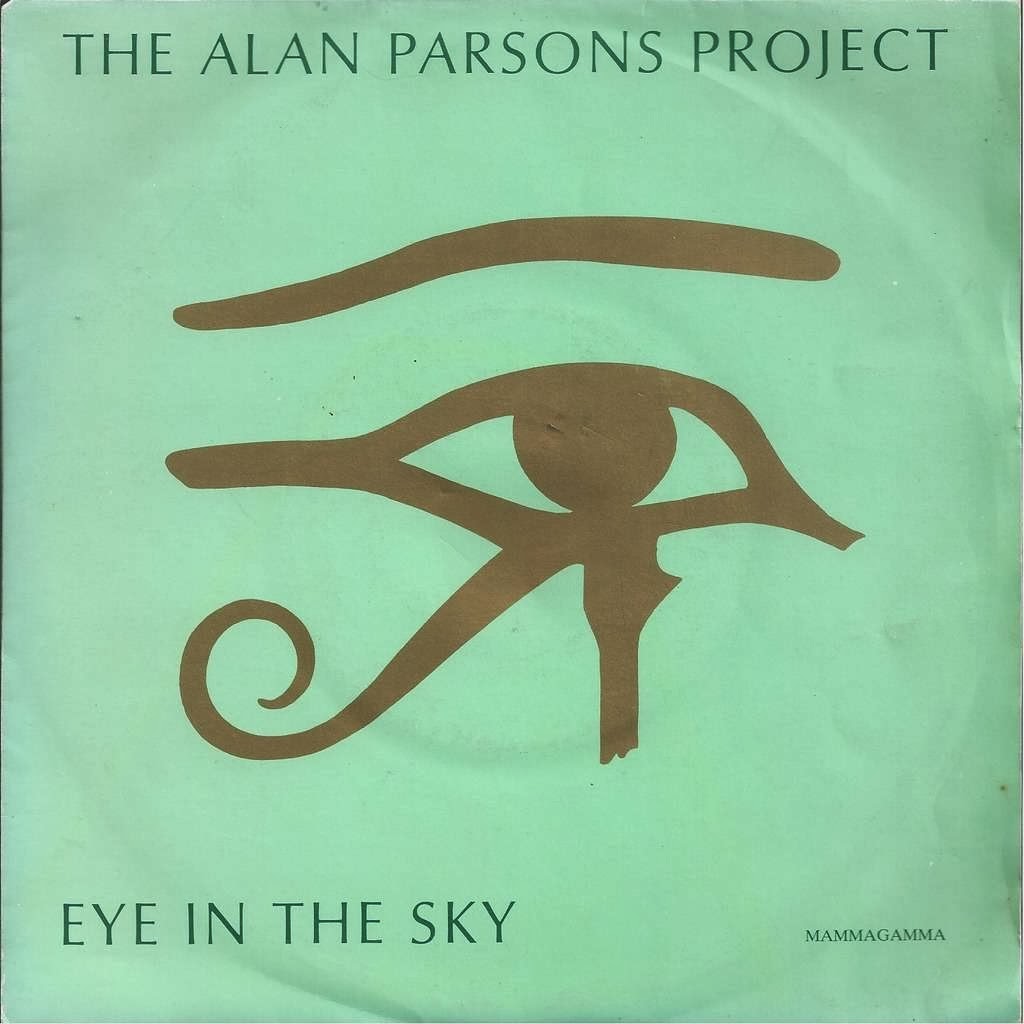
Whenever a riot breaks out in a third world country, the UN security forces should just play the Alan Parsons Project's "Eye in the Sky," because it might be the most soothing song ever made. I think it would be physically impossible to use violence against another human being while Eric Woolfson is gently admonishing the listener, "Don't say words you're gonna regret/Don't let fire rush to your head." 

Ostensibly, Eye in the Sky was supposed to be a concept album about Orwellian surveillance or "Big Brother is watching you" or something vaguely dystopian along those lines. Of course, it turns out that George Orwell was completely wrong about all of those things and we would never have to worry about government agents following our every move, but the Alan Parsons Project couldn't have known that back in 1982. Despite surveillance being the song's official "concept," however, I've always imagined that "Eye in the Sky" is being sung from the point of view of a passive middle-aged man whose marriage is falling apart. He's so meek and mild that his wife is brazenly cheating on him and she doesn't think he'll do anything about it. Well, he won't. But what he will do is imagine that he is this big, powerful, omniscient being who can see and hear all. Sure, in reality he's this docile wimp, but in his mind he's a fierce, omnipotent sorcerer hell-bent on vengeance. I'm a sucker for songs about people who try to pretend that they're powerful even though in reality they're quite pathetic. "Eye in the Sky" is like an '80s version of the Who's "I Can See For Miles."
Don't think sorry's easily said
Don't try turning tables instead
You've taken lots of chances before
But I'm not gonna give anymore, don't ask me
That's how it goes
Cause part of me knows what you're thinkin'

Don't say words you're gonna regret
Don't let the fire rush to your head
I've heard the accusation before
And I ain't gonna take any more, believe me
The sun in your eyes
Made some of the lies worth believing

I am the eye in the sky
Looking at you
I can read your mind
I am the maker of rules
Dealing with fools
I can cheat you blind
And I don't need to see any more
To know that
I can read your mind

Don't leave false illusions behind
Don't cry, I ain't changing my mind
So find another fool like before
Cause I ain't gonna live anymore believing
Some of the lies
While all of the signs are deceiving
Oooooh, I'm scared. Woolfson captures the gentle menace of this character as only he can. He starts out low, but jumps up an octave by the time he arrives at "And I ain't gonna take anymore, believe me." The chorus has those nice stacked harmonies, like a drowsier Journey, suggesting "Don't fuck with me, woman." This is what a wimpy guy sounds like when he's angry. But even a couple of threats take too much energy out of the guy, so by the time he gets to "I can read your mind," he's soft and gentle again as he tiptoes his way back to the study. "I can't stop you darling, but I can make you feel very, very guilty about it while you're doing it."

Musically, the song should carry a disclaimer: "Do not listen to while driving as it may induce sleep." "Eye in the Sky" is a perfect stew of somnolent: the swampy keyboard (reminding me, on the chorus, of Rick Wright's funky licks on Dark Side of the Moon's "Breathe" reprise), the delicately finger-picked acoustic guitars, and do I even detect a steel guitar adding a slight country flavor? But it's those constant, omnipresent rhythm guitars that lull you into that (false?) sense of security. According to Parsons, "...I hated the song when we first started recording it — I was quite ready to drop it altogether. Then we hit upon the hypnotic guitar chugs and it all came together." Well, Alan, don't say words you're gonna regret.

Monday, January 20, 2014

Breaking Down "Breaking Us In Two" Is Hard To Do

Initially written as a jingle for the KitKat candy bar, Joe Jackson ended up liking "Breaking Us In Two" so much, he decided to keep it for himself. OK, I made that up. My guess is the song, which peaked at #18 in the US, was an attempt to write a contemporary and yet "classic" sounding romantic standard, and I'd say he more or less succeeded. It certainly opened up the second side of Night and Day with an explosive burst of panache, as if Joe had just pulled back the ornately decorated doors of a ritzy, sparkling ballroom and invited us to walk on in. Nonetheless, the verse has a naggingly familiar feeling. Oh, wait a second, maybe that's because he lifted it from Badfinger's "Day After Day"?

The lyrics veer a bit close to the generic side, with Joe hoping to rhyme "do" with "do" and "us" with "us," without anyone noticing (I noticed), but his corrosive cynicism somehow still manages to shine through. Maybe Joe hadn't yet learned to enjoy the comforts of female companionship, but at least his veins weren't bulging out of his neck anymore while he was complaining about it.
Don't you feel like trying something new
Don't you feel like breaking out
Of breaking us in two
You don't do the things that I do
You want to do things I can't do
Always something breaking us in two

You and I could never live alone
But don't you feel like breaking out
Just one day on your own
Why does what I'm saying hurt you
I didn't say that we were through
Always something breaking us in two

They say two hearts should beat as one for us
We'll fight it out to see it through
I say that won't be too much fun for us
Though it's oh so nice to get advice
It's oh so hard to do

Could we be much closer if we tried
We could stay at home and stare
Into each other's eyes
Maybe we could last an hour
Maybe then we'd see right through
Always something breaking us in two
Bickering aside, with its gentle latin percussion and vibraphone embellishment, the song is like a glamorous ride in a Central Park carriage. Oddly, for a song that oozes such Big Apple atmosphere, the video was clearly filmed in England and seems to be more suited toward an early '70s Rod Stewart or Elton John vibe.


On the whole, the song could probably pass for a genuine Tin Pan Alley standard aside from one arguable error in judgement: the amazingly dated synthesizer solo. Gershwin meets ... E.T.?

Wednesday, January 15, 2014

"Head Over Heels": It Can't Be Your Secret Favorite Go-Go's Song, Because It's My Secret Favorite Go-Go's Song

I may have been dimly familiar with the chorus of "Vacation," but (to my initial loss and belated enjoyment) the only Go-Go's song I really, truly knew until about three years ago was "Head Over Heels." I knew "Head Over Heels" because it was one of the tracks on my infamous '80s Tape. In fact, it was one of the hardest rocking songs on that tape, and I remember being surprised that one of the hardest rocking songs on that tape was by the so-called "all-girl group." And yet, despite being impressed by that, I didn't take the Go-Go's very seriously or bother to listen to their other music ... for another fifteen years! Well, to everything there is a season, but in the meantime, there was "Head Over Heels."

Now let me describe to you what I feel like when I listen to "Head Over Heels." When I listen to "Head Over Heels," I feel like I've just stumbled out of bed at 6:00 in the morning and I've splashed my face with cold water. When I listen to "Head Over Heels," I feel like I've just jumped out of an airplane and I'm hurtling seven thousand miles per hour toward the surface of the earth. When I listen to "Head Over Heels," I feel like I've just snorted ten zillion grams of coke and I'm running around Los Angeles like a crazy person. "Head Over Heels" is three minutes and thirty-eight seconds of pure, concentrated pop energy.


The song is a collaboration between Charlotte and Kathy (Charlotte claims that she wrote the bulk of it and that Kathy merely helped out, but then I've heard Jane refer to it as "Kathy's song," so let's just call it even). I used to think "Head Over Heels" was a cookie-cutter love song, with the singer being "head over heels in love," but after having learned a little more about the Go-Go's, I now realize that it's more of a song about tumbling head over heels through "life," which is not necessarily a good thing:
Been running so long
I've nearly lost all track of time
In every direction
I couldn't see the warning signs
I must be losin' it
'Cause my mind plays tricks on me
It looked so easy
But you know looks sometimes deceive

Been running so fast
Right from the starting line
No more connections
I don't need any more advice
One hand's just reaching out
And one's just hangin' on
It seems my weaknesses
Just keep going strong

Head over heels
Where should I go
Can't stop myself
Out of control
Head over heels
No time to think
Looks like the whole world's
Out of sync

Been running so hard
When what I need is to unwind
The voice of reason
Is one I left so far behind
I've waited so long
So long to play this part
And just remembered
That I'd forgotten about my heart
Somebody check this entire band into the Betty Ford Clinic! This ain't no love song; it's more like a first-person account of drug addiction. The Go-Go's were a runaway freight train and apparently they knew it; as Belinda writes of the song, "It perfectly captured our state of mind at that point in time." I continue to be impressed by the manner in which the Go-Go's were able to write lyrics that do not seem particularly highbrow or intellectual, and yet still manage to avoid cliche. I mean, songwriters have been rhyming "part" and "heart" since songwriting has been a thing, but no one has ever expressed quite what that last verse expresses with that rhyme, i.e. blindly chasing a goal without taking care of oneself. And if slant rhymes were your drug of choice, Charlotte and Kathy would be your dealers: "time/signs," "me/deceive," "line/advice," "on/strong" ... I think "part/heart" is the only genuine rhyme in the whole damn song. And the best part is, I noticed none of this until about ten minutes ago, because who even notices the lyrics when the music rocks this hard?

When rock critics talk about "power pop," they tend to mean '70s bands like the Raspberries or Cheap Trick, but what they should mean is a song like "Head Over Heels," which has that "power," and yet it is so absolutely ... "pop." You get me? The track storms out of the gate with Charlotte's electric piano and never lets up for one nanosecond, as the hooks just pile on top of each other like streaks of paint on a Jackson Pollock canvas (Did I just compare the Go-Go's to Jackson Pollock? Why yes I did). Jane does a nice job singing high harmony with Belinda on lines like "from the starting line" and "anymore advice," trying to tame the beast, but this beast can't be tamed. "Head ovah heeeeels," she growls like a panther. "Can't stop myself": she wants it all and she wants it now.

But's that not the best part of the song. Oh no. The best part of the song is the solo. Charlotte hammers away at that electric piano like it's about to take away her heroin fix, playing a melody line that doesn't appear anywhere else in the song, and then suddenly she slides her fingers along the keys and starts rocking out Jerry Lee Lewis style, while the band roars along behind her. Goodness gracious, great ovaries of fire!

The first time I listened to the second disc of Return to the Valley of the Go-Go's, I was riding Muni on my way to work. I'd been so transfixed by the first disc, of course, that it had taken me a couple of months to get around to the second disc. The point is, I hadn't heard "Head Over Heels" in a long, long while, and I'd almost forgotten that it was even on that collection, or that it was even one of the Go-Go's' later hits. I briefly wondered if I'd like it as much as I used to, or be sick of it, but when it came on, no sir. It was like hearing an old friend tucked in between all these new Go-Go friends. At any rate, I was standing up and holding on to one of the bars because the car was packed. But when I got to that solo, I twisted and contorted so that I could reach down to my mp3 player and turn that shit up. Because, if that solo doesn't make you want to crank up the volume in your headphones, then I don't know what would.

That night, I went on YouTube and thought, "There's no way the video could match the sheer energy of the recording." Thank God I didn't bet on that, because I would've lost my life savings, even though the band is performing on some empty sound stage with bad multi-colored lighting. Despite wearing a baggy grey off-the-shoulder sweatshirt/sweatpants combination (?), Belinda actually looks pretty cute here, although the haircut isn't doing her any favors. At 0:29 you can actually see her look down for her "mark" on the set, most likely a piece of tape. Uhh, Belinda ... we're not supposed to "see" you doing that, but whatever.

Then come the real special effects. Belinda twirls around and the set goes dark. Suddenly, the lights come back up, and ... she's on the same set! "Why did they turn the lights off in the first place?," you're asking. Because it looked cool! And it looks even cooler when spotlights suddenly shine over Kathy, Charlotte, and Jane in succession. It's like the studio was filming test footage, and then decided they liked the footage and left it in the video. Then there's a bizarre interlude where Jane is reading a book on a monitor while a couple in silhouette starts kissing behind her. All is essentially normal as Charlotte starts the solo, but when she runs her fingers across the keys for that little glissando ... the keys fly off the piano! At that point, all hell breaks loose as we're treated to a surreal, disorienting montage of normal-seeming L.A. buildings, freeway traffic jams, dancing cartoon L.A. buildings, random Go-Go's close-ups, and a ring placed on Gina's finger that suddenly turns into a Beetle. What the hell just happened. It's like they spent 80% of the budget on that one little montage. And yet, it may have been worth it.

Then, as Kathy's bass solo and the immortal hand claps grace our ears, Gina and Kathy find themselves on an airport runway without seeming to have moved in the least. The director closes out the clip by dividing up the screen into little strips so that the Go-Go's can all take their turns singing and/or keeping Belinda from hogging the entire screen. But in the final seconds, Belinda performs her supremely chaotic dancing, she tosses her hands into the air, and the song comes to a crashing halt. Whoo!


Although "Head Over Heels" became a reasonably sizable hit, peaking at #11, I've rarely heard it on the radio and I thought I was the only person who knew about it and/or liked it (nevertheless, I almost dropped my zucchini when I heard it come on the speaker system at my local supermarket a couple of weeks ago; nothing like a coked-out '80s girl band to give me energy while I'm wreaking havoc in the produce aisle). Little did I know that, at least according to the commentators over at the A.V. Club, it's everyone's secret favorite Go-Go's song. One commentator started a "game" of "Pick your favorite Go-Go's song," and these were some of the responses:
Best Go-Go's song -- Go!
I pick "Head Over Heels."

Seconded. Must be the handclaps.

seconded....the bridge with the handclaps is a killer

I'd pick Head Over Heels. The video has the best example of 80s "Go-Gos dancing" you'll ever see. Plus a one-shouldered sweatshirt AND someone wearing a proto-Kill Bill (or, retro Bruce Lee) yellow jacket!

Our Lips are Sealed was the first time I heard them, so it's a special song for me. But I am a sucker for using the piano as a rhythm instrument, so Head over Heels wins for me too. The piano rock out music before the hand claps is the moment in the song I wait for.

"Head Over Heels" is great. One of those rare songs that's actually enhanced by its' 80s production.

I had no idea this many other people love "Head Over Heels." It should be played on the radio more than "Come On Eileen" and "Coming Home (Major Tom)" combined. It has a freakin' bass solo, for Pete's sake. A real, live eighties bass solo. And everyone else is correct about the handclaps.

You could fit my patience for most 80s pop into a thimble, but "Head Over Heels" is one of those great singles. It's one of the few uses of synth from back then that doesn't make me feel sad and icky.

I'm pretty sure there is no synth on "Head Over Heels," although there is an electric piano.

I absolutely love "Head Over Heels" and feel it's their best song by a mile, but based on the video, Belinda Carlisle dances like my mom.
I guess the secret is out.

Friday, January 10, 2014

Three Singles From Sports, Illustrated

Despite Patrick Bateman's infamous claim that Huey Lewis and the News "didn't really come into their own, commercially or artistically, until their 1983 smash, Sports," given my feelings toward Picture This, I'm not so sure I'm about to go along with that. I'll also have to pick a bone with Stephen Thomas Erlewine, who writes in his AMG review, "Where their previous albums were cluttered with generic filler, nearly every song on Sports has a huge hook." Correction: nearly every single on Sports has a huge hook. Because let's face it, some of these album tracks are pretty crappy. "Bad Is Bad" is accurately titled, "Finally Found A Home" may have finally found a home in my desktop Recycling Bin, and "You Crack Me Up" is like a poor man's "You May Be Right" (which actually does a better job of cracking me up). And whereas "Buzz Buzz Buzz" closed Picture This on a zesty and surprising note, "Honky Tonk Blues" closes Sports with what might be the least authentic Hank Williams cover in the history of popular music. Hello, McFly!

Granted, there were more hit singles (five) on Sports than there were remaining album tracks (four), but I don't grade albums like a record executive does. Sports is Huey Lewis and the News' Thriller: sure, maybe it has a lot of great singles on it, but I don't know if it's necessarily a great album. To use a sports metaphor, Sports is like a baseball line-up with five all-star sluggers and four semi-injured, washed up bench players who just got called up from the minors. By contrast, Picture This may have had only one or two all-star hitters, but everybody in the line-up had a solid batting average and they could all do the little things right. Man, that team really gelled in the clubhouse. Anyway, here's my post where I round up the other three singles from Sports I didn't already tackle.

A lot of people probably have a soft spot in their hearts for "The Heart of Rock and Roll," but let's admit it: Huey's done better. Yeah, sure, I thought this song was awesome ... when I was five years old. As Jefferson Starship proved a couple of years later, there's nothing lamer than a band proclaiming the continued relevance of rock an roll over a slickly-produced, mid-tempo slice of bar boogie that wouldn't have even qualified as a ZZ Top b-side. How is this song lame? Let me count the ways:
  1. The heartbeat sound effect. You hear this on the radio and you're thinking, "All right! Dark Side of the Moon! Oh wait, this isn't "Speak To Me/Breathe"..." No, it's some lame fucking heartbeat sound effect.
  2. Huey's reluctance to say the word "ass." "Ass" isn't even a bad word! It certainly isn't one of the seven deadly words. Remember when Huey chickened out and decided not to say "shit" on his debut album? That's a word you don't want to say on the radio. But "ass"? Howard Stern probably says that every five seconds. Even Clark Gable wasn't afraid to say "damn" - and that was in 1939!
  3. The horrible little "The-The-The-The-They say the..." effect at the start of the last chorus. I can see them sitting in the studio now: "Check this out, guys! I can put this cheesy delay effect on the vocals, this is gonna be great!"


Then of course there's the requisite Vietnam song that almost every bar band/heartland rocker was contractually required to record in the '80s. Truth be told, I didn't even realize "Walking on a Thin" line was a Vietnam song until someone pointed it out to me on the internet. Does that mean that the songwriters (Andre Pessis and Kevin Wells) and the performers were brilliantly subtle, or ineffectively subtle?
Sometimes in my bed at night
I curse the dark and I pray for light
And sometimes, the light's no consolation
Blinded by a memory
Afraid of what it might do to me
And the tears and the sweat only mock my desperation

Don't you know me I'm the boy next door
The one you find so easy to ignore
Is that what I was fighting for?
Walking on a thin line
Straight off the front line
Labeled as freaks loose on the streets of the city
Walking on a thin line
Straight off the front line
Take a look at my face, see what it's doing to me

Taught me how to shoot to kill
A specialist with a deadly skill
A skill I needed to have to be a survivor
It's over now or so they say
Well, sometimes, it don't turn out that way
Cause your never the same when you've been under fire


Well if it was that bad, why did you even go to Vietnam in the first place? Geez buddy. Ah, but the true crowning achievement of Sports is the little doo-wop pastiche known to the world as "If This Is It."

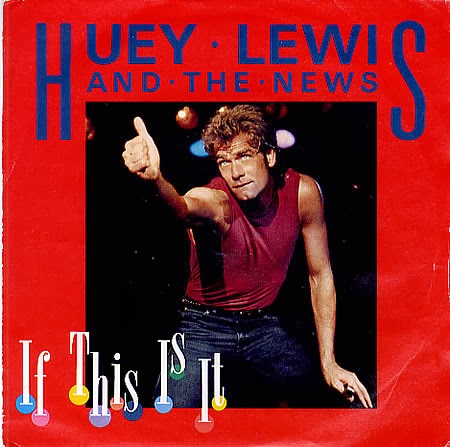
Here, ladies and germs, is Huey at his most effortless and effervescent. No ill-advised anthemic statements on the state of rock and roll, no jaded political commentary arriving about ten years too late to have any legitimate impact ... just pure, refined, concentrated Huey. The video was apparently filmed at the Santa Cruz Beach Boardwalk, and my guess is either in April or October, because otherwise it would have been foggier than a librarian's glasses in a hot tub. Signy Coleman was supposed to make a return appearance, but I guess there was a scheduling conflict and they ended up using her friend Janet (the naughty brunette) and another woman named Sandra (the mysterious blond) instead. Mostly, I'm just impressed they had enough room in the budget for a boa constrictor, an airplane flying a "Please Let Me Know" banner, and a shark that can swim through sand. Musically, the song's most transcendent moment would have to be the ascending, harmonizing guitar chords that climb and climb against the backing vocals at about the 3:37 mark. Oh yeah. That's the hard stuff, Huey.

Sunday, January 5, 2014

"Pressure": Welcome To Billy Joel's Nightmare

If you thought the life of a yuppie was all fun and games, well, clearly you never caught "Pressure." Billy Joel's a man who's known something about pressure - songwriting pressure:
The pressure I was writing about in this song wasn't necessarily music business pressure, it was writing pressure. ... At the time, I was saying, "Well, I gotta write some more stuff for the album"; I was about halfway through, and I said, "Well, what am I gonna do? I don't have any ideas, it's gone, it's dead, I have nothing, nothing, nothing. There's nothing." And then the woman who is my secretary came into the house at that point and said, "Wow, you look like you're under a lot of pressure. I bet you that'd be a good idea for a song." And I went, "Thank you!"
Someone give that secretary a raise! However, a modest peak at #20 may or may not have alleviated any mounting commercial pressure from Columbia Records. Sliding along with a keyboard-driven, white funk vibe, at first the pressure in "Pressure" doesn't seem so bad. But then, in comes a baroque synthesizer riff that continues to poke and prod at your eardrums and it feels like a thousand insects are slowly eating away at your brain. The '80s are here - and they're going to drive you insaaaaaayne.
You have to learn to pace yourself
Pressure
You're just like everybody else
Pressure
You've only had to run so far
So good
But you will come to a place
Where the only thing you feel
Are loaded guns in your face
And you'll have to deal with
Pressure

You used to call me paranoid
Pressure
But even you cannot avoid
Pressure
You turned the tap dance into your crusade
Now here you are with your faith
And your Peter Pan advice
You have no scars on your face
And you cannot handle
Pressure

All grown up and no place to go
Psych 1, Psych 2
What do you know?
All your life is Channel 13
Sesame Street
What does it mean?
It means some serious pressure is what it means. "In the 9th, two men out and three men on"? How about a rain delay? I believe I read somewhere that, at one point the pressure got so intense in the recording studio that, right around the 3:56 mark, Billy immediately dropped all the instruments out of the mix and shouted "Pressure!" into the microphone as loud as he could.

But if the music hasn't persuaded you, the video certainly will. Let me just say that you can check out of this video any time you like, but you can never leave. Here's what being a Yuppie is really like: you find yourself trapped in a dark room where you're forced to watch rapid-fire films that berate you with images of MacArthur, Sinatra, Vietnam, atomic bombs, and stamps, while occasionally words like "Mother," "Hate," and "Money" flash across the screen; careless drivers speed right through a puddle and ruin your brand-new suit; your bedroom fills up with sloshing water; seemingly innocuous rugs suck you into their feathery clutches, while the jaded cognoscenti looks on; your childhood self becomes trapped in a bright white maze and/or stuck in The Shining, only to be sucked into a vegetable-devouring television; and you find yourself on a game show where you've managed to win without knowing how you did it or even how you got there in the first place (priceless contestant description: "William Joel, Age: 29, Occupation: Computer Software, Interests: fast bikes, cooking, water sports"). Sesame Street, Time magazine, and Channel 13 aren't going to save you here.

Tuesday, December 31, 2013

The Alan Parsons Project: Prog Goes Yuppie

The '80s might have been rough on a number of genres, but progressive rock really took it in the groin. I guess the double whammy of punk and MTV really didn't do middle-aged instrumental virtuosos playing side-long thematic suites about medieval goblins any favors. Sure, I suppose a lucky few, such as Styx and Yes, managed to shift with the spandex tide and remain successful, if not exactly relevant (sub-question: were Styx and Yes ever exactly relevant?). But some progressive rock acts not only managed to make it out of 1979 alive, but also managed to thrive. Say hello to the Alan Parsons Project.

Of course, nothing screams out "edgy rock and roll" like calling your band a "project." I mean, what, were they hoping to win first place in the local science fair? We'd already had the Jeff Beck Group, the Jimi Hendrix Experience, even the Bob Seger System, but in 1976, no one had ever seen the likes of the Alan Parsons Project.

However, it turns out that the Alan Parsons Project was an entirely appropriate name for the Alan Parsons Project. Just who was this "Alan Parsons," anyway? Well, once upon a time, there was an EMI Studios employee. This EMI employee broke into the industry by co-engineering a little album called Abbey Road. Then, a few years later, he achieved true fame among audiophiles by essentially co-producing another little album called Dark Side of the Moon. You know those pristine clock and airplane sounds? Alan Parsons. The random mumblings of Pink Floyd's roadie ("I dunno, I was really drunk at the time")? Alan Parsons. For most recording technicians, this would have been enough. Perhaps he could have remained satisfied as an in-demand studio engineer, but no, Alan Parsons wanted more.

Just what did Alan Parsons want? Well, he didn't sing, and he didn't really care much for performing. Apparently he just wanted to fart around in the studio and make little pet projects - sort of like Jeff Lynne, but without the orchestra. And yet, the thing was, he still wanted to capitalize on his name, so that people would know it wasn't just some random bozo's albums they were going to be buying. Even though he was teaming up with a songwriting partner-in-crime (the delightfully named Eric Woolfson), he still wasn't really putting together a proper "band." Hence: The Alan Parsons Project.


You know how Dungeons & Dragons and Sci-Fi geeks might sit around late at night in their friends' mom's basement and think up half-intriguing, half-silly ideas for concept albums that'll never get made? Well, the Alan Parsons Project actually went out and made those albums. "Hey, I got it, wouldn't it be cool if somebody did a concept album entirely out of ... Edgar Allan Poe short stories?" Behold: Tales Of Mystery And Imagination. "Dude, dude, someone should make an album based on Asimov's I, Robot!" Done and done. At a time when rock songwriting had finally earned the freedom to be uncompromisingly personal, Parsons and Woolfson's ultimate goal was to be about as impersonal as you could possibly get. They were openly writing songs out of other people's ideas!

Ah, but just when you thought they didn't have it in them, by their third album the Project started coming up with their own vague concepts that didn't happen to be based on any specific work (or works) of literature. For instance, Pyramid was based on ... Egyptian mythology? The $25,000 Pyramid? Your guess is as good as mine. Eve was even stranger: a concept album about misogyny. I think? See, when listening to Alan Parsons Project albums, it's probably best not to take their concepts too seriously. I'm not sure that Parsons and Woolfson did. Here's the album's closing track, sung by Lesley Duncan, who not only wrote "Love Song" (which Elton John covered on Tumbleweed Connection), but also sang backing vocals on that earlier Parsons project - you know, the one with the prism on the cover:


Oh, there's also the fact that the Project didn't have a lead singer. Instead, Parsons simply picked vocalists he liked and assigned different singers to different songs. There's nothing like random, generic stadium rock frontmen to breathe life into your cold, sterile studio productions. I think some of the singers brought something unique to the material, such as the Zombies' Colin Blunstone and the Hollies' Allan Clarke, but a lot of the time, such as on "Games People Play" from 1980's Turn of a Friendly Card (which, peaking at #16, became their biggest US hit single yet), I wonder if they just ended up turning the songs into Styx-lite.


The irony here is that, on Turn of a Friendly Card's second single, "Time," the Alan Parsons Project finally found its perfect lead singer: co-writer Eric Woolfson.

Eric Woolfson has the Calmest Voice Of All Time. His voice is like honey laced with Nyquil laced with Love Potion #9. As he quietly croons "Time/Keeps flowing like a river/To the sea," you'd have to poke me with a cattle prod to keep me from drifting off into a blissful dreamland. What the song has to do with gambling, however, I have absolutely no idea. Part of me wonders, with its closing lyric of "forevermore," if it might have simply been a leftover from Tales Of Mystery And Imagination.


Here's a question: why did the Alan Parsons Project spend four albums throwing their music into the hands of faceless British AOR also-rans, when the singer who perfectly complimented their style was sitting right there in front of them the whole time? Suddenly Woolfson steps in, sounding like the second coming of Pink Floyd's Rick Wright, and instead of experiencing any sort of complaint or backlash, the Project becomes bigger than ever before (with "Time" peaking at #15)! But a "project" couldn't have a real lead singer, could it? Could it?

Thursday, December 26, 2013

The Making Of Talk Show AKA This Is The Way The Go-Go's End: Not With A Bang But With An Album

How did the Go-Go's fall apart? Let me count the ways:

1) Drugs
2) Egos
3) Disappointing Sales
4) Drugs
5) Jealousy
6) Changing tastes
7) Did I mention drugs?

But before the Go-Go's bit the dust, they managed to make one more album. New producer Martin Rushent had quite the pedigree: The Buzzcocks, The Human League, The Stranglers, Altered Images, even engineering credits on T.Rex's Electric Warrior and Fleetwood Mac's Future Games (oh yeah!). But if he thought he could bring some much-needed discipline to the Go-Go's, well, he had another thing coming. From Lips Unsealed: "He was a lovely, low-key Englishman whose success had brought him a measure of wealth, stature, and a particular way of working. Then he ran into the Go-Go's; we were like a storm hitting his verdant Tudor studio in Berkshire." It turns out that, even while unraveling, the Go-Go's were still pretty hilarious:
Jane lectured me on the importance of my writing and getting songwriter credits on the album so I would make money, and Charlotte came over to my house numerous times to write with me, but I was too scattered to be creative ... It was no secret why. On some tapes we made of us trying to work, I could hear myself in the background snorting coke. On other tapes, I was on the phone arguing with Mike.
Come on Belinda, we need that follow-up to "Skidmarks On My Heart." I guess it was a tall order. I mean, how was she going to compose any lyrics if she couldn't even board an airplane?
I missed two flights in a row. I got to the airport okay, but I was too high to navigate the terminal and get on the plane. I caught a cab home after both false starts. On the third try, I had a big wad of coke with me and I went into the bathroom to do a line and figure out how to deal with everything. Realizing I couldn't deal, I decided to go home.

As I waited for a cab, I was positive that plainclothes detectives had me under surveillance. Several walked slowly past me, turned, and made eye contact, which I assumed meant they wanted me to know that they were aware of me. How? Well, either they had hidden cameras in the bathroom or they had noticed that I was completed gone. There was also the possibility that I was paranoid.
Yes, there is also that possibility as well. Nevertheless, this cat was starting to run out of nine lives - which brings me to another observation about the Talk Show era. For the most part, Belinda and the Go-Go's had been fortunate, sonically and visually, to avoid becoming too stained by the '80s, but around 1984, I think the '80s were finally starting to catch up with them. To put it another way, the Go-Go's were going through their Lesbian Phase. Like, all of them, at the exact same time. Short hair, short hair, and even shorter hair. While I still can't quite keep my eyes away, I must admit that Belinda's physical appearance during this period hit, shall we say, a bit of a rough patch. Some might suggest that she put back on a little of the weight that she'd lost from her punk days, but my issue isn't so much her weight as it is her hairstyle and fashion choices - if, given the woman's state of mind, you could even call them "choices." Belinda's appearance circa 1984 looks all the more bizarre considering her appearance circa 1986, only two measly years later. Let me just say this: if I told someone that Belinda Carlisle was my '80s Dream Woman and all they saw was a picture or a video of Belinda circa 1984, they might think I was insane. And I probably wouldn't blame them. However, out of this neon cocoon would burst a glistening butterfly.

Here's a clip from a behind the scenes show called Album Flash (apparently on Cinemax?) where the increasingly butch Belinda holds court on everything from old high school classmates to her childhood hobby of mutilating Barbie dolls. Highlights:

"I hated Barbie dolls. I liked the way they looked, but I remember, I used to get Barbie dolls, the first thing that would come off was the hair. I'd get scissors from my mom, and she's go, 'OK, don't cut their hair,' and I'd go, 'OK mom,' and I'd like, chop 'em up and they'd have little butch haircuts and stuff."

"When I go back to Thousand Oaks, a lot of the kids, you know, know that I went to Newbury Park High School and all that kind of stuff, and it's funny because people that used to torture me in high school now are my 'best friends.' It always works like that."

(Also classic is Kathy's response, in another clip, to a question about what it means to be a "female" musician in rock: "Being a woman in the music industry is the same as being a man in the music industry. It really doesn't mean a thing to me. I mean, I don't think about it. Ever. Why should I?")


At any rate, while Belinda's brain was being buried in a snow storm, Jane's was experiencing a new kind of personal clarity:
Then, in the middle of making the album, Jane decided she wanted to sing some of the songs, and she kind of flipped out when she was told no.

As I knew, the word "no" was a hard thing for any of us to hear. We were not told no that often, certainly not as much as we should have been. I understood Jane's problem. She was cute, full of personality, and she wrote some of our best songs; she had an ego just like anyone else, yet she stood off to the side, and it bugged the crap out of her - until finally she blew.

I suppose we could have talked it out, but that wasn't the way I handled problems. My way was to ignore them, to pretend they didn't exist. If I didn't confront Jane, she wouldn't confront me about any of my problems. And that's pretty much the way the Go-Go's functioned in general.

One day Jane just couldn't take it anymore. She smashed the mirror in her hotel room and flew back to the States. When she returned, she had decided to leave the band and pursue a solo career, though she kept that news from us for a few more months.
And if she kept that news from the other Go-Go's, she certainly kept that news from the public. Thus, as we look at all the various clips from 1984, we're treated to the spectacle of Jane Wiedlin dutifully pretending to still be excited about her role in the band while secretly loathing every remaining second of it. Here's a clip from a dressing room in Utica, NY, with Belinda in full Grace Jones mode and Jane holding enough grease in her hair to fry an omelette.


So if you're thinking that a Go-Go's without Jane wouldn't be any kind of Go-Go's at all, well, you would be right.

Monday, December 23, 2013

Zrbo's Favorite Song of the Year

As I said in the introduction, this year's music offerings didn't really impress me all that much. I wasn't that impressed with Covenant's latest album Modern Ruin, nor with VNV Nation's Transnational. A lot of the songs that were the big hits of the year like Blurred Lines and Get Lucky failed to really connect with me. However, there was one band that I discovered a few months back that I've really taken a liking to, and that band is.... (opens envelope)...

#1 - Chvrches - Gun

Supposedly Chvrches are some sort of up-and-coming indie/critical darling, but I actually happened to catch them for the first time when I was flipping channels on regular old TV. It was the video for The Mother We Share, another song that I also could have picked for my top spot, both it and Gun are equally good, it just comes down to preference.

Anyways, Chvrches are from Scotland and lead singer Lauren Mayberry apparently has a Masters Degree in Journalism, which I suppose makes her intellectual or something. Her fragile voice reminds me of shoegazing group Cranes (and wouldn't you know it but look who wrote a good deal of those AMG reviews for Cranes... Mr. Ned Raggett strikes again). AMG says Chvrches are "synth pop inspired by Kate Bush and Prince". And they seem to live up to that description as I've found a video of them performing a cover of Prince's "I Would Die 4 U" at Minneapolis' First Avenue appropriately. So that's it, watch the psychedelic video and enjoy.

Friday, December 20, 2013

Night And Day: Joe Jackson Goes Full Yuppie

And then Joe Jackson ... became Billy Joel.

Well, that's probably not how he'd put it, but pretty much, yeah.

And he started selling like Billy Joel too. Although Night And Day was Joe Jackson's most commercially successful record (peaking at #3 in the UK and #4 in the US), most rock critics don't necessarily think that it's his best record. Well, I do. But saying that it is his best album is not to say that it is a perfect album. Night and Day is almost two albums, in fact - and not necessarily a "night" album and a "day" album (come again?). On the one hand it's Joe's "latin jazz" album, and on the other hand it's his "Cole Porter/Irving Berlin/Rodgers & Hart/Great American Songbook" album. It's like he wanted to do two albums and he sort of combined them into one, or maybe he was eating chips and salsa while watching a Busby Berkeley marathon, I don't know. In some ways, this mixture doesn't exactly "work," but compared to the rest of the Top 40 music of 1982, I'd say it certainly beats the competition. Not everyone is quite as generous as I am, however; even though Stephen Thomas Erlewine gives the album four-and-a-half stars, his actual AMG review is surprisingly critical and harsh:
1982 will forever be known as the year that the punks got class -- or at least when Joe Jackson and Elvis Costello, rivals for the title of Britain's reigning Angry Young Man -- decided that they were not just rockers, but really songwriters in the Tin Pan Alley tradition ... In retrospect, the ambitions of these two 27-year-olds (both born in August 1954, just two weeks apart) seem a little grandiose, and if Imperial Bedroom didn't live up to its masterpiece marketing campaign (stalling at number 30 on the charts without generating a hit), it has garnered a stronger reputation than Night and Day, which was a much more popular album, climbing all the way to number four on the U.S. charts, thanks to the Top Ten single "Steppin' Out." Night and Day had greater success because it's sleek and bright, entirely more accessible than the dense, occasionally unwieldy darkness of Imperial Bedroom. Plus, Jackson plays up the comparisons to classic pop songwriting by lifting his album title from Cole Porter, dividing the record into a "night" and "day" side, and then topping it off with a neat line drawing of him at his piano in a New York apartment on the cover. All of these classy trappings are apparent on the surface, which is the problem with the record: it's all stylized, with the feel eclipsing the writing, which is kind of ironic considering that Jackson so clearly strives to be a sophisticated cosmopolitan songwriter here. He gets the cosmopolitan, big-city feel down pat; although the record never delivers on the "night" and "day" split, with the latter side feeling every bit as nocturnal as the former, his blend of percolating Latin rhythms, jazzy horns and pianos, stylish synths, and splashy pop melodies uncannily feel like a bustling, glitzy evening in the big city. On that front, Night and Day is a success, since it creates a mood and sustains it very well. Where it lets down is the substance of the songs. At a mere nine tracks, it's a brief album even by 1982 standards, and it seems even shorter because about half the numbers are more about sound than song. "A Slow Song" gets by on its form, not what it says, while "Target" and "Cancer" are swinging Latin-flavored jams that disappear into the air. "Chinatown" is a novelty pastiche that's slightly off-key, but nowhere near as irritating as "T.V. Age," where Jackson mimics David Byrne's hyper-manic vocal mannerisms. These all fit the concept of the LP and they're engaging on record, but they're slight, especially given Jackson's overarching ambition -- and their flimsiness is brought into sharp relief by the remaining four songs, which are among Jackson's very best ... If all of Night and Day played at this level, it would be the self-styled masterpiece Joe Jackson intended it to be. Instead, it is a very good record that delivers some nice, stylish pleasures; but its shortcomings reveal precisely how difficult it is to follow in the tradition of Porter and Gershwin.
Well, fine, Mr. Erlewine, let's see you try to make a New Wave/Latin jazz-pop/Tin Pan Alley album. In essence, while I agree with many of these observations, I'm not sure Erlewine really sees the forest for the trees. He sounds like someone who heard that the album was great, and then when he actually listened to it, he felt disappointed. I, on the other hand, heard that the album was pretty good but not a classic, and so when I actually listened to it, I felt like it slightly surpassed my expectations. OK, so Joe didn't quite fulfill his ambitions. Why punish a guy for trying to be ambitious ... in the '80s? All right, so he focused a little too much on the surface textures. Why is that a "problem"? Why does everything need to have "shortcomings"? Hardly any other mainstream '80s pop albums contained so many ideas. If it's a mess, at least it's an inviting mess. Imperial Bedroom can go to hell. That's my two cents. All right, Stephen, we're cool now.

At the time, I think most people were too shocked by the sudden appearance of Joe Gershwin to complain that he didn't quite measure up to his predecessors George and Ira. I mean, if there were those expecting Joe to slip back into his fiery power pop mode after the "stylistic detour" of Jumpin' Jive, the sprightly, percussive sizzle of "Another World" quickly put that notion to rest (although the hypnotic mood is almost derailed by his less-than-soothing vocal entry). "I was so low/People almost made me give up trying/Always said no/Then I turned around/Saw someone smiling/I stepped into another world." Uh ... are you sure you're talking about New York, Joe? Well, the Big Apple is Little Earl's favorite city in the whole wide world, so he certainly doesn't need to convince me. Jackson is putting on a top hat, coat and tails, he's about to hit the town like an '80s Fred Astaire, and I'm about to join him. He may not be able to dance like Fred Astaire, but with that thin, partially balding physique, he certainly has the visual resemblance nailed.


Suddenly, on Track 2, [Billy] Joe[l] Jackson attempts to locate a suitable Chinese restaurant, only to end up in the wrong part of town, while employing a racially insensitive accent and Oriental musical motif along the way. Most darkly comic line: "I took a right/Then I took a wrong turn/Someone asked me/For a quarter/It didn't seem to fit/He didn't look much like a Chinaman." You and Christopher Columbus, Joe.


As the night (or day?) wears on during Joe's subterranean journey through the Manhattan streets, he appears to pop in and out of several clubs. Yes, as Erlewine notes, cuts like "Target" and "Cancer" are more like improvised interludes than full-fledged songs, but not every song has to be a hit single, you know? Besides, on an album that reveals a much more socially outgoing Joe, "Cancer" allows him to show his more pessimistic, and somewhat libertarian, side. It's like he's trying to say, "Why don't you just ban fun while you're at it?" At least while he's busy complaining, he's pairing up his grouchiness with a delectable salsa groove. We're all going to die of cancer - but I can dance to it!
Everything
Everything gives you cancer
Everything
Everything gives you cancer
There's no cure, there's no answer
Everything gives you cancer

Don't touch that dial
Don't try to smile
Just take this pill
It's in your file

Don't work hard
Don't play hard
Don't plan for the graveyard
Remember

Don't work by night
Don't play by day
You'll feel all right
But you will pay

No caffeine
No protein
No booze or
Nicotine
Remember


"A Slow Song," the show-stopper closer that was Joe's admirable attempt to write a "song about songs," has a nice dramatic build-up and some memorable turns of phrase, but I think Joe forgot to write a chorus:
Music has charms they say
But in some people's hands
It becomes a savage beast
Can't they control it
Why don't they hold it back

You see my friend and me
Don't have an easy day
And at night we dance not fight
And we need the energy
If not the sympathy

But I'm brutalized by bass
And terrorized by treble
I'm open to change my mood but
I always get caught in the middle

And I get tired of DJ's
Why's it always what he plays
I'm gonna push right through
I'm gonna tell him too
Tell him to
Play us
Play us a slow song


Yes, DJ, play us a slow song - just not this one. Maybe some Boyz II Men, "End of the Road"? But I digress. If songs about Chinatown and lung cancer were all that Night And Day had going for it, then sure, it would be all style and no substance. But, as Erlewine mentioned, there are a few other songs on the album that are "among Jackson's very best." You'll notice I put an ellipse there, so that you wouldn't see which songs he was talking about. That's because, just as Joe surprised his '80s Yuppie public, I wanted to give an equal surprise to my '00s "post-pseudo-slacker-Generation iPod" readers. (Note to self: need a better name for my generation?)

Thursday, December 19, 2013

Zrbo's Favorite Songs of the Year: Numbers 3 and 2

#3 Lady Gaga - Aura/Burqa (demo version)


I must have a thing for Lady Gaga. Yes, I've heard the complaints. "She's ripping off Madonna" / "she's trying to hard to be provocative" / "it's just pop music." Gaga's pretty much guilty on all three counts, but it doesn't matter because even though the music may just be gussied up pop music, it's interesting gussied up pop music. Take the demo that leaked earlier this year for the song that would end up being simply called "Aura". I prefer this version to the more polished final cut we got on the album ARTPOP. I like how the song sounds like it's all over the place. It begins with twangy guitars out of some Robert Rodriguez mock B-movie, then moves into some modern dubstep thing with lots of stutters and breaks. By this time you may be thinking "what the heck am I listening to?" and just then the song bursts into a delectably sugary sweet chorus that would even make ol' Madonna smile. I love it.

------------------------------------------------------------------------------

#2 Benny Mardones - Into the Night


And here's my requisite retro pick of the year. I'd never heard this song until Little Earl posted an entry about it this past summer. At first I liked the song ironically, mainly for the dated music video. But after a while the song clawed its way into my head and now I unabashedly adore it. It begins almost lazily, but slowly builds in intensity so that by the end of the song you've got the full on "slowly dipping his toes into a vat of acid" screams as Little Earl so eloquently described. Here's to you and your pedophilic ways Mr. Mardones, earning you my number 2 spot for 2013.