Wednesday, November 14, 2012

The English Beat: Saved Their Best Song For Later

Occasionally a British band will try to release their debut album in the United States, only to find out that some obscure American band is already using the same name. This is how Squeeze became U.K. Squeeze, how Suede became the London Suede, and how the Beat became the English Beat.

There wasn't much that was particularly English about the English Beat, however. Their first album, I Just Can't Stop It!, like the Specials' debut, is considered one of the defining Ska Revival albums. Also like the Specials' debut, I listened to it years ago and it passed through me like water. Again, it sounded well-intentioned but boring - just another bunch of English kids who didn't bring enough of a twist to their fandom. Witness the first single from the album, a cover of Smokey Robinson and the Miracles' "Tears of a Clown" (like Madness, the English Beat released their debut single on 2 Tone Records, but signed elsewhere afterwards). I can hear an interesting ska cover of "Tears of a Clown" somewhere in my head, but I don't think this is it. The novelty-ish aspect of the cover is reinforced by the guy in the background at the end of the song singing "Tears of a clon." Tears of a clon? Really, mon?


However, the band did have a great logo.


Also, their lead singer, Dave Wakeling, arguably had more marbles in his mouth than Paul Weller or Joe Strummer. But get him pontificating on the meaning of English Beat songs, and he's pretty entertaining. Here's an excerpt from his interview for the AV Club's "Set List" series, where he explains the inspiration for another popular hit from the debut album, "Mirror In The Bathroom":
The lyrics were written when I was working on a construction site. I’d had a couple of drinks the night before, and forgot to hang up my clothes to dry for the next day. It gets very wet on those construction sites, and it was the winter, so it was a snowy wet. I got into the bathroom and realized my clothes were all on the floor in a wet, sandy pile. So I hung them up and thought, “Well, if I steam them, at least I’ll be puttin’ ’em on warm.” I had a shower, and then I was shaving in the mirror, with the hangover and the wet clothes, and the thought of trying to break up frozen sand to put into the concrete machine was not that tasty. And I started talking to myself in the mirror, and said, “Dave, we don’t have to do this, mate. We don’t have to do this.” And in the mirror behind me, the door of the bathroom had a tiny little latch on it, and I said to myself, “The door’s locked. There’s only me and you. Just me and you here. We don’t have to do this.” And of course we did, because we needed money for Guinness that night. [Laughs.]

So on the motorbike we got, and skidded our way back to the construction site. And while I was on the bike, I was pondering it. “The door is locked, just you and me.” Had a nice feel to it. “Mirror In The bathroom.” That’s a great idea, but you can’t have a pop song called “Mirror In The Bathroom,” can you? That’s stupid. You’re meant to have pop songs called, “I Love You, Lady,” or something.


Still, I probably wouldn't have given the English Beat a second look until I heard "Save It For Later," a single from their third album, when it was included on the Pitchfork 500. By this time the band had more of a '60s R&B than a ska sound - well, it's more like a "if '60s R&B, ska, and the Byrds had a three-way, while 'Strawberry Fields Forever' watched" sound, but whatever, they're British. As with their earlier material, I didn't think much of it at first, but for some reason it grew on me.
Two dozen other dirty lovers
Must be a sucker for it
Cry, cry, but I don't need my mother
Just hold my hand while I come
To a decision on it

Sooner or later
Your legs give way, you hit the ground
Save it for later
Don't run away and let me down
Sooner or later
You hit the deck, you get found out
Save it for later
Don't run away and let me down
You let me down
Although only a minor hit in both the UK and US at the time, this song has become, unbeknownst to me, something of an '80s classic. Theories abound as to the song's meaning: Ned Raggett writes that it "remains one of the few pop songs about holding off on sex instead of taking the plunge," while others claim it's about oral sex. In the AV Club interview, however, Wakeling says something entirely different:
It started off as a dirty schoolboy joke. The phrase “save it for later” is meant to be “save it,” comma, “fellator.” As in, “Leave it as it is, cocksucker.” [Laughs.] But we didn’t have the term “cocksucker” in England at the time. We didn’t really learn that one ’til we came to America. So it wasn’t really a putdown, because we didn’t really use that term to put down people at the time, and I don’t think they do very much in England now, either. Anyways, that was the nature of the joke.

It was a song really about not knowing what to do, because you knew people looked at you as though you were a man, but you knew you didn’t know how to operate in a man’s world. You still were responding to things the same way as you always had as a boy. And it’s a scary thing, really, being scared of all the implications of your life and not knowing what else to do other than to try and bravely march forward into the dark regardless. It’s been hard to describe. People ask, “What’s that song about?” Well, it’s about nothing. It’s about not knowing anything. [Laughs.] Or feeling like you know nothing, and grasping in the dark for your place in the world, and trying to do it with a wry humor. It’s like your legs give way, and every time you try to stand up and pretend to be a man, the boy in you would flip over in front of everybody and you’re embarrassed again, y’know? Particularly I suppose as you try and learn how to deal with girls turning into women. They could say one thing and you’d go bright red, look at the floor and start shuffling around like you just got told off by your teacher at school.
Somehow, without picking up on any of that, I knew that the song was about something enigmatic and mysterious. A song doesn't always need to be "about" something to be about something, you know what I mean?

Besides, sometimes a single can just capture a "moment." And "Save It For Later" catches that great moment in '80s British pop where bands who started out in such a stylistically narrow scene finally began branching out and performing whatever kind of music they liked. I mean, why cover a Motown song in a ska style, when you can write your own Motown-style song and record it in a Motown style?


Above all, "Save It For Later" (and its accompanying video) just radiates this whole aura of cool. It's like a room full of intelligent people with great taste in everything. As those elegant strings swirl over the fade-out, I imagine dancing the night away on the banks of the Seine, cocktail in hand, marveling at the majesty of life. Work with me, here.

But alas, just as they might have been hitting a new peak, the English Beat broke up. Wakeling and fellow vocalist Ranking Roger went on to form General Public, while guitarist Andy Cox and bassist David Steele found another singer, came up with a ridiculous new band name, and had a couple of hits in 1989 that you might have heard somewhere.

Saturday, November 10, 2012

Men Without Hats' "The Safety Dance"/Weird Al's "The Brady Bunch"

While listening to Weird Al's second album In 3-D, I heard a track called "The Brady Bunch" that stood out to me from the other cuts and had a melody I didn't recognize. The lyrics went like this:
You can watch Mister Rogers
You can watch Three's Company
And you can turn on Fame
Or the Newlywed Game
Or the Addams Family

Say, you can watch Barney Miller
And you can watch your MTV
And you can watch 'till your eyes fall out of your head
That'll be OK with me
And you can watch...TV
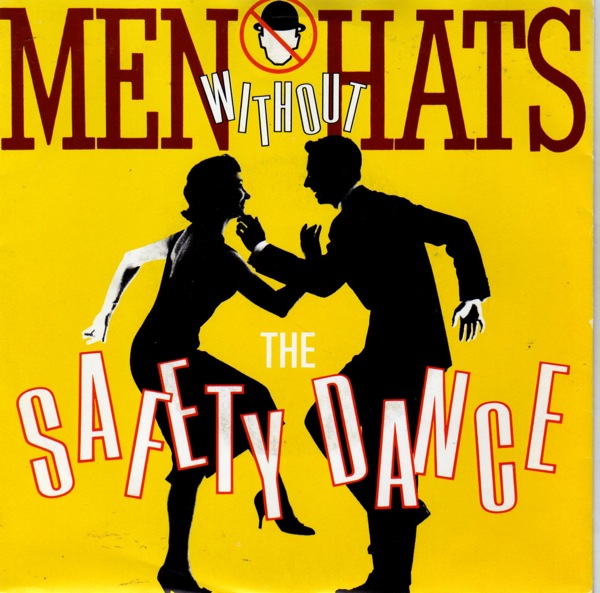
I remember thinking, "Damn, for a Weird Al original, this is really catchy!" Of course, it wasn't an original. It was a parody of Men Without Hats' "The Safety Dance."


This may be the rare instance of a Weird Al parody that is actually not as weird as the original song. Men Without Hat's lead singer and songwriter, Ivan Doroschuk, sounds like he's a robot that is running low on batteries. Particularly unnerving is the way his voice drops when he sings the word "Say," as if his computer programming has momentarily frozen. Even stranger than his delivery are the enigmatic lyrics:
We can dance if we want to
We can leave your friends behind
'Cause your friends don't dance and if they don't dance
Well they're no friends of mine
Say, we can go where we want to
A place where they will never find
And we can act like we come from out of this world
Leave the real one far behind
And we can dance
And sing!

We can go when we want to
The night is young and so am I
And we can dress real neat from our hats to our feet
And surprise 'em with the victory cry
Say, we can act if want to
If we don't nobody will
And you can act real rude and totally removed
And I can act like an imbecile
So obviously the song is about ... safety? Dancing? Dancing safely? Numerous theories floated around, from "a celebration of safe sex" to "a warning about nuclear proliferation." But the true inspiration was a little less dramatic:
The writer/performer, Ivan Doroschuk, has explained that "The Safety Dance" is a protest against bouncers stopping dancers pogoing to 1980s New Wave music in clubs when disco was dying and New Wave was up and coming. New Wave dancing, especially pogoing, was different from disco dancing, because it was done individually instead of with partners and involved holding the torso rigid and thrashing about. To uninformed bystanders this could look dangerous, especially if pogoers accidentally bounced into one another (the more deliberately violent evolution of pogoing is slam dancing). The bouncers did not like pogoing so they would tell pogoers to stop or be kicked out of the club. Thus, the song is a protest and a call for freedom of expression. Other lyrics in the song include references to the way pogoing looked to bouncers, especially "And you can act real rude and totally removed/And I can act like an imbecile".
Little did Doroschuk realize just how much of an imbecile the world wanted him to act like. The song peaked at #3 in the U.S. and #6 in the U.K. Men Without Hats were on their way!

Which brings me back to "The Brady Bunch." In the second half of his parody, Weird Al doesn't even come up with his own lyrics. He simply starts singing the Brady Bunch theme, word for word, to the melody of "The Safety Dance." In this fashion, Weird Al demonstrates that he can parody a song that is already funny, and although it might not end up being as funny as the original, it can still be its own sort of funny. Have you ever started making stuff up late at night with your friends? "The Brady Bunch" is sort of like that. Maybe it was a good idea, maybe it wasn't, but damn, you were having too much of a good time to care.

Monday, November 5, 2012

The Sadness Of Madness?

"Baggy Trousers," the first single from Madness' second album, Absolutely, probably seemed like more of the same nuttiness as before, with its aggressive vibraphone playing and its gleeful, if unsentimental, recollection of boyhood antics:
Lots of girls and lots of boys
Lots of smells and lots of noise
Playing football in the park
Kicking pushbikes after dark
Baggy trousers, dirty shirt
Pulling hair and eating dirt
Teacher comes to break it up
Back of the 'ead with a plastic cup

Oh what fun we had
But did it really turn out bad
All I learnt at school
Was how to bend not break the rules
Oh what fun we had
But at the time it seemed so bad
Trying different ways
To make a difference to the days


"Embarrassment," however, was a different bag of chips:
Primarily written by Lee Thompson, the plot of the song reflected the unfolding turmoil following the news that his teenage sister, Tracy Thompson, had become pregnant and was carrying a black man's child. The subsequent rejection by her family, and the shame felt, was reflected in the song. As Thompson was on the road with the band, he only heard snippets of the story, through phone calls and letters, but this was enough for him to piece the story together.

Received a letter just the other day,
Don't seem they wanna know you no more,
They've laid it down given you their score,
Within the first two lines it bluntly read.

You're not to come see us no more,
Keep away from our door,
Don't come 'round here no more
What on earth did you do that for?

Our aunt, she don't wanna know, she says,
What will the neighbours think, they'll think,
We don't that's what they'll think, we don't,
But I will, 'cause I know they think I don't

Our uncle he don't wanna know, he says,
We are a disgrace to the human race, he says,
How can you show your face,
When you're a disgrace to the human race?
Wot's this all about? Madness attempting social commentary? Well, if you're worried that a song about teenage pregnancy and racism might not be any "fun," worry no more. In fact, the tension between the indignation in the lyrics and the peppiness of the music is, in my opinion, something that makes "Embarrassment" soar. Hell, there's even tension between the lyrics and the lyrics: while the parents in the song are harsh and unforgiving, the band itself is, one can assume, more sympathetic to the girl's plight. Had Madness mastered the concept of the unreliable narrator?

Not only were the band branching out lyrically, but musically as well: instead of the usual ska vibe, "Embarrassment" employs a Motown beat straight out of early Supremes songs such as "Baby Love" and "Where Did Our Love Go?" I find myself instinctively tapping my feet to a story about a family excommunicating their daughter. Not an easy thing to make someone do.

Indeed, there is nothing like the sound of an already strong band truly coming into its own. It's not that Madness were profoundly altering their style or their subject matter, but that they were adding new elements while still retaining all the old elements that made them "Madness." It's like they were simultaneously aging and staying young ... at the same time!


More overtly glum was the first single from their third album, "Grey Day":
After eating I go out,
People passing by me shout
I can't stand this agony
Why don't they talk to me?

In the park I have to rest
I lie down and I do my best,
The rain is falling on my face
I wish I could sink without a trace

In the morning I awake,
My arms my legs my body aches,
The sky outside is wet and grey,
So begins another weary day
Sounds like Madness suddenly needed to be put on suicide watch. (Side note: how come the British seem to do these types of songs so well?)


If "Embarrassment" was a tragic song with upbeat music, "Shut Up" was a comical song with sinister music. According to Wikipedia, the single "tells a story of a criminal who, despite obvious evidence, tries to convince people he is not guilty." While the lyrics of the song, and the melody of the verses, suggest a silly atmosphere, the chorus feels very dark and foreboding, with heavy guitar chords and forceful piano playing which seems to bounce between off-key ragtime goofiness and classical piano-style grandeur:
I tell you I didn't do it
'Cause I wasn't there
Don't blame me, it just isn't fair
You listened to their side
Now listen to mine
Can't think of a story
Sure you'll find me some time

Now pass the blame and don't blame me
Just close your eyes and count to three
(One two three)
Then I'll be gone and you'll forget
The broken window, T.V. set


At this point, Madness were churning out clever, snappy, complex British pop gems without even breaking a sweat. A sweat, I tell you! The band may have had bigger and more famous hits than songs like "Embarrassment" and "Shut Up," but these are probably my favorite Madness singles nonetheless.

Thursday, November 1, 2012

The Go-Go's Tour England With Madness And Get Spat On

So what does the British Ska Revival have to do with the Go-Go's? Funny you ask. From Lips Unsealed:
In December 1979, we opened at the Whiskey for Madness, an English ska band whose recently released first album, One Step Beyond..., was earning them raves and a handful of hits, including "One Step Beyond...," "The Prince," "My Girl," and "Night Boat to Cairo." They hit the town with a unique sound and the fun attitude of English boys out for a good time.

At sound check, I clicked with the group's lead singer, Graham McPherson, who went by the name Suggs. By showtime, we were flirting and having a good time watching each other onstage. Afterward, everyone from both bands went back to their hotel, the Tropicana, and partied pretty hard. I woke up next morning in a chaise lounge next to the pool.
Sounds pretty mild by her standards.
After Madness left town, Suggs wrote me a few letters and sent me some English cigarettes. I knew he liked me, but I didn't let myself imagine anything developing since I knew from following the bands in the English magazines that he was involved with punk beauty Betty Bright. Still.
Get a grip on yourself, Belinda! He's taken.
A few months later, Madness returned to L.A. and I don't know why I let myself, but I hoped Suggs would try to start something. He didn't. I heard he might have had a dalliance with a cute waitress, but that was mere rumor and I didn't want to turn my quaint romantic fantasy into a disappointment...
Let it go already!
That decision was probably smart, too, because Madness liked us and before they left town they invited the Go-Go's to open for them on their UK tour that spring and summer. We jumped at the opportunity.
And so, our young kitschy heroines crossed the ocean and toured Britannia. Initially harboring glamorous visions of Trans-Atlantic stardom, reality soon set in:
Even beer was a luxury. When we toured with Madness, we waited for them to finish their preshow dinner and then dug through the trash for the scraps they threw out. I still managed to gain thirty pounds over the next two months thanks to the Nutella I smeared on white bread every morning.
Mmmmm. At least it sounds like a step up from the oatmeal and Sweet 'N' Low she was living on earlier. While overseas, the band also hung out with the Specials and sang backing vocals on the closing track of More Specials, a cover of Guy Lombardo's "Enjoy Yourself (It's Later Than You Think)." I can't detect Belinda too well, but Jane stands out like a sore thumb.


The Go-Go's finding camaraderie with the British Ska Revival bands? Sounds odd at first, but when you think about it, it actually makes a lot of sense. Like the 2-Tone groups, the Go-Go's came out of a thriving punk scene, but found themselves gravitating toward the pop side of things. Of course, it would be wonderful to say that British punk audiences embraced the group as immediately as Madness and the Specials did, but that wasn't exactly the case:
They were young, angry neo-Nazi extremists who hated everyone, including us - and that was before we played the first song. Once they saw we were five girls from Los Angeles, they yelled vile things and called us terrible names. They spit on us too. They called it "gobbing."
"Gobbing"? Great. Only in England would they come up with a special name for spitting on people (and why do I get the feeling that British punks would probably spit on you, even if they liked you?).
They ran up to the stage, coughed up a wad of spit, and hocked it at us ... I never saw the gobs coming, but I felt my stomach turn after they hit. There were stories about performers getting sick after being hit in the eye or accidentally swallowing someone else's spit. We came offstage covered in snot, and I cried afterwards, as did the other girls.
I believe this is what they call in the business "paying your dues." Now just imagine, if you will, these same young women only a couple of years later, their image splattered all over MTV, being passed off as America's squeaky-clean sweethearts. On this particular tour, they may have been squeaky, but they were most definitely not clean.

Tuesday, October 23, 2012

Madness, I Tell You, Madness!

With all due respect to the Specials, if you're looking for the best British Ska Revival band, you're looking for Madness.

Having not been too taken by the Specials, I waited a little while on Madness. But about five years ago, I downloaded Divine Madness, one of their singles collections, and I must tell you that I did not regret it.

Madness are like a big ball of zany. When I listen to a Madness song, I picture seven funny Cockney pub dwellers dressed in bow ties and bowler hats all standing on the doorstep of a house, and the leader suddenly shouts "Go!" and they burst through the door and start rearranging all the furniture and tilting the paintings on the wall and turning the sinks on and off like the Cat in the Hat, and then they put everything back in place and exit the front door with split-second precision, and the house is completely quiet again and you don't even have time to figure out what just happened.

Madness, a band of seven like the Specials, and featuring lead singer Graham McPherson (otherwise known as Suggs), dubbed their own style of music "the Nutty Sound." Although ska may be a large part of the Nutty Sound, there is no mistaking Madness for mere reggae revivalists. You see, the band also had a prominent fondness for what you might call "music hall" or "Vaudeville." Honking saxophone breaks, plinking piano solos, vibraphones, "horror soundtrack" vocal interjections ... Madness weren't a ska revival band, they were a Victorian-era carnival sideshow!

The band's first single, "The Prince," was released on 2 Tone Records, the label founded by the Specials' keyboardist Jerry Dammers. Apparently, bands could sign a contract with 2 Tone allowing them to leave the label after releasing just one single, which is what Madness ultimately did. But artistically, the connection between the two groups would remain.


"One Step Beyond..." Madness' second single and first UK Top 10 hit, was, more importantly, the opening track on their debut album, and it functioned as the perfect statement of purpose. "Hey you! Don't watch that, watch this! This is the heavy heavy monster sound!" And with that ... they're off. Before the fat kid in bed can even figure out what's going on, the song comes to a crashing halt. I can just see young, impressionable British children sitting in front of their TVs at home in 1980, seeing this for the first time, thinking, "Wait, who were those guys?"


"Those guys" were Madness, my friends, and they were here to stay. Pressured by their new record company, the group released another track from One Step Beyond..., "Night Boat To Cairo," as the headlining cut of an EP. Something tells me the band didn't actually travel to Egypt to film this clip:
After the decision to issue the Work Rest and Play EP, a promotional music video was needed. However, there was a lack of time before the release, and not enough to make an effective video. Therefore, Madness filmed a karaoke type video in front of a blatantly chroma keyed backdrop of an Egyptian pyramid, with the lyrics appearing on screen in "bouncing ball" style as Suggs sang them.  During the long instrumental sections of the song, the band often ran around the set, marching and performing their signature "Nutty Train".

Despite the video's poor effects and unprofessional feel, it became very popular with fans, possibly due to the carefree nature and fooling around of the band onscreen (likely attributable to the large amount of alcohol they consumed while filming).
I see. Let's hear it for the bouncing ball, because without it, I genuinely could not decipher these lyrics. In my head it was always "Something something something ... banks of the River Nile ... something something."


But just as the world thought it was picking up on Madness' whole modus operandi, their third single, "My Girl," revealed a quieter, more vulnerable, more observational side to the group:
My girl's mad at me
Been on the telephone for an hour
We hardly said a word
I tried and tried but I could not be heard

Why can't I explain?
Why do I feel this pain?
'Cause everything I say
She doesn't understand
She doesn't realize
She takes it all the wrong way


"Pain"? "Wrong"? Who kidnapped Madness and fed them downers? At the time, the downbeat nature of "My Girl" probably seemed like an exception to the nuttiness. In truth, it was a sign of things to come.

Friday, October 19, 2012

The Specials: How Special, Really?

Q: What's black, white, and British all over?

In the '90s, out of the corner of my eye, I noticed a few of my peers listening to ska revival bands. Every now and then I heard someone mention a band called the Specials. I assumed they were a band from the '90s. Later I learned they were a band from the late '70s and early '80s, and that they were part of the British New Wave. I liked a lot of other New Wave bands, so I figured I would like the Specials. Allmusic gave their debut album five stars. It was produced by Elvis Costello! Should be right up my alley.

I'll say one thing, The Specials certainly had a dynamic stage presence: four white instrumentalists, two black singers from Jamaica (Neville Staple and Lynval Golding), and a third singer, who was probably the whitest white guy in the world.


Terry Hall sounds like he just stepped out of a cabaret wearing a top hat and cane. He eternally seems like he's about five seconds from completely losing interest in you. He could be Damon Albarn's long-lost uncle. Terry Hall doesn't sound like he should be anywhere near reggae. But that's why it works, I suppose.

At any rate, when I finally did listen to the Specials' debut album, I thought it was ... boring. It didn't seem to set itself apart from a million other bands who've played ska and reggae. Here, for example, is their cover of the 1967 Dandy Livingstone song, "A Message To You, Rudy."


Kind of ... bland, right? I started to wonder if critics had praised The Specials only because of the novelty of a British band performing that type of music during that particular era. Another example: An EP featuring a live version of the album's "Too Much Too Young" as its headlining track went to #1 in the UK in 1980. I probably find the lyrics, a serio-comic tale about teen pregnancy, more interesting than the music, which is kind of repetitive and slightly gets on my nerves:
You've done too much
Much too young
Now you're married with a kid
When you could be having fun with me

Ain't you heard of the starving millions
Ain't you heard of contraception
Really want a program of sterilization
Take control of the population boom
It's in your living room
Keep a generation gap
Try wearing a cap


Sure, I got it: the Specials had a genuine appreciation for ska and were sincere in their attempt to popularize it. But that's not enough! I mean, the Clash didn't simply mimic the reggae artists they liked; they added their own punk guitar rage and indecipherable Joe Strummer vocals to the mix. They performed reggae with their own distinct voice.


The Specials' debut album just sounds like a ska tribute bar band down the street. There's a lot of slow, unfocused jamming. I expected it to be tighter, poppier, funkier, heavier. However, it turns out that the Specials did record some songs that more closely match my earlier expectations; they're just not on the debut album. Maybe Elvis Costello did a crappy job?

Witness the band's first single, "Gangsters," which is more of what I expected the Specials to sound like. "Why must you record my phone calls?/Are you planning a bootleg LP?" Hall deadpans into the mic. I dig this surf rock/lounge-pop feel.


I also like some of the singles from their second album, the imaginatively titled More Specials, such as "Rat Race," with its kitschy '60s keyboards and wry British educational references that would have never found their way onto a genuine reggae record:
You're working at your leisure to learn the things you'll need
The promises you make tomorrow will carry no guarantee
I've seen your qualifications, you've got a Ph.D.
I've got one art O level, it did nothing for me

Working for the rat race
You know you're wasting your time
Working for the rat race
You're no friend of mine


Now this is a bit more like it! Turns out the Specials were actually a singles band. That said, the band's finest single ... was yet to come.

Sunday, October 14, 2012

When The British Revived Ska

For obvious reasons, '70s British punk musicians were all passionate fans of ... reggae.

Look, I don't understand it either, but just take my word for it. Maybe it was reggae's frequently political lyrics, or its minimalist production values. Maybe British white kids saw reggae as a more authentic kind of black music than the relatively corporate disco of the era. Whatever the reason, they loved it. Not only did they love it, but they wanted to play it.

The first British reggae-tinged punk act I gave my serious attention to was the Clash. Hell, I liked the Clash's reggae more than actual reggae! When I started to read about the so-called British Ska Revival, I imagined that I would really like it, and that it would sound a lot like the Clash.

It didn't. In fact, after my initial exposure to the British Ska Revival, I was not terribly impressed. I dismissed it and ignored it for years. But upon revisiting the entirety of New Wave, I can admit that my initial diagnosis was premature. The things is, I didn't actually manage to hear the best British Ska Revival songs, most of which were singles, not album tracks. So I am changing my tune, mon.

Almost every British New Wave act, from Elvis Costello to Nick Lowe to Joe Jackson to XTC, tried a little bit of reggae, or ska, or rocksteady, or whatever they liked to call it (to be honest, I'm not sure I know the difference). The Police titled their second album Regatta De Blanc ("White Reggae"). But the official British Ska Revival was a specific "scene" that revolved around the 2-Tone record label, and three bands in particular. In this series, I am going to tell you about those three bands.

Tuesday, October 9, 2012

Early Go-Go's Mischief And Mayhem - Part II

After the Go-Go's third show in 1978, Belinda stepped off the stage "feeling like we had played our best show yet...":
But then I popped a cassette of that show into the tape player of a friend's car. Until then, I had never heard myself sing. I was horrified. I sounded terrible. I could carry a tune, but barely. I also screamed more than I sang.

I hit the Stop button, put my hands over my face, and thought, Oh my God, I need to take some vocal lessons.


More daunting than vocal lessons, however, was the unreliability of their drummer, Elissa Bello, who "frequently missed rehearsals and didn't seem to be taking the band seriously enough." Um, like the rest of the Go-Go's were?

Gina was a talented, serious, and trained drummer from Baltimore who had come to L.A. with Edie and the Eggs, and art-house group fronted by Edith Massey, a favorite actress of cult movie director John Waters.

We broke the news to Elissa, who was understandably upset and ended up telling people that she'd been booted because she was dating a girl whose ex was our manager, and blah blah blah. It wasn't true. Elissa was fired because she wasn't reliable and it became obvious we needed a drummer with serious talent and attitude.
Well, it certainly sounds like Elissa had the attitude, just maybe not the talent (also: do I still detect some sour grapes, more than thirty years later?). Soon to be dumped bassist Margot Olaverra frequently displayed issues of her own:
At some point in the evening, whether we were playing or partying, she would end up on the stage in whatever club we were in, shouting, "Where is my purse? Somebody stole my purse!" Then she cried. Then she got mad at everyone, grabbed the microphone, and shouted, "Motherfuckers, give me back my purse!"

People got so used to it they rolled their eyes and said, "There she goes again." As far as I know, here purse was never stolen.
Maybe it was part of the act. Hell, in the punk scene, you could be disturbingly weird on-stage, intentionally, and receive praise for it!
In July, Devo played at the Starwood, and the Ohio art school grads were so good they subsequently ended up being the house band at the Whiskey.

I was a huge fan of Devo, but I was always intimidated around Mark Mothersbaugh and the other guys. It wasn't for any reason other than that they were smart college graduates who had a well-thought-out vision, and I feared not understanding whatever it was they were talking about.
That's OK Belinda, no one else really understood it either.


But she probably felt like a Mensa member compared to a certain Van Halen frontman:
In his memoir, David Lee Roth said he screwed one of the Go-Go's. Not true - unless there was some hanky-panky I didn't know about. He may have exaggerated a close encounter the two of us had one night outside the Whiskey following a Van Halen show. He was entertaining a gaggle of girls on the sidewalk, and I was walking to the Rainbow from my apartment. As I passed by, he grabbed me and we made out on the corner.

Till that moment, we had never met. I'm not even sure that should be counted a meeting.
Oh, I think it counts, Belinda.


But soon, two contemporary British bands would do more for the Go-Go's than merely intimidate them with their art school intellect, or their lips.

Friday, October 5, 2012

The Greg Kihn Band's "Jeopardy"/Weird Al's "I Lost On Jeopardy"

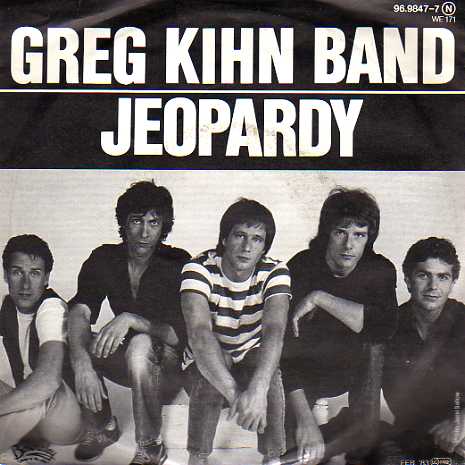
Greg Kihn was a Huey Lewis-esque bar band rocker with a penchant for punny album titles (Next of Kihn, Kihnspiracy, Rockihnroll, Kihnsolidation, Kihntagious, Citizen Kihn ... it goes on). In 1983, he released the #2 hit "Jeopardy," which featured some killer music, but some rather generic lyrics:
Where were you
When I needed you
Well you could not be found
What can I do
Oh I believed in you
You're running me around

Well you can take it as a warning
Or take it anyway you like
It's the lightning not the thunder
You never know where it's gonna strike

Our love's in jeopardy, baby ooh


It was a good jam, but something - hard to say what, exactly - was missing. Only one man knew what that special something was. I can practically see him sitting there in his basement, the light bulb appearing over his head. "Hmm ... 'Jeopardy'..."


Suddenly, in the hands of Weird Al, a mundane love song became the dark, twisted tale of an overly-confident game show contestant.

While the song's video is excellent, there is something to be said for simply listening to "I Lost On Jeopardy" on its own; with less visual distractions, the angst of the protagonist really seeps in. However, it's fascinating to see what Jeopardy used to look like before Alex Trebek took over, and before the "answers" were displayed by a block of actual television monitors on the wall. Someone on YouTube commented, "Why didn't he get the actual host, and use the actual set?" Umm ... Weird Al did get the actual host, and he did get the actual set. Did you know that Jeopardy goes back to 1964? In fact, in the early '80s, the show had briefly gone off the air, but the popularity of "I Lost On Jeopardy" helped bring it back in its new and improved incarnation. Also, keep your eye out for the real Greg Kihn in a "hey everybody, I'm a good sport" cameo.

In another sign of Weird Al's new-found industry clout, not only did "I Lost On Jeopardy" feature then-current host Art Fleming in the video, it also featured announcer Don Pardo, who delivers this scathing monologue over the guitar solo:
That's right Al
You lost
And now let me tell you what you didn't win
A twenty volume set of the Encyclopedia International
A case of Turtle Wax
And a year's supply of Rice-A-Roni, the San Francisco treat
But that's not all
You also made yourself look like a jerk in front of millions of people
And you brought shame and disgrace on your family name for generations to come
You don't get to come back tomorrow
You don't even get a lousy copy of our home game
You're a comple-hete loo-hoo-ser
Admit it: this is probably what most of us feel like saying to failed game show contestants (announcers included), but we're just too polite to go there. There's this pathetic notion on game shows and thousands of other contests held daily in small towns all across America, in summer camps, in high schools, in retirement homes, that you should be given points for "trying," and that even if you come in last, you should still win "something." You know what? Maybe you just failed, OK? Maybe you don't deserve our charity. As if a case of Turtle Wax is going to make you feel any better.

But as brilliant as Don Pardo's brutal contestant takedown is, the greatest moment of the song, in my opinion, occurs immediately afterward. Here is Weird Al, he's just been completely raked over the coals by the show's announcer, he should be a shambling wreck of a man, but he simply jumps right back in with an enthusiastic "Don't know what!" His failure has essentially bounced right off him. I find this oddly inspiring. Instead of sounding utterly despondent, he only sounds mildly miffed. "Guess it just wasn't my night," he surmises. That one little moment, I think, says miles about the boundless optimism of the American spirit. The man should be crushed and ruined, but nope, he's still dreaming of doing better "next weekend on The Price Is Right." In America, hope springs eternal.